How Many Creatives Do I Need: A Clear Answer
Depending on your budget, you need between 2 and 20+ new creatives per week. The exact number depends on your ad budget, your audience size, and how fast your ads fatigue. There's no fixed number. But there is a logic behind it, and you can work it out yourself.
What Does Creative Volume Actually Mean?
Creative volume describes how many different ad assets (images, videos, hooks, variants) you test against your audience within a given time period. It's not about the total number of creatives you've ever made, it's about ongoing supply. An account with high creative volume brings fresh variants into rotation every week; one with low volume runs the same two ads for months.
That sounds obvious, but it's the core of the problem: most accounts don't die because the product is bad. They die because the ads get tired and nobody replaces them. I've noticed this myself a few times, too late: revenue drops, budget gets cranked up, but the actual problem was never the price. It was a single ad that had been the same for weeks.
Why the Number Fluctuates in the First Place
Creative fatigue is the main reason. The more impressions an ad collects, the harder its click-through rate drops, your audience has simply seen the creative too many times already. With small budgets this takes longer, because fewer people see the ad in the first place. With big budgets, an ad can burn out within a few days because the algorithm serves it so aggressively.
If you have a lot of budget, you need more supply. If you have a small budget, you can get by with less, but you still shouldn't stick with a single ad.
How Many Ads to Test: The Table by Budget
Here's a rough guide. These numbers are estimated benchmarks based on typical testing cycles on Meta and TikTok.
| Daily Budget | New Creatives per Week | Typical Test Duration per Variant |
|---|---|---|
| up to €20 | 2–3 | 5–7 days |
| €20–100 | 3–5 | 3–5 days |
| €100–500 | 5–10 | 2–4 days |
| €500+ | 10–20+ | 1–3 days |
These numbers apply to the testing phase, i.e. before you have a clear winner. Once an ad is running stably, you can scale back volume in the short term and focus on scaling.
But scaling back doesn't mean stopping. Even winning creatives fatigue eventually.
If you don't yet know how much budget actually makes sense before thinking about creative count, it's worth checking out our article on setting your ad budget.
The 3 Layers That Together Make Up a Creative
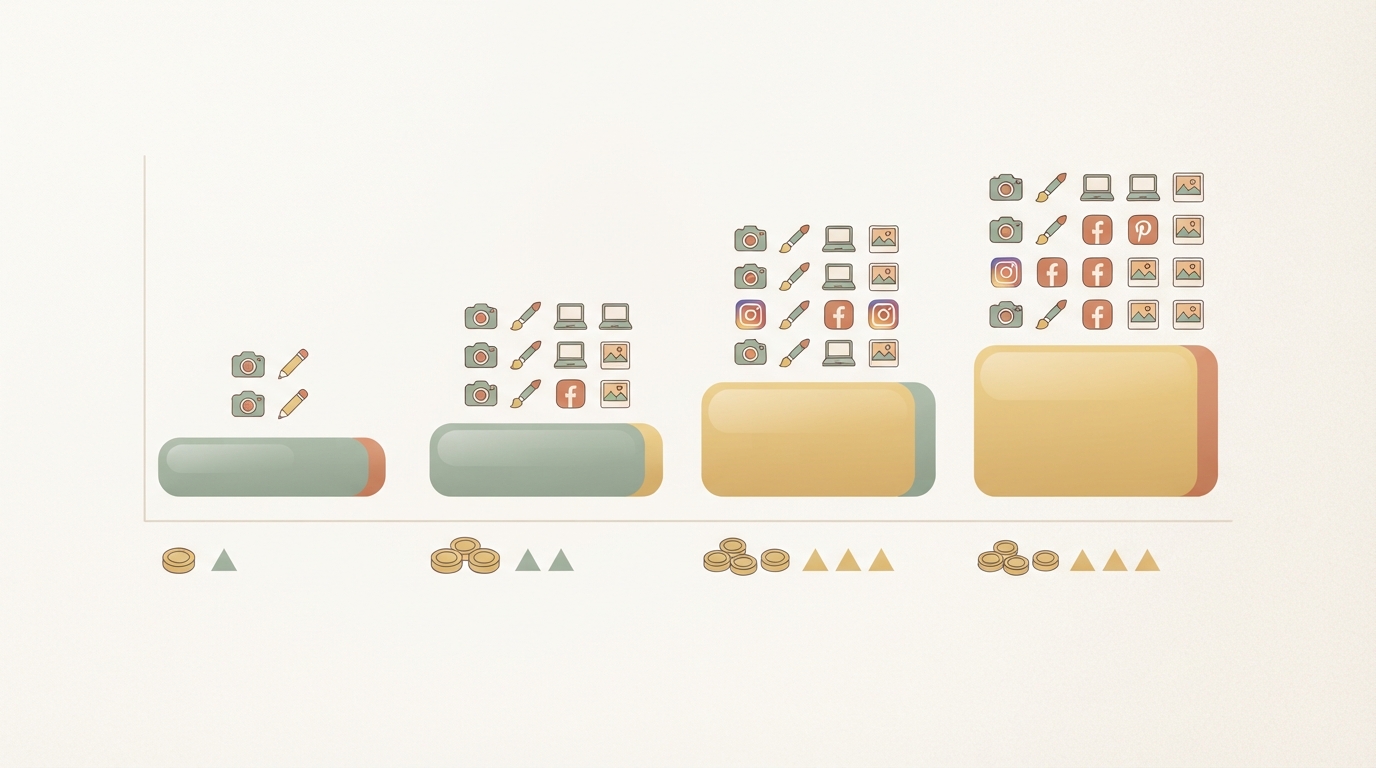
A creative isn't just the finished image or video, it's the combination of hook, format, and offer that gets tested together. If you only change the final image while the hook and offer stay the same, you're not actually testing a new variant, you're testing a cosmetic change.
Three layers you should really vary:
- The hook: the first 1–3 seconds or the first line that decides whether someone keeps watching
- The format: UGC video, statement graphic, testimonial, before-and-after, text-only
- The offer or angle: which problem, which benefit, which emotion takes center stage
If you keep the hook the same and only change the format, that counts as half a variant. A real test changes at least two of the three layers. That's exactly why five new creatives are often not enough, when in reality it's the same image five times with a different background.
We took a closer look at how to write a hook that actually stops the scroll in the first few seconds in a dedicated article: Writing a Video Hook: The 6 Patterns That Actually Stop the Scroll.
Step 1: Find Your Current Fatigue Rate
Before you even plan new creatives, look at how fast your existing ads are currently declining. Open your ad account and sort the last 30 days by frequency (how many times, on average, a person has seen the ad) and CTR over time.
If CTR already drops noticeably at a frequency of 1.5 to 2, your audience is fatiguing quickly, usually because the audience is narrow or the budget is high relative to reach. If it only drops at a frequency of 3 to 4, you have more room and need fresh variants less often.
This number is your personal compass, not the table above.
The table gives you a starting point. Your own fatigue rate tells you whether to move up or down from there.
Step 2: Plan a Fixed Weekly Rhythm Instead of Ad-Hoc Production
Most accounts don't fail because of creativity, they fail because of rhythm. Set a fixed day for new variants to go live, for example every Monday, and produce in advance accordingly.
A typical weekly rhythm for an account with a €100–500 daily budget might look like this: 3–5 new variants go live on Mondays and Thursdays, with evaluation in between. That adds up to the 5–10 new additions per week from the table, but spread out so you're not creating everything at once every Monday. If you instead wait until an ad visibly tanks, you're always producing reactively and lagging behind fatigue.
Step 3: Build a Base Framework You Vary, Instead of Starting From Scratch
Create 2–3 base formats (for example, a UGC testimonial, a statement graphic, a before-and-after) and vary the hook, offer, and color scheme within them. This drastically cuts production time because you're not inventing a completely new concept every week.
This is fundamentally the same idea as content recycling: a single long video or a good podcast episode can be broken down into dozens of individual posts instead of filming something new for each one. With ads, the principle works similarly, except here you're splitting one base format into multiple hook variants.
If you're already producing content regularly anyway, you can save yourself some of the work for ads too. The article Creating a Content Plan: The Mistake Almost Everyone Makes shows what a coherent plan like that looks like.
Step 4: Use Competitive Data to Pre-Select Hooks Instead of Guessing Blindly
Before you produce 10 new variants, it's worth checking which hooks and angles are actually working in your niche right now. This saves you production time on variants that would never have worked anyway.
This is exactly where we come in: instead of guessing from the gut, I continuously analyze data from thousands of real projects and show you which hooks, formats, and angles are most likely to work in your specific market. This doesn't replace your own creativity, but it stops you from spending weeks on variants that never had a chance.
How Much Creative Volume Do Different Business Models Need?
Not every business model has the same need for creative volume, because purchase decisions happen at different speeds. A cheap impulse product needs more variants than a high-priced B2B offer with a long sales cycle.
| Model | Typical Need | Why |
|---|---|---|
| E-commerce, low price | high (5–15/week) | impulse buy, fast fatigue from volume |
| SaaS, mid price | medium (3–8/week) | longer decision path, multiple touchpoints |
| B2B / high-ticket | low (2–5/week) | few but targeted leads, quality over quantity |
| Affiliate / performance | high (5–15/week) | multiple offers tested in parallel |
If you're in the affiliate space, for example, the question shifts again: there, it's often less about a single perfect creative and more about testing several offers at once. More on that in the article Building an Affiliate Program: The Mistake Almost Everyone Makes.
What If You Don't Have a Big Team?
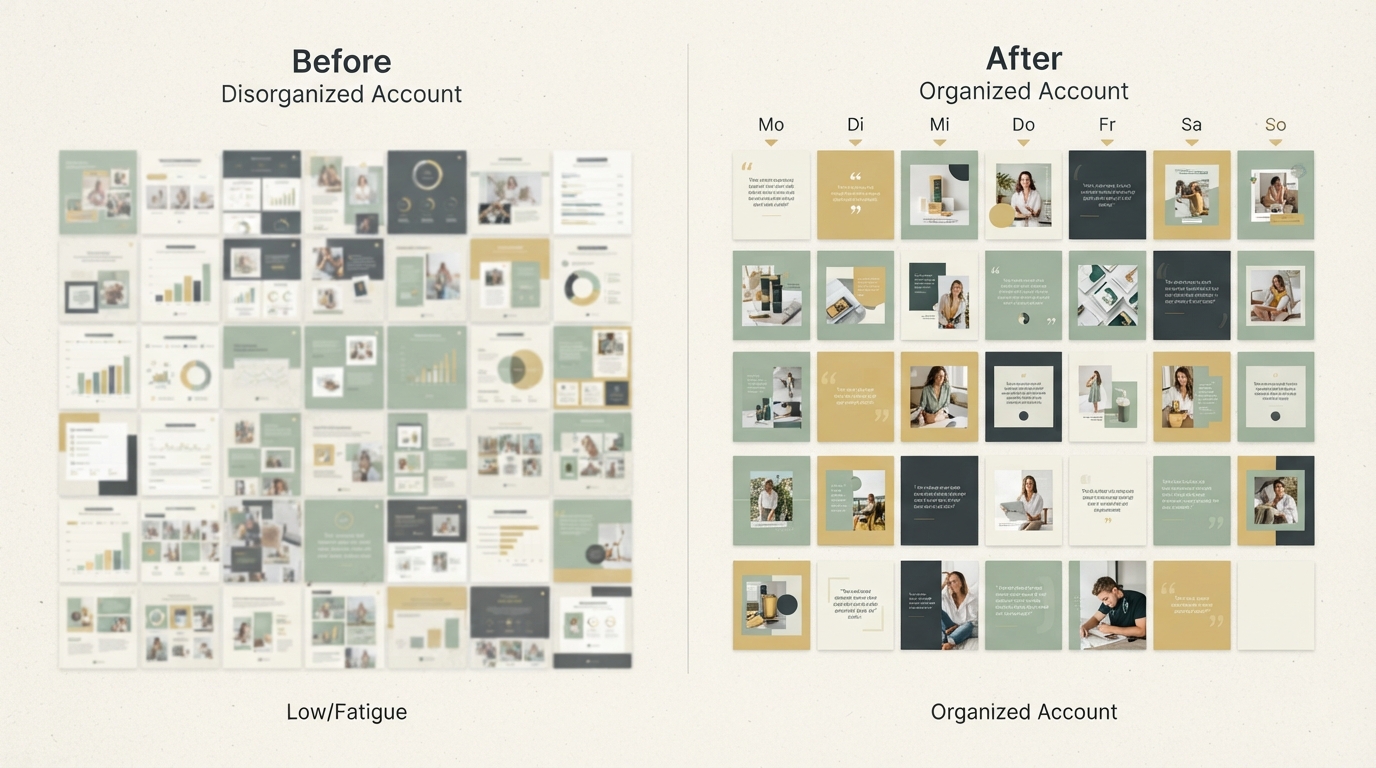
Then you scale smaller, not bigger. A one-person business can't realistically produce 15 new variants every week, and it doesn't need to.
In that case, focus on 2–3 genuinely distinct base formats and consistently vary the hook within them. This is essentially the same idea as in Paul Graham's essay "Do Things That Don't Scale": at the start, it's not about volume, it's about actually starting to test and learn what resonates with your audience.
Better 3 well-thought-out variants per week than 10 sloppy ones.
For production itself, it helps to build a small toolkit system in advance: fixed templates for copy, colors, and editing that you just fill with new content. That way the effort per variant stays small, even if you're working alone. I know how tedious this seems at first, but this one step ends up saving you the most time later on.
Number of Creatives and Retargeting: An Often Overlooked Point
Retargeting campaigns tend to need fewer, but more targeted creatives than cold-audience campaigns. The audience already knows you, so different angles work here: addressing specific objections, showing social proof, offering a limited-time deal.
For retargeting, 2–4 variants per week are often enough, focused more on handling objections than grabbing attention. You'll find more on how to set up retargeting technically and strategically in the article Setting Up Retargeting: The Mistake Almost Everyone Makes.
Tools That Help With Production
If you produce creatives yourself, at some point you'll need tools that take image production off your hands without hiring a designer every time. Platforms like {{saas:diode.computer}} show just how much specialized work AI-powered tools can now take on.
The same principle applies to ad creatives: AI generates the rough draft, you polish the fine details. That's exactly the idea behind our AI Studio, ad images and creative variants are generated based on your brand, so you're not starting from zero with every new variant.
What If I'm Testing on Multiple Platforms at Once?
Then you don't automatically need more creatives overall, but you do need platform-specific adjustments. A TikTok creative dropped 1:1 onto Facebook often feels out of place there, because user behavior and format expectations differ.
On TikTok, users expect a rawer, less polished UGC aesthetic. On Facebook, slightly more polished, statement-style creatives often perform better. So if you produce 5 base variants a week, plan to adapt 1–2 of them for the respective platform instead of running one version everywhere.
The article on running TikTok ads shows exactly how this differs on TikTok, and Facebook Ads for Beginners: The Mistake Almost Everyone Makes covers Facebook.
What You Should Really Watch When Planning Creatives
- Keep an eye on frequency: once it climbs above 2–3, it's time for fresh supply
- Change at least two layers: hook, format, or offer, never just the color
- Fixed rhythm instead of ad hoc: one or two set production days per week
- Plan to fit your model: impulse buys need more volume than high-ticket B2B
- Don't forget your winners: even top performers need replacing eventually
- Start small if needed: better 3 well-thought-out variants than 10 rushed ones
The Answer in One Sentence
There's no magic number, but there is a logic: the bigger the budget and the more impulsive the purchase, the more supply you need. You'll see the limit in your own frequency-CTR curve, not in someone else's rule of thumb.
With a daily budget up to €20, 8–12 new variants a month, spread across 2–3 per week, are often enough. What matters more than quantity is that you actually change the hook or offer, not just the visuals.
Usually by a dropping CTR as frequency rises, often noticeable starting around a frequency of 2 to 3. A rising cost-per-click with unchanged targeting is another signal.
Not completely from scratch, but adapted. You can usually use one base format across platforms, as long as you adjust the edit, length, and tone for each platform.
As a rough guide: 3 to 5 variants per angle before you draw a clear conclusion about performance. With a smaller budget, this can take longer because fewer impressions accumulate per day.
Frequently asked
How many new creatives do I need per week?
It depends on your daily budget: with up to €20, 2–3 new variants a week are often enough; with €100–500, it's usually 5–10. Above €500 in daily budget, the need can rise to 10–20 or more. These figures apply to the testing phase, not to winning ads that are already running.
How do I know I need more creatives?
Look at frequency and CTR over the last 30 days in your ad account. If CTR already drops noticeably at a frequency of 1.5 to 2, your audience is fatiguing quickly and you need fresh supply more often. If it only drops at a frequency of 3 to 4, you have more room.
Does a new image already count as a new creative?
Not necessarily. A real creative consists of three layers: hook, format, and offer, if you only change the image but the hook and offer stay the same, that's just a cosmetic variant. A genuine test changes at least two of these three layers at once.
Do all business models need the same number of creatives?
No, the need depends heavily on the business model. Cheap e-commerce or affiliate offers with fast impulse buys usually need 5–15 variants a week, while B2B or high-ticket offers with a long sales cycle often get by with 2–5 variants.
Written by
Bohdan BernatekFounder, Starte.ai
Founder of Starte.ai. Built a business to 125,000+ organic leads and seven-figure revenue — and now works with founders personally, deriving a strategy for their own brand from data across thousands of real projects and producing the creatives for it.