"""
Analyzing Competitor Ads
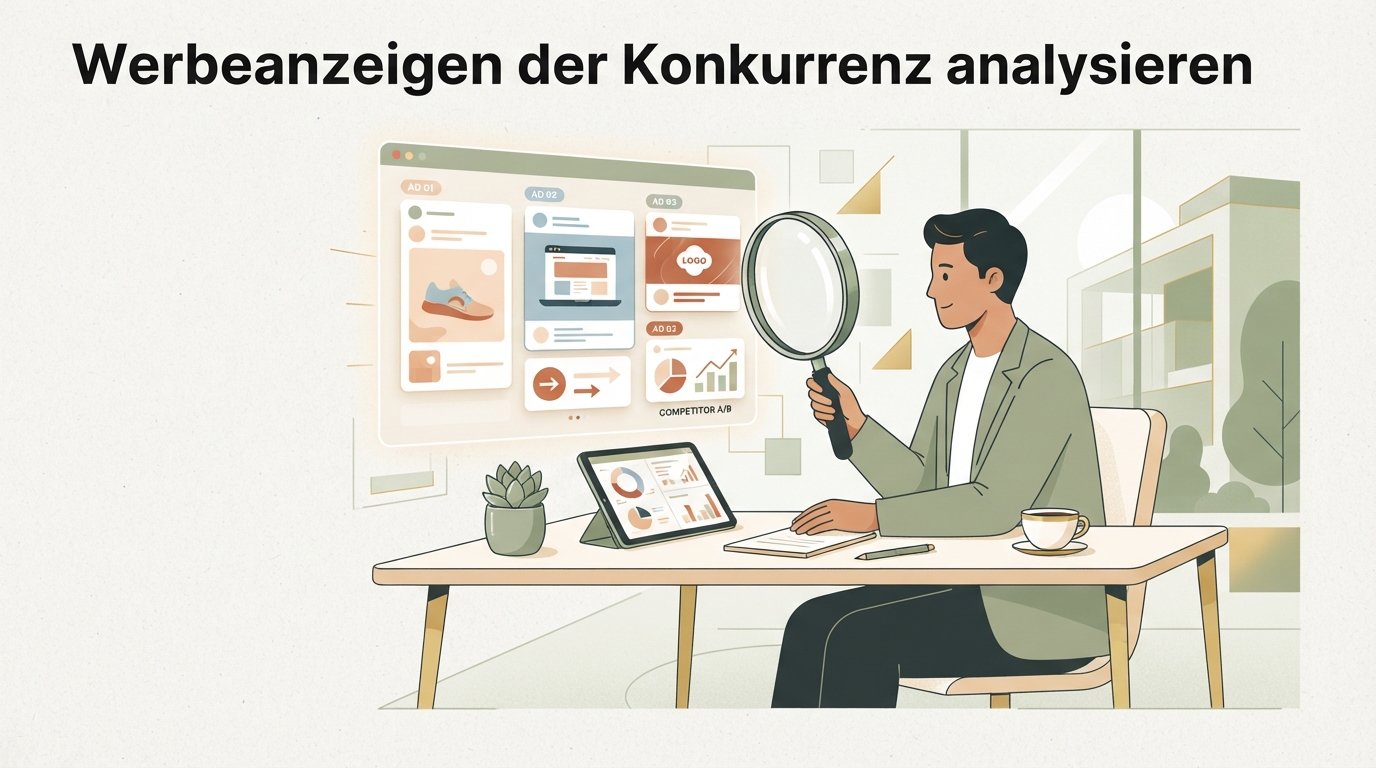
Analyzing competitor ads doesn't mean collecting pretty ads and rebuilding them. It means figuring out why one ad has been running for weeks while another vanished after three days. That distinction is exactly what determines whether you end up with an offer of your own — or just a worse copy.
I see the same mistake constantly: people open an ad library, find an ad they like, and copy the image and copy almost word for word. They copy the surface, not the reason the ad works. And without that reason, the copy usually falls flat.
Why analyzing competitor ads is even worth doing
An ad that's been running for a long time has proven itself with real money. Advertisers pull ads the moment they lose money — that's simple math. If an ad has been running unchanged for four, six, or ten weeks, it's paying off for the advertiser. That's not a coincidence, and it's not a matter of taste.
That's why an ad's runtime is the single most important indicator you have — more important than the visuals or the copy. So using an ad library really means: searching for ads that have been running a long time, not the ads you personally like. That's a shift in perspective most people skip right at the start.
Seeing competitor ads is now accessible to almost anyone. Meta runs a public database called the Ad Library, where you can see every active — and some inactive — ad, including its runtime. TikTok has a similar tool, the Creative Center. Google, through its Ads Transparency Center, at least shows which ads a competitor is currently running.
So you don't need insider access. Just the right way of reading it.
Step 1: Find the right competitors, not just the best-known ones
The first mistake happens before you even look at a single ad: searching for the wrong competitors. Most people type in the name of the market leaders because those come to mind first. The problem: market leaders often have huge budgets and are testing dozens of variants at once, which dilutes the signal.
It's more useful to look at three groups. First, direct competitors — other providers with almost the same product. Second, providers solving the same problem a different way, say with a tool instead of a service. Third, smaller, newer players who've only recently started running ads. That third group is especially valuable, since it's closer to your own starting point than an established player with a million-dollar budget.
Start by writing a list of eight to twelve names. Not three, not twenty.
With three, you won't see enough patterns. With twenty, you'll drown in data before you've even started.
Step 2: Search the ad library systematically
Using an ad library only pays off if you go about it in a structured way instead of scrolling aimlessly. Open the Meta Ad Library, enter the company name or domain, and filter by country and, if possible, by platform.
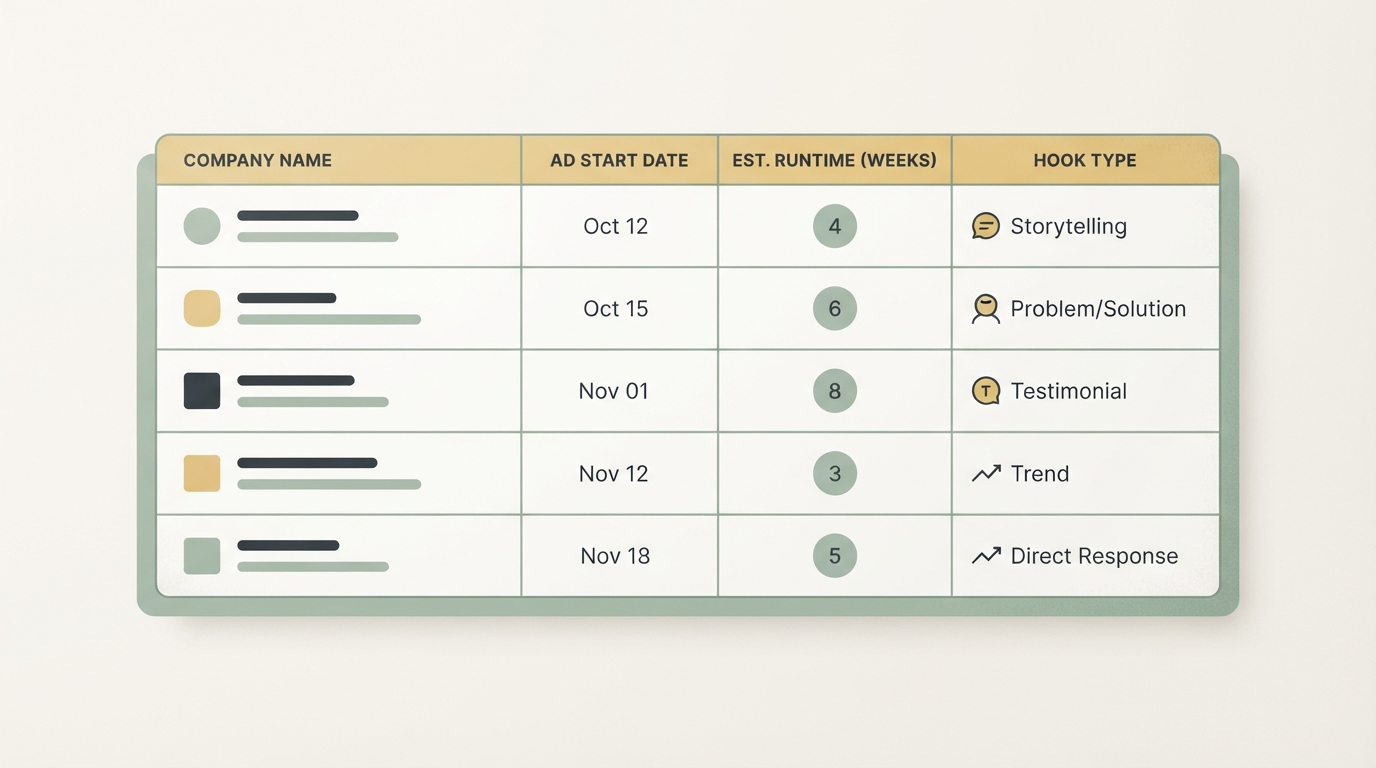
Pay attention to three things. First, the ad's start date, which tells you whether it's new or established. Second, the number of variants a brand is running in parallel, which tells you how much budget is behind it. Third, if available, the target audience by country or general region.
Build yourself a simple table: company, ad link, start date, estimated runtime, a short note on the hook. That sounds simple, but this table is exactly what everything else you build later is based on.
| Signal | What it means | How to use it |
|---|---|---|
| Ad has been running 4+ weeks | Likely paying off for the advertiser | Analyze the hook and angle more closely |
| Ad has been running under 1 week | Probably still being tested, often dropped | Note it, but don't use it as a template |
| Multiple variants with the same hook | The hook itself works, not just one image | Reuse the hook structure, design your own visuals |
| Many variants, different hooks | Advertiser is still testing, unclear signal | Wait, or use only as an idea source |
Step 2b: Finding and breaking down hooks
A hook is the first sentence or first image of an ad that forces a scroll-stop. Without a working hook, nobody sees the rest of the ad, no matter how good the offer behind it is.
Finding hooks means, concretely: look at the first two seconds of a video ad or the first line of a text ad, and ask yourself what feeling it's triggering. Most hooks fall into one of a handful of basic patterns. A named pain point, addressed directly ("Still paying for X? You don't have to"). A surprising number or statistic. A before-and-after promise. A question the audience has already been asking themselves.
If you look at the three longest-running ads from each of five competitors, you'll usually find that two or three hook patterns keep repeating. That's not a coincidence — that's the market telling you what resonates with your audience. Patrick McKenzie has described this well in his writing on marketing and pricing: the market tells you pretty directly what it responds to, if you actually look closely instead of guessing.
Note the angle behind each hook too — the perspective the product is being sold from. The same software can be sold as a time-saver, a cost-cutter, or a status symbol, depending on who the ad is targeting. The angle is often more important than the exact wording.
Step 3: Reading the target audience and offer from the ad
You can almost always infer who an advertiser is trying to reach from a running ad, even without access to their targeting data. Language, visuals, and any price or discount mentioned reveal a lot.
Look at the language being used. Industry jargon points to a professional audience, everyday language points more toward consumers. Pay attention to the imagery: does it show one person at a desk, or a whole team in an office? That tells you whether the focus is B2C or B2B. And check whether a price, discount, or trial period is mentioned — that shows you how price-sensitive the audience likely is.
One example: Vector (vector.co) is a B2B tool that identifies anonymous website visitors and makes them usable for targeted ads. For a provider like this, business language, case-study references, and lead-increase numbers would be typical signals in the ads, since the target audience is marketing decision-makers, not private individuals.
Step 4: Build your own creatives from it, don't copy
The decisive step is moving from analysis to your own material — and this is exactly where most people fail. You now have a list of hooks, angles, and patterns. The temptation is strong to take the most successful hook almost word for word.
Don't.
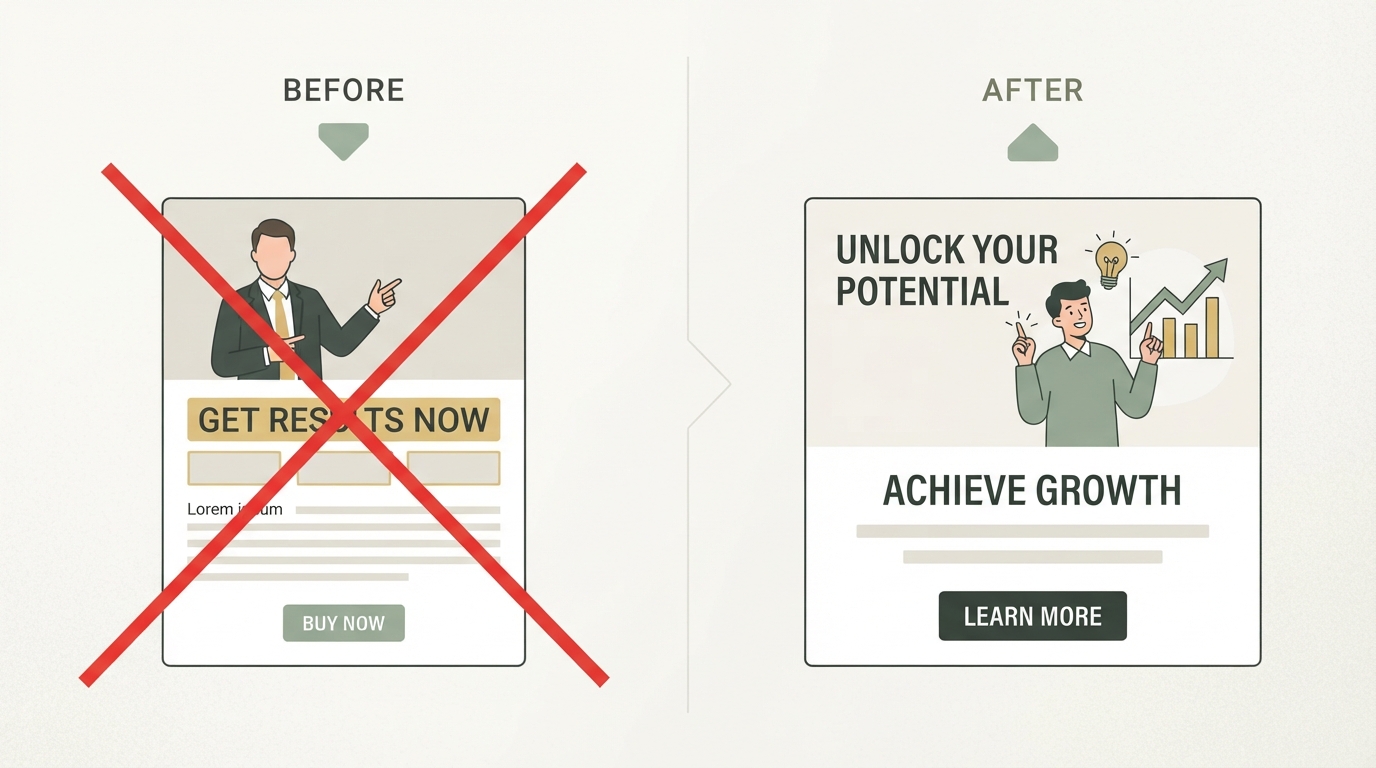
Instead, take the pattern, not the wording. If three competitors are working with a before-and-after angle, that means: this format probably works with your audience too. It doesn't mean you should use the same sentence. Write your own before-and-after, with your own product, your own numbers, your own language.
Turn this into a small template for yourself: pattern that works → your pain point → your proof → your own wording. When it comes to sales copy in general, it helps to get clear on what's genuinely unique about your own offer, rather than just mirroring the competition. That's exactly what the article how to write good ad copy covers, if you want to go deeper on this.
Also important: watch for angles your competitors are missing. If possible, look at negative reviews of competitor products. What are people complaining about? That's often an angle nobody's using yet, because it's the competitor's own weak spot. That's exactly where your ad can step in without looking like a copy.
Step 5: Test instead of guess
Even the best analysis is no substitute for a real test. Turn your two or three strongest derivations into actual ad variants and run them against each other with a small budget.
A small budget is completely enough at the start to get initial signals. What matters is that you really only change one variable per test — either the hook, or the image, or the audience, not all of them at once. Otherwise you won't know at the end what actually made the difference.
I made this mistake myself early on, changing too many things at once, and afterward had no idea which change had actually made the difference. That just costs time and budget. A clean test with a single variable is more boring, but it actually gets you further.
How often should you re-check the competition?
Once is too little, every week is too much. A good rhythm is a quick check of your five to eight most important competitors every two to four weeks. For newly added ads, check the hook and angle. For ads that have disappeared, take a moment to think about why they might have been pulled.
This way, you build up a feel for the market over months, without any complicated tools. You'll see trends coming before they're everywhere, simply because you're looking regularly instead of just once.
Manual vs. software: what's realistic
Searching ad libraries manually works, but it costs a lot of time, especially if you want to keep an eye on several competitors over months. Software that continuously monitors multiple competitors' running ads and shows you runtime and hook frequency mainly saves time here, not the thinking.
| Approach | Time required | What you get |
|---|---|---|
| Manual in the ad library | High, ongoing | Full control, but tedious repetition |
| Collecting screenshots in a folder | Medium | An overview, but quickly becomes messy |
| Ongoing monitoring tool | Low after setup | Automatic updates on new/disappeared ads |
The thinking work — reading out the hook and the angle — stays with you either way. No tool can do the understanding of why an ad works for you.
This is exactly where I see the biggest gap for a lot of founders: they analyze ads, but afterward don't know how to turn that into a coherent overall package of strategy, creatives, and rollout. At Starte.ai, we take exactly this kind of data, combine it with insights from thousands of real projects, and derive a strategy that fits your market — and build the matching creatives right along with it. We've generated over 125,000 leads with our own systems. That's no promise for your project, but it's a sign that a systematic approach often gets you further than a handful of good ideas.
What else you should take away
Two related topics round out the full picture. First, defining your target audience itself: before you analyze ads, it helps to know how to roughly narrow down your own audience — you'll find more on that in the article how to find a profitable niche. Second, the question of whether your product actually fits the audience you're analyzing, which ties closely into the topic of product-market fit.
If you want to go even deeper into the psychology behind successful ads — why people respond to certain hooks in the first place — it's worth checking out sales psychology for founders. Ad analysis and sales psychology are more closely linked than they seem at first glance.
The takeaway: Build a list of eight to twelve competitors, collect the longest-running ads in a simple table, note down the hook and angle instead of hoarding screenshots, and derive your own pattern from it — never the finished copy. """
Frequently asked
Is it legal to analyze competitor ads?
Yes. Ad libraries like Meta's or TikTok's are publicly accessible and exist specifically to create transparency around the ads being run. You're only analyzing what's already public.
How can I tell if an ad is actually working?
The most important signal is runtime. If an ad has been running unchanged for several weeks, that suggests it's paying off for the advertiser. Short runtimes are more likely a sign of an abandoned test.
Can I copy a competitor's hook almost word for word?
Legally, that can be risky depending on the exact wording, and it usually doesn't get you very far anyway. It's better to take the pattern behind the hook and rewrite it in your own words, with your own proof and your own numbers.
How many competitors should I keep an eye on regularly?
Five to eight is a good benchmark. Fewer often gives you too few patterns, while significantly more makes regular monitoring needlessly time-consuming without meaningfully improving the quality of your insights.
Written by
Bohdan BernatekFounder, Starte.ai
Founder of Starte.ai. Built a business to 125,000+ organic leads and seven-figure revenue — and now works with founders personally, deriving a strategy for their own brand from data across thousands of real projects and producing the creatives for it.