Best No-Code Tool for SaaS 2026: The Overview
For complex web apps: Bubble. For mobile apps: FlutterFlow. For quick internal tools: Softr or Glide. For anything that's more automation than a real app: Webflow plus Make or Zapier. That's the short answer to the question of the best no-code tool for SaaS 2026 — which one ends up fitting depends on what you're building: a dashboard with heavy logic, a simple booking tool, or something with its own data model.
If you already have a rough idea, you'll find the right row in the table further down. Everyone else should first understand what no-code tools are fundamentally built on: visual logic instead of code, and pre-built blocks for database, auth, payments, and frontend. The difference between providers lies in how deep these blocks go and how much you can customize before you hit a wall.
Many founders only notice that wall late. Again and again, the wrong tool choice only becomes visible after a few months: the database can no longer be extended cleanly, new user roles don't fit the existing model, or the app noticeably slows down under more traffic. Then you're essentially starting over.
What "No-Code" Actually Means in 2026
No-code rarely means "zero code at all" anymore. Almost every serious tool now has a layer for custom scripts or API calls, because pure click interfaces simply aren't enough for complex logic. As a rough rule of thumb: if you need more than simple if-then rules — say, nested conditions across multiple user roles — you'll almost inevitably end up with a tool that has its own scripting layer.
The trend is heading toward low-code with AI support: you describe what you want, and the tool generates the logic, or at least a first draft of it. That's also why a lot of people now use the terms no-code and low-code pretty interchangeably.
When I'm evaluating a new tool, the first thing I ask myself is: how fast can I get from idea to something real users can test, without having to write code? That's really the only question that matters to you as a founder.
Comparison Table: Which Tool for Which Type of SaaS
The right tool depends on three factors: complexity of the logic, target platform (web or mobile), and how deep your data structure goes. Here's the overview, sorted by use case rather than by vendor marketing claims:
| SaaS Type | Recommended Tool | Strength | Complexity Limit (Tables/Users) |
|---|---|---|---|
| Web app with complex logic (e.g. dashboards, calculations) | Bubble | Very flexible database, lots of plugins, real business logic | Scales well to tens of thousands of users; performance checks recommended beyond that |
| Mobile-first app | FlutterFlow or Adalo | Native app feel, export to real Flutter code possible (FlutterFlow) | Backend logic often more limited than Bubble |
| Internal tool / database app | Softr or Glide | Extremely fast to get running, good Airtable/Google Sheets integration | Up to roughly 5–10 linked tables, after which query performance often becomes an issue |
| Marketing site with booking/forms | Webflow + Make | Very clean design, solid SEO foundation | No real app backend, more a website than a SaaS |
| Automation-heavy product | Make or Zapier as the core | Connects hundreds of tools without code | No frontend of its own, you need something in front of it |
| AI-powered prototype with code export | Tools like Replit Agent, Lovable, or v0 | Very fast to working code, no vendor lock-in | Requires more technical understanding when debugging |
If you're not sure yet which row your idea belongs in, it's worth reading how a SaaS business model actually works — the business model often already determines which tool category is even in the running.
Bubble: For Anything With Real Business Logic
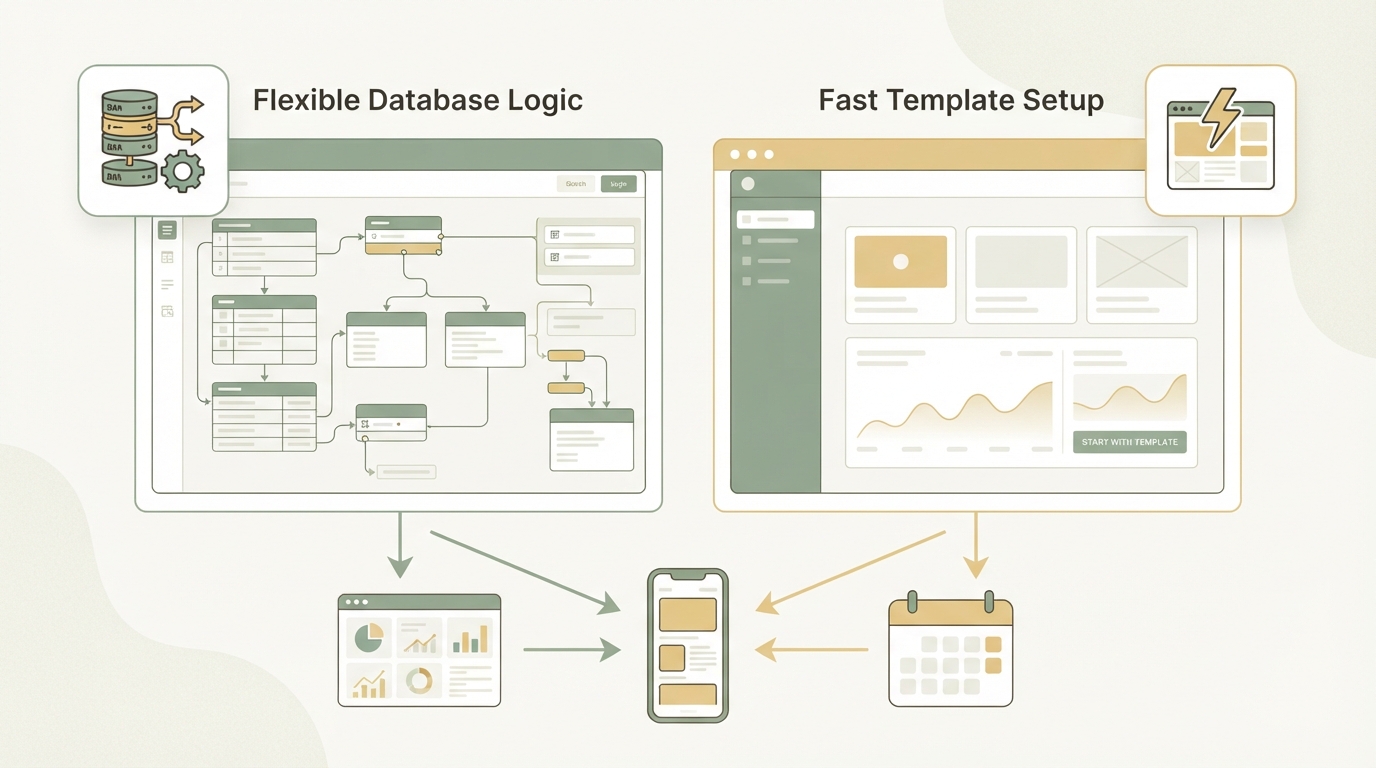
Bubble is the right choice when your SaaS does more than just display data — when it calculates, applies rules, or distinguishes between user roles. That's exactly what a lot of simpler tools just can't do.
Someone on the Bubble forum recently built a marketplace with Stripe integration, entirely without a single line of code, including payout logic between buyers and sellers. That's typical for Bubble: you see projects like this fairly often there, along with accounting tools or internal admin systems for agencies that you'd normally only be able to pull off with a dev team. The trade-off is one or two weeks of an uncomfortable learning curve. Bubble is especially unforgiving toward beginners when it comes to event logic, and the database designer demands a different way of thinking than classic tables: you're not just modeling columns, you're thinking in workflows and conditions that build on each other.
In practice, performance is the first thing Bubble users start complaining about once things get serious. Bubble runs on its own infrastructure, which can hit limits under very heavy simultaneous traffic. For the first few hundred or thousand users, that's usually not an issue. But once your product really takes off, a recurring pattern shows up in Bubble forums and communities: people describe reaching exactly this point where they start considering a switch to real code, or at least a hybrid solution.
FlutterFlow and Adalo: When "Mobile" Matters More Than "Web"
If an app needs to feel like a genuine native app, FlutterFlow is usually the better choice over classic web no-code tools. FlutterFlow exports real Flutter code. That's hugely important, because you won't have to rewrite everything from scratch later if you bring in a dev team.
If your product grows later and you add a developer, they can keep working with real Flutter code instead of starting from zero. That's a detail a lot of people underestimate. Adalo, by comparison, is often easier to get started with, but less deep in terms of what you actually end up with.
The long-term rule of thumb: if your product needs to keep growing technically, FlutterFlow is the better choice. If you just want to quickly test whether your app idea interests anyone at all, Adalo is enough.
Softr and Glide: The Fastest Route to an MVP
Softr or Glide is often the fastest way to get to something usable if you need a data-driven internal tool or a simple portal. Both tools are built on top of an existing data source at their core, usually Airtable or Google Sheets, and turn it into a real interface with login, filters, and forms.
If your data already lives somewhere in a spreadsheet, this goes remarkably fast: often it takes hours instead of weeks before a customer has a working portal in front of them to test.
Airtable and Google Sheets are great for simple relationships, but as soon as you need a lot of nested data models — say, users who belong to teams, which belong to projects, which have their own permissions — it gets tedious. As a rough rule of thumb: once you need more than 5 to 10 tables with interdependencies, or query performance starts noticeably dropping off, that's the point where switching to Bubble or even real code can be worth it.
If you want to define your MVP at this stage before even picking a tool, it's worth checking out how to actually build an MVP — putting idea before tool in that order often saves you weeks.
AI-Native Builders: The Fastest-Growing Trend of 2026
AI-native tools like Lovable, Replit Agent, or v0 differ from classic no-code tools in that they generate actual code instead of connecting visual blocks. With Lovable, for example, you type a prompt like "build me a booking tool with login and calendar view" into the chat window, and the tool generates a working React application with a database connection, which you see directly in the browser and can keep customizing. v0 works the same way: you describe a component or an entire page in plain language, get several versions suggested, and pick the one that fits best.
For a lot of simple to mid-complexity projects, this is by now a genuine alternative to classic no-code. The big advantage: no vendor lock-in. You get real code that you can, in theory, host anywhere and keep building with any developer.
The honest catch is: you still need a basic understanding of what the generated code is doing once something breaks. That's not a contradiction to building a no-code SaaS, but it's also not quite the "zero knowledge needed" promise some providers suggest. If you're starting with absolutely no technical background, you'll often find it easier at first with classic visual builders like Bubble or Softr.
If you're currently on the hunt for the best no-code tool for SaaS 2026, it's also worth taking a look at Starte.ai if you first want to check whether your idea actually has demand before committing to a tool.
What These Tools Can't Do: The Honest Limits
No no-code tool fully replaces a dev team once your product's technical demands grow. That's the uncomfortable truth behind all the hype.
Three limits that keep coming up:
First, performance at scale. Most no-code platforms run on shared infrastructure. For the first few thousand users, that's almost always enough. Past a certain point — often somewhere between ten thousand and a hundred thousand active users — it can get tight, depending on the tool.
Second, highly custom integrations. If you want to connect an unusual API that doesn't have a ready-made plugin, you'll often need a line of code after all, or at least someone who can read API documentation.
Third, data privacy and compliance in sensitive industries. In healthcare or finance, you often have to ask exactly where your no-code provider's data is stored and whether that's compatible with GDPR and industry requirements. Concretely, this usually comes down to three questions: where the servers are located, whether there's a data processing agreement, and how backups are handled. Some tools are further along here than others, but no serious provider will give you a blanket "GDPR-compliant" guarantee.
One example of a product that grew significantly despite real technical complexity: Snaptrade connects fintech apps to broker accounts through a unified API, with an estimated ~$4.46M MRR and about 142,000 monthly visits. You realistically wouldn't build a product like that entirely in a classic no-code tool, but the underlying idea — solving a niche problem for fintech developers — can often still be validated with a simple no-code MVP before you build out the real system.
Automation Instead of an App: When Make or Zapier Are Enough
Sometimes you don't need a "SaaS tool" in the classic sense at all, just a clever combination of existing tools. If what's really behind your product is a process — say, moving data from A to B with a bit of logic in between — then Make or Zapier is often cheaper and faster than building an entire app backend.
I see this pattern quite often with a lot of first versions of B2B ideas: someone builds a landing page with Webflow, and behind it runs Make, which processes form data, generates an invoice, and sends a Slack message.
Frequently asked
Was ist das beste No-Code Tool für SaaS 2026?
Es gibt nicht das eine beste Tool, sondern es hängt davon ab, was du baust. Bubble eignet sich für Web-Apps mit komplexer Logik, FlutterFlow oder Adalo für mobile Apps, Softr oder Glide für schnelle interne Tools und Webflow plus Make/Zapier für Automatisierung statt echter App.
Ist Bubble oder Softr besser für ein SaaS-MVP?
Softr ist meist die schnellere Wahl, wenn deine Daten schon in Airtable oder Google Sheets liegen und die Beziehungen einfach sind, weil du dann oft in Stunden statt Wochen ein Portal stehen hast. Bubble lohnt sich dagegen, sobald dein Produkt rechnet, Regeln anwendet oder mehrere Nutzerrollen unterscheiden muss, kostet dafür aber mehr Einarbeitung.
Was sind KI-native No-Code Builder wie Lovable oder v0?
Das sind Tools, die im Gegensatz zu klassischen No-Code-Baukästen echten Code generieren statt visuelle Blöcke zu verbinden. Du beschreibst zum Beispiel bei Lovable dein Vorhaben in normaler Sprache und bekommst eine lauffähige React-Anwendung mit Datenbank-Anbindung, die du direkt weiter anpassen kannst.
Wo stößt No-Code bei SaaS-Apps an seine Grenzen?
Die typische Grenze zeigt sich bei komplexen, verschachtelten Datenmodellen, etwa wenn Nutzer zu Teams gehören, die wiederum zu Projekten mit eigenen Berechtigungen gehören. Auch Performance bei sehr viel gleichzeitigem Traffic kann bei manchen Tools wie Bubble irgendwann zum Thema werden.
Written by
Bohdan BernatekFounder, Starte.ai
Founder of Starte.ai. Built a business to 125,000+ organic leads and seven-figure revenue — and now works with founders personally, deriving a strategy for their own brand from data across thousands of real projects and producing the creatives for it.