What Is a Creative Brief?
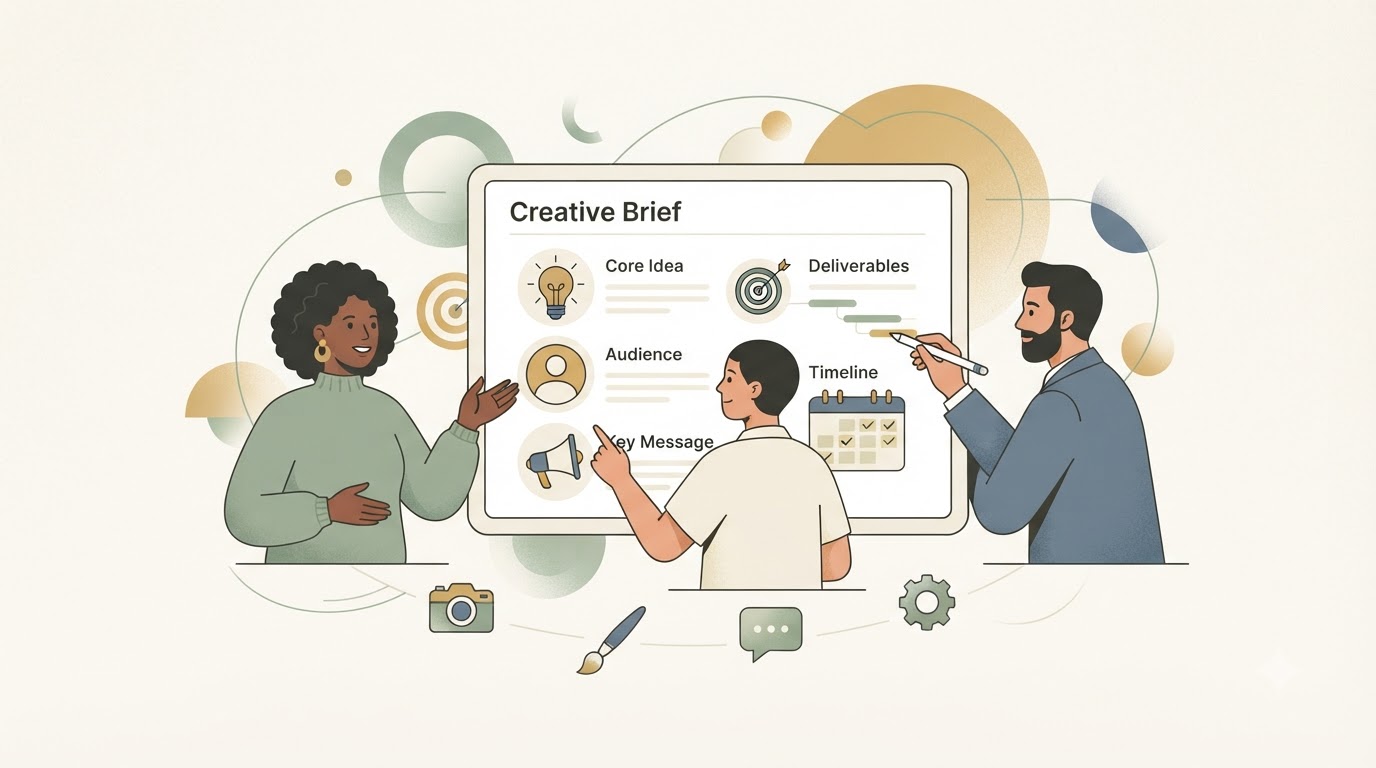
A creative brief is a document covering goal, audience, message, tone, and format — everything a designer needs to build your creative correctly, without pinging you five times along the way. A brief saves money because it front-loads the three most expensive rounds of feedback before a single draft even exists. And it works because it takes interpretation out of the process: the designer doesn't have to guess what you mean, they just read it.
I used to think a brief was only for big agencies with their own creative team. Wrong. The moment you're paying even one freelancer for an ad image, you need one. Otherwise you're paying for three rounds of revisions you could have skipped entirely.
Why a Bad Brief Costs You More Than Time
Without a brief, you get whatever the designer thinks is good — not what actually works for your audience. That's the real issue.
A designer without context fills the gaps with their own taste. That can be great. It can also completely miss your audience. If you've ever needed three feedback rounds just to explain what you actually meant, that probably wasn't a communication problem. The document that answers those questions upfront was simply missing.
With paid ads, there's an added cost: every round eats time, and time is literally money in campaigns. A weak creative that goes live three days late can push back an entire test phase. If you run Facebook or TikTok campaigns regularly, you learn fast: the most expensive creative isn't the one that performs poorly. It's the one that never gets finished on time.
The Components of a Creative Brief
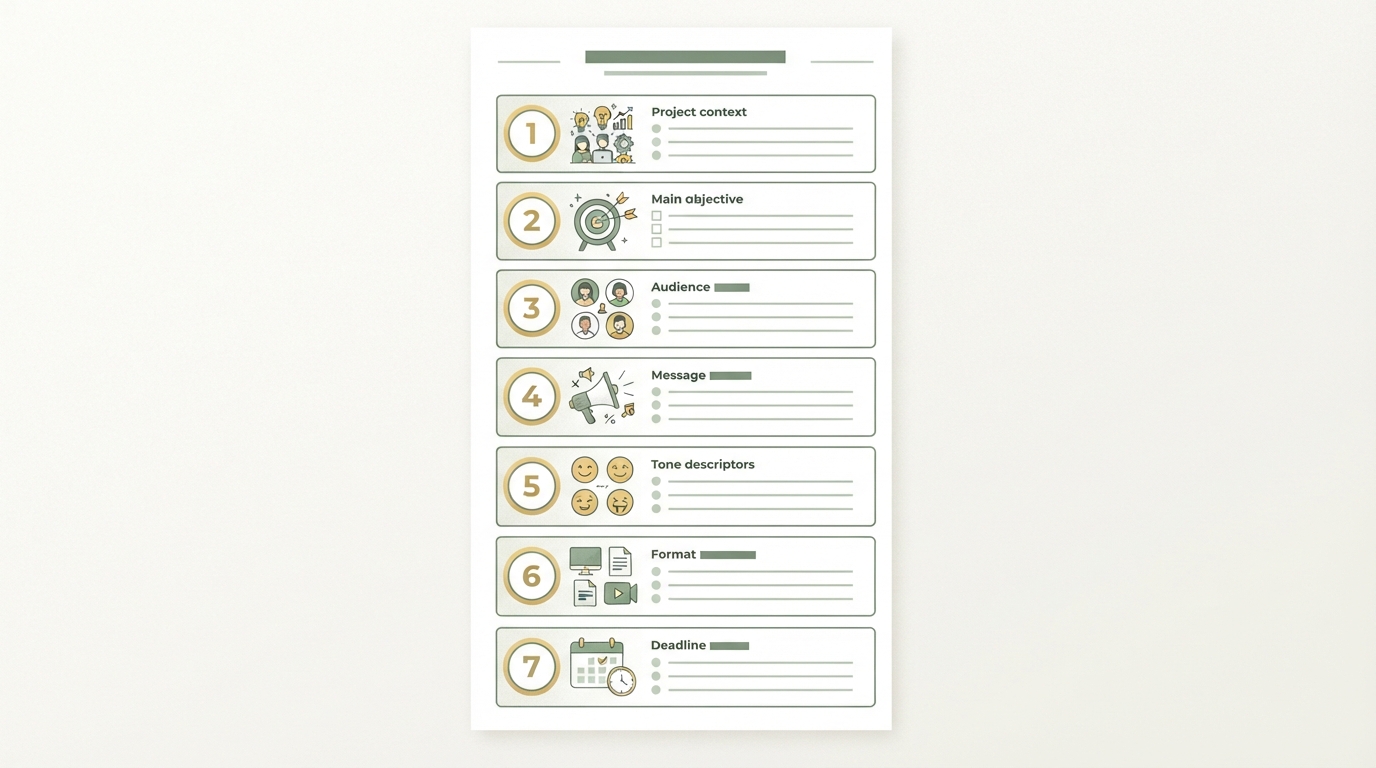
A good brief answers seven questions — no more. Pack in more than that, and nobody reads the whole thing.
- Project name & context — what's this about, which product, which campaign
- Goal — what should the creative achieve (clicks, installs, sales, brand awareness)
- Audience — who's seeing this, what problem does this person have right now
- Core message — the one sentence people should remember
- Tone & style — casual or serious, loud or quiet, with examples of brands that nail the tone
- Format & mandatory specs — dimensions, platform, logo placement, colors, legal disclaimers
- References & deadline — two or three examples showing what you mean, plus the due date
That's the basic structure for a designer brief. For a pure ad brief for paid campaigns, there's often one more item: the hook — the first second or line that stops the scroll. If you've never deliberately crafted a hook before, Writing a Video Hook: The 6 Patterns That Actually Stop the Scroll has six patterns you can drop straight into your brief.
What to Watch for When Writing a Brief
- Is the goal stated in measurable terms (click-through rate, not "should land well")?
- Is the audience specific, not just "women 25-45"?
- Is there exactly one core message, not three competing ones?
- Are mandatory specs (logo, colors, legal notices) clearly stated?
- Are reference examples attached, rather than a text description of "modern and fresh"?
- Is the deadline realistic for how complex the format is?
What Is a Creative Brief — A Practical Example
The easiest way to understand the structure is through a real example, not an abstract list.
Project: Summer campaign, skincare serum Goal: Traffic to landing page, click-through rate above industry average Audience: Women 28-45, already buy skincare online, historically respond well to before/after formats Core message: "Visibly smoother skin in 4 weeks, no additives" (only use if backed by a study/test) Tone: calm, trustworthy, no shouting or countdown panic. Reference: [example brand]'s feed, not [example brand 2]'s Format: 1080x1350 for Instagram Feed, plus 9:16 version for Stories Mandatory specs: logo bottom right, brand color #2A5C4B, asterisk disclaimer on efficacy claims References: three attached images of similar campaigns Deadline: 5 business days, first drafts
The whole thing fits on one page. No wall of text, no interpretation needed.
If you're adapting this template for yourself: never leave the "core message" box empty. That's where most briefs fall apart, because the message turns out to actually be three messages.
Common Creative Brief Mistakes
Most bad briefs don't fail because of missing fields — they fail because the answers in the fields that do exist are too vague.
| Mistake | Why it hurts | Better approach |
|---|---|---|
| "Audience: everyone" | Designer can't design with intent | Describe a specific person with a problem and context |
| Three messages at once | Creative gets cluttered, nothing sticks | One core message, cut everything else |
| No reference examples | Everyone interprets "modern" differently | Attach 2-3 images or ads as anchors |
| Goal isn't measurable | No one knows if it worked | State a concrete metric (CTR, cost per lead) |
| Deadline with no buffer for feedback | The final revision round gets rushed | Build in time for at least one revision |
| Tone described only with adjectives | "Fresh and dynamic" says almost nothing | Name a brand that already nails that tone |
The biggest mistake I keep seeing: people write the brief for themselves, not for the designer. They already know what they mean. The problem: the designer doesn't. A brief isn't done until a total stranger can read it and start working without asking a single question.
Ad Brief vs. Classic Creative Brief: What's the Difference?
An ad brief is a narrower, campaign-focused version of a creative brief, tailored to paid advertising rather than brand work in general. Classic briefs for brand shoots are often about consistency over months. An ad brief cares about one thing above all: does the creative stop the scroll, and does it drive the intended action?
| Aspect | Classic Creative Brief | Ad Brief |
|---|---|---|
| Time horizon | Months, often part of a campaign series | Single ad or test phase, often days |
| Focus | Brand consistency, tone | Hook, CTR, conversion |
| Iteration speed | Slower, multiple review rounds | Fast, testing several variants in parallel |
| Success metric | Recognition, brand image | Hard numbers: CTR, cost per result |
If you test ads regularly, you'll notice fast: an ad brief pays off most when you're running several variants at once, not just one. How much budget you should actually set aside for that depends heavily on your campaign phase. More on that in Setting Your Ad Budget: 6 Steps Instead of Gut Feeling.

How a Brief Fits Into the Bigger Marketing Flow
A creative brief rarely stands alone. It's usually the last step before an idea becomes an ad, coming after audience research and offer definition.
That's exactly where things get tight for a lot of solo founders. You spot a trend, you have a rough sense of the audience, but the step from "this could work" to a clean brief a designer can act on immediately often takes more time than the design itself. If you'd like support with that, Starte.ai can derive a strategy for your brand from the data of thousands of real projects, and from there you can build briefs already tailored to your niche's audience and tone, instead of starting from zero. The first strategy call is free, and you can try getting started with no commitment.
If what's actually missing for you is the campaign idea itself rather than the brief format, take a look at Creating a Content Plan: The Mistake Almost Everyone Makes. That covers the step before this one.
Tools That Help With the Briefing Process
A brief is ultimately just a document, but the process around it works a lot better with the right tools — instead of starting from zero on every new project.
For reference material and competitive research, many teams now use tools that show live data from real campaigns instead of relying on gut feeling. {{saas:vector.co}}, for example, identifies anonymous website visitors by company, which helps you fill in the audience section of your brief with real data instead of assumptions — estimated at around 99,000 visits a month. For B2B products, where the audience section of a brief often stays too vague, this can be a solid starting point.
A creative brief doesn't need to be perfect. It just needs to be clear enough that a total stranger can read it and start working without asking a single question. Write out the seven points properly once, attach two reference examples, and never leave the core message field empty.
Frequently asked
How long should a creative brief be?
A good brief is one page max, maybe a page and a half — nobody reads more than that in full anyway. Once you've answered all seven questions (project name, goal, audience, core message, tone, format, references), it's done.
What's the most common mistake in a creative brief?
Most people write the brief for themselves, not for the designer — they already know what they mean. The biggest mistake is keeping the core message too vague, or cramming three messages in at once instead of settling on one clear one.
Do I really need a creative brief as a freelancer or solo founder?
Yes, the moment you're paying even one freelancer for an ad image. Without a brief, you're paying for three rounds of revisions you could have avoided — the designer just fills in the gaps with their own taste.
What's the difference between a creative brief and an ad brief?
An ad brief is narrower and campaign-focused — what matters most is whether the creative stops the scroll and drives the desired action. A classic creative brief focuses more on brand consistency over a longer period.
Written by
Bohdan BernatekFounder, Starte.ai
Founder of Starte.ai. Built a business to 125,000+ organic leads and seven-figure revenue — and now works with founders personally, deriving a strategy for their own brand from data across thousands of real projects and producing the creatives for it.