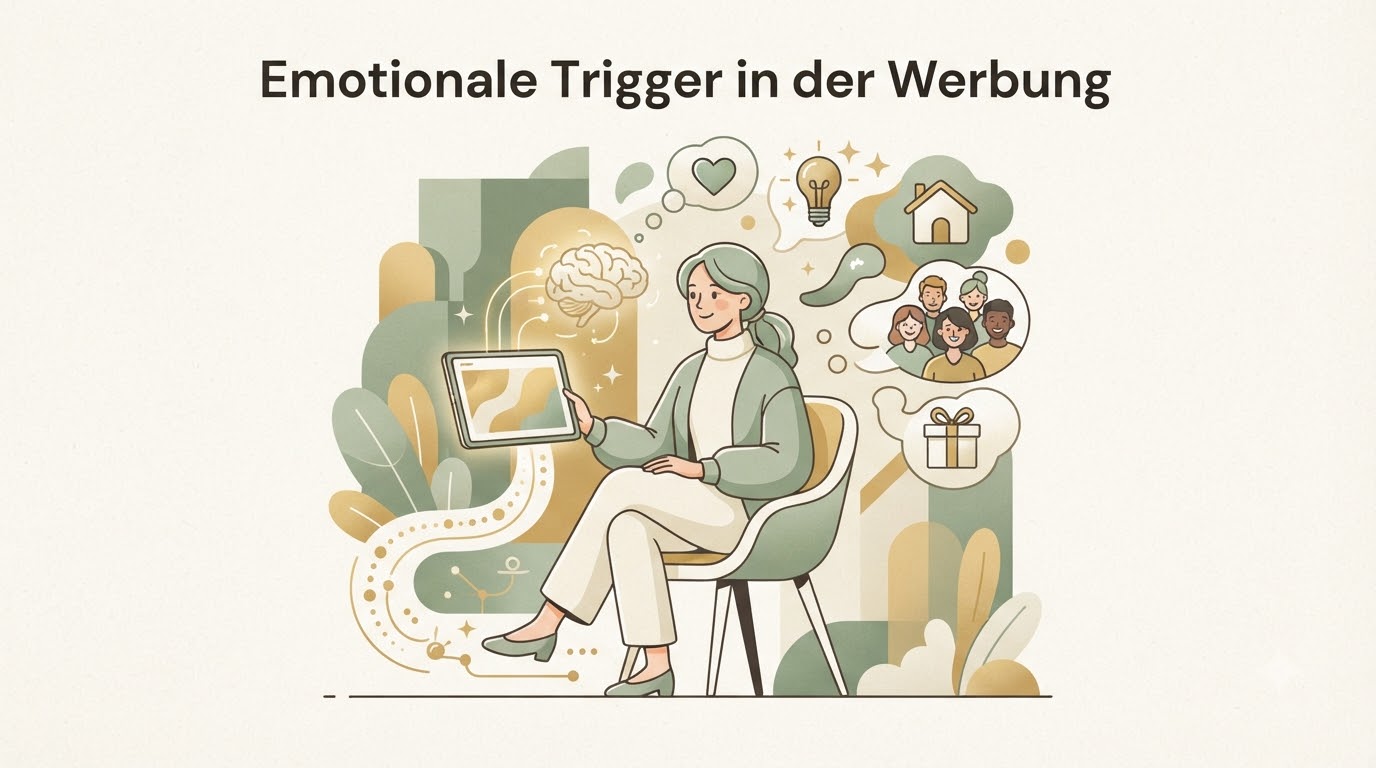
What are emotional triggers in advertising, exactly?
Emotional triggers in advertising are psychological stimuli that trigger an unconscious emotional reaction before the mind rationally evaluates. They work because people feel first and then justify their decision with logic afterward.
Whoever exploits emotions in advertising rather than addressing them loses customers faster than they gain them. The difference between the two is usually paper-thin. But it exists, and this article shows you exactly where.
An emotional trigger works before the message is rationally examined. People don't decide primarily with logic. They feel first, and then justify their decision with arguments. This isn't a bold claim from me—it's been consensus in consumer psychology for decades.
Before you think about colors, fonts, or the perfect offer, ask yourself what feeling you want to trigger. Fear of loss? Belonging? Pride? Curiosity? Each of these feelings requires different imagery, a different tone, a different structure.
What moves people to buy is rarely the product itself. It's what the product says about them, or which problem it removes from their head.
Why do emotions work better than pure facts?
The brain processes emotions faster than numbers and arguments—roughly 0.3 seconds faster. Facts convince in the second step, when the person is already emotionally interested. They're the justification, not the trigger.
On a client project recently, it was exactly about this: a landing page for a subscription tool, packed with feature tables but without a single image that conveyed a feeling. The numbers were all correct. Yet hardly anyone stayed.
Only when we added an image at the top showing the actual relief—not the function, but the feeling afterward—did dwell time noticeably change. The table was still there at the end. It just wasn't the first argument anymore.
The 7 emotional triggers that work most often in advertising
These seven patterns show up in nearly every good campaign, whether B2C or B2B. I've sorted them by effectiveness, not popularity:
- Fear of loss – the worry of missing out or losing something
- Belonging and social validation – the desire to be part of a group
- Curiosity – a knowledge gap that wants to be closed
- Status and pride – the desire to stand out rather than fit in
- Trust and security – the question of whether a purchase will prove right
- Surprise and pattern disruption – a stimulus that breaks through banner blindness
- Time pressure and urgency – a real deadline or actual scarcity
1. Fear of Loss (Loss Aversion)
People want to avoid a loss more strongly than they want to pursue an equal gain. This is one of the best-documented effects in behavioral economics. In advertising, it shows up as "Don't miss it," "Only today," or more subtly: "What your current tool costs you every month without you realizing it."
Works well for: Discount campaigns, software with switching costs, insurance, anything where a status quo would have to be abandoned. Works poorly for: Impulse purchases without real time pressure, because artificial scarcity is quickly recognized there for what it is.
2. Belonging and Social Validation
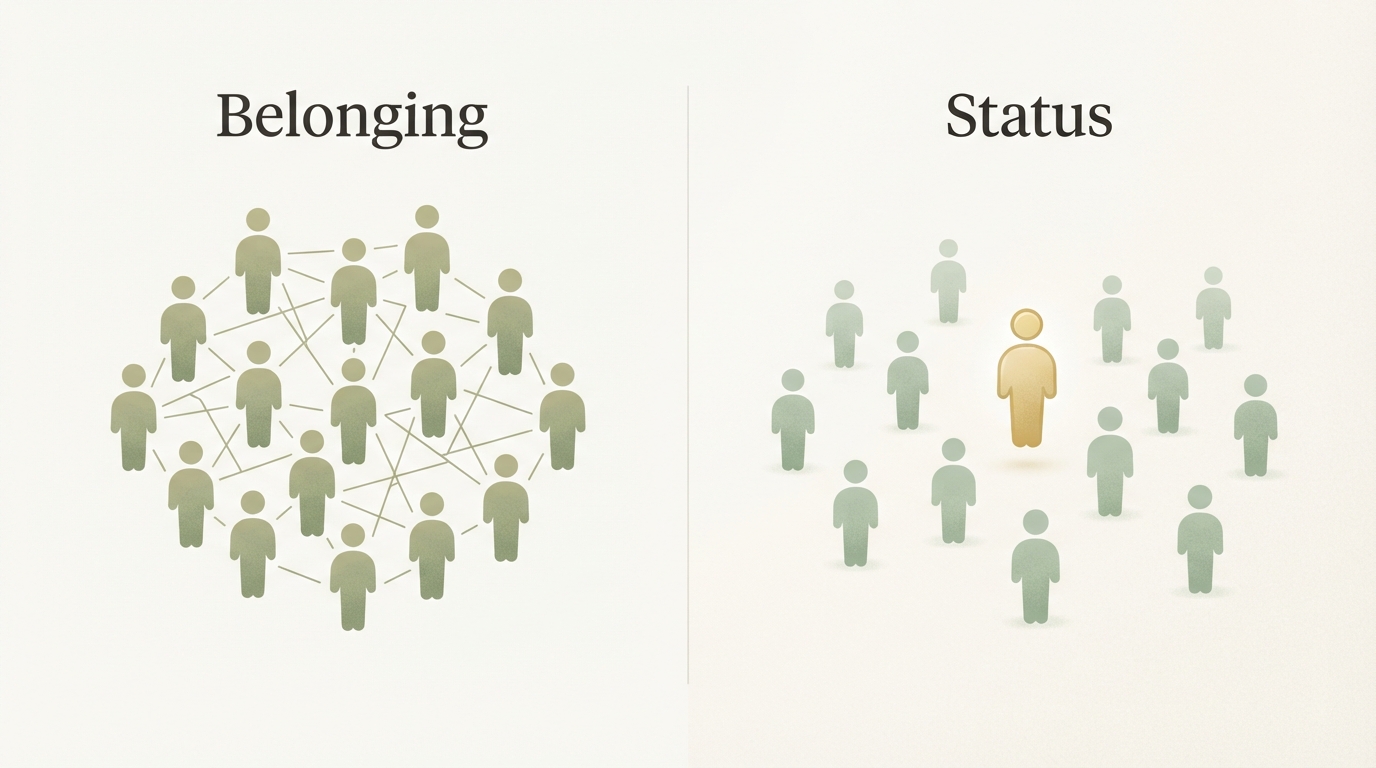
People want to belong to a group they respect or aspire to be part of. Testimonials, "Over 10,000 users," community images—it all serves this trigger. It works because our brains long treated group belonging as a survival question. Today it's not about survival anymore, but the feeling remains.
Important: The number must be accurate or clearly marked as an estimate. Made-up user numbers eventually get exposed, and then trust is gone—forever.
3. Curiosity and the Knowledge Gap
A good example: "The mistake almost everyone makes with their first ad account." You want to know what that mistake is. This gap between what you know and what you want to know creates real cognitive pressure.
We also use this effect, by the way, in our approach to the first three seconds of a video. Curiosity works best when the payoff actually delivers value. Otherwise, the viewer's next click is their last.
4. Belonging Through Status and Pride
A subtle difference from point 2: This isn't about "fitting in," it's about "standing out." Premium brands, limited editions, exclusive access. The trigger isn't fear of missing out, but pride in having something others don't.
5. Trust and Security
Before someone buys, they want to know: Will this disappoint me? Trust signals like certifications, real customer testimonials, a clear return guarantee, or simply a face instead of an anonymous logo lower this uncertainty. Especially for higher-priced products or first purchases, this is often the decisive trigger, not the price.
6. Surprise and Pattern Disruption
An image or sentence that doesn't show what's expected breaks through banner blindness. The brain is trained on patterns and stops automatically at deviations.
Too much surprise without a connecting thread feels random, though. The disruption needs to lead back to the message, or confusion is all that remains.
7. Time Pressure and Urgency
Closely related to trigger 1, but independent: a real deadline, a seasonal occasion, limited inventory. The word "real" matters. A countdown that restarts fresh every week gets seen through by attentive users, and that hurts your whole brand more than slightly less urgency.
When does each trigger fit? A quick overview
| Trigger | Works well for | Doesn't work well for |
|---|---|---|
| Loss aversion | Software, subscriptions, insurance | Impulse purchases, gifts |
| Belonging | Community products, consumer goods | Highly individual B2B solutions |
| Curiosity | Content, hooks, products needing explanation | Pure commodity products |
| Status | Premium, limited editions | Price-sensitive mass market |
| Trust | First purchases, high-priced products | – (relevant almost everywhere) |
| Surprise | Awareness campaigns | Explanation-heavy retargeting ads |
| Urgency | Seasonal campaigns, real deadlines | Permanent offers |
That last column matters almost more to me than the middle one. A trigger in the wrong place doesn't work neutrally—it feels off, and that costs credibility.
How do you use emotional triggers cleanly without manipulating?
The difference is whether the trigger is based on something real or something invented. Real scarcity (limited seats, an actual date) is a legitimate trigger. Invented scarcity is manipulation, and people spot that pretty reliably these days.
I've developed a few criteria I run through myself before an ad goes live:
- Is the number or deadline I'm showing real and verifiable?
- Would I feel comfortable if the customer got exactly what the emotional trigger promised after buying?
- Does the ad build on a fear I'm artificially amplifying instead of solving?
- Does trust remain intact even when the customer reads the ad twice?
- Does the trigger fit the target audience, or am I using it just because it "always works"?
If any of these questions triggers an uneasy feeling, that's already your answer.
Emotional triggers across different advertising formats
How a trigger works depends heavily on format. A text ad on Google responds to search intent—loss aversion or curiosity work well in the headline there. A TikTok or Reels ad lives by the first seconds, where surprise or a bold claim pulls.
More on how to build that specifically for short video formats is in our article on Running TikTok Ads.
Retargeting is another matter entirely. The person already knows you, cold curiosity doesn't work as well, trust and a gentle reminder often work better. If you haven't set up your retargeting properly yet, it's worth looking at Setting Up Retargeting: The Mistake Almost Everyone Makes before you use the wrong triggers there.
A real-world example: how the "control" trigger works
Say we're running a campaign for a B2B tool for competitive monitoring. The premise: make anonymous website visitors visible so a sales team follows up strategically instead of on a whim.
The emotional trigger underneath isn't fear or curiosity in the classic sense, but a sense of control: "I now know who's actually interested instead of guessing."
This control feeling is the real lever, not the function itself. The ad doesn't sell "tracking software," it sells the end of uncertainty about whether a lead is worth pursuing. For a highly technical audience, a different trigger often works alongside it: the competence signal. "This solution understands my problem without me having to explain it at length." Trust beats urgency here, in almost every case.
Emotional triggers and price communication
One often-overlooked trigger: the way a price is presented triggers emotions all by itself. A price without context feels arbitrary. A price with clear reasoning ("because you'll save X with it") feels fair, even if it's higher.
If you're thinking about raising your prices, you'll find in Raising Prices Without Losing Customers: The 4-Phase Migration an approach that factors in exactly this emotional side, not just the math.

This is where it gets hard for most founders
The problem is rarely knowing the right trigger. The problem is weighting it correctly for your target audience, your product, and your budget.
What works for a fashion brand often completely falls flat for a B2B SaaS, and vice versa.
Our software at Starte.ai handles this calibration: It continuously evaluates data from thousands of real projects and shows which triggers, ad formats, and audiences actually work in which markets. From that, we don't derive generic strategy, but the one most likely to fit your specific product. Bohdan Bernatek, our founder, personally guides projects through this—the first strategy call is free.
From insight to finished ad
A trigger alone doesn't make a good ad. It needs a script, an image, a hook to carry it. If you want to proceed systematically instead of from the gut, it's worth checking out Creating a Content Plan: The Mistake Almost Everyone Makes first, so your emotional triggers don't just show up in one ad but run consistently across all your content.
In the end, it doesn't matter how many triggers you know. What matters is finding the one that truly fits your product and your audience. Start with one, test it rigorously, and expand from there.
Frequently asked
Which emotional triggers work best in advertising?
The seven most effective triggers are fear of loss, belonging, curiosity, status and pride, trust, surprise, and time pressure. Which trigger works best depends on what you're selling—there's no one-size-fits-all solution.
Why do emotions work better than facts in advertising?
The brain processes emotions roughly 0.3 seconds faster than numbers and arguments. Facts convince in the second step, once a person is already emotionally interested—they're the justification, not the trigger.
How do I know if I'm emotionally manipulating instead of engaging?
Ask yourself: Is the number or deadline I'm showing truly real and verifiable? Would I feel comfortable if the customer got exactly what my ad promised? If either question creates discomfort, you're probably manipulating.
Does artificial scarcity still work in advertising?
Not reliably. A countdown that restarts every week gets figured out quickly and damages your credibility more than it helps. Real scarcity (limited spots, actual deadlines) works; invented scarcity doesn't.
Written by
Bohdan BernatekFounder, Starte.ai
Founder of Starte.ai. Built a business to 125,000+ organic leads and seven-figure revenue — and now works with founders personally, deriving a strategy for their own brand from data across thousands of real projects and producing the creatives for it.