How Do You Find a Profitable Niche?
How do you find a profitable niche? A profitable niche is a narrow market where enough people have a specific problem they'd pay to solve. You find it in real conversations, on Reddit, in reviews, in support threads, not in trend lists. Work through ten forums with the right questions, and that's often enough to spot a clear pattern: with clean research, a recurring problem usually surfaces after 20 to 30 reviews, and that's your starting point.
Google "best SaaS ideas 2026" and you'll land on the same ten ideas as everyone else. Instead, look at 1-star reviews of market leaders, read forums and support threads. That's where you'll find recurring complaints that point to a real market gap.
What Actually Counts as a Profitable Niche?
Not "fitness" or "productivity" — those are industries, not niches. A real niche sounds more like: "Training plans for powerlifters who need to peak for a competition date." Sounds small. That's exactly the point.
A niche market differs from a broad market in that the target audience can describe itself. If your potential customer can say who they are and what they're missing in one sentence, you've probably found a market you can actually work with. With "everyone who wants to be more productive," nobody can do that.
Why Small Often Beats Broad
A sharp niche beats a broad market because it makes you visible without an ad budget. In a crowded mass market, you need marketing money just to get heard. In a narrow niche, it's often enough to show up in the one place where these people already gather. Rob Walling has been making this point in his bootstrapping writing for years: small, willing-to-pay audiences beat large, indifferent ones.
This same pattern runs through many bootstrapped SaaS success stories. They don't serve "everyone who does X" — they serve a very precisely describable subset of that. This makes them unattractive to investors at first. And that's exactly why they're easy to reach, without ten other providers fighting over them.
Step 1: Search in Real Conversations, Not in Your Head
Start where people complain, not where you brainstorm ideas. Reddit subforums for a profession, Facebook groups for a hobby, review sites for existing tools — everywhere, people are writing unprompted about what annoys them. That's more honest than any survey, because nobody's thinking about you while they write it.
Open five to ten forums or communities in an area you know well or can quickly get up to speed on. Don't read the top posts — read the comments. Right there, in the third reply to a third comment, you'll often find the line "isn't there a tool for this?" — and that's what you're looking for.
Why Hobby Niches Are Often Underrated
If you know the problem from your own hobby, you have a real edge. Guitar tone, weight management for combat sport athletes, club management in amateur sports — these areas seem small, but if you're actually in them, you instantly understand the audience's language.
That's a head start that would otherwise take you months to build.
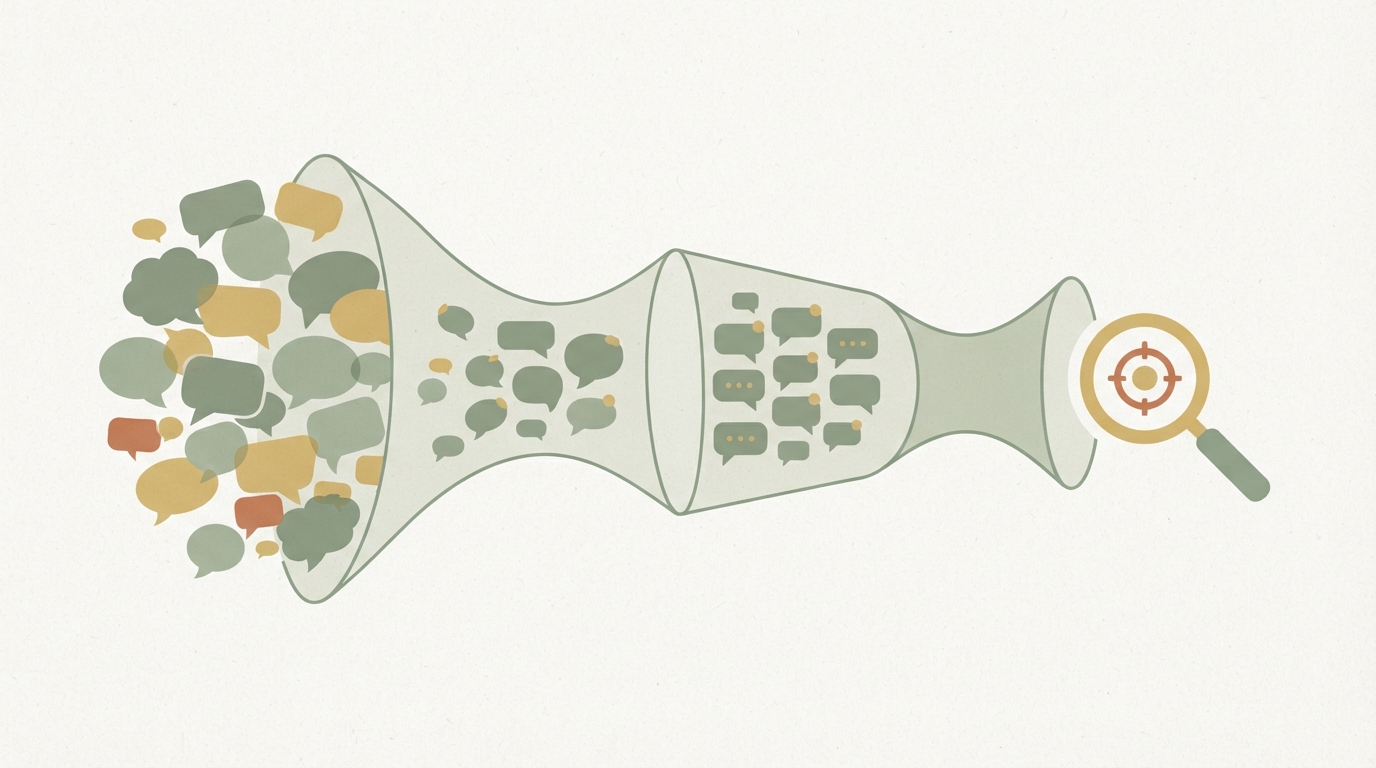
Step 2: Analyze the 1- and 2-Star Reviews of Market Leaders
The worst reviews of an established provider are your free product roadmap. If ten different people independently criticize the same thing, that's not a one-off — it's a gap. And that's exactly where you can step in without starting from zero.
Open the reviews of the three biggest providers in a space that interests you. Sort by "lowest rating first." Write down what people say word for word, not your interpretation of it. After 20 to 30 reviews, a pattern usually emerges: too complicated, too expensive for small users, missing integration with Tool X, poor support. Each of these is a possible angle for you.
Three competitors, one shared complaint. That's already half a roadmap entry.
This, by the way, is also the idea behind "copy with improvement": you're not reinventing anything, you're taking a product that already works and making it so easy to use that even the least experienced person in the target audience gets it right away. Same features, but an experience that feels noticeably lighter.
Step 3: Check Whether People in This Space Are Already Spending Money
A niche is only interesting if there's already willingness to pay, not just interest. Interest is cheap. Everyone says "cool idea." Money is the only proof that counts.
If you find a market with a few competitors, that's often better than a completely empty one. Sounds paradoxical, but it's true: empty markets are sometimes empty because nobody pays for anything there. Areas with a boring reputation — taxes, compliance, immigration processes, insurance — scare off most founders, but they often bring in higher revenue than the next pretty photo-app project. Tools like Stripe or Zapier started in exactly these "boring" but well-funded spaces before becoming the household names they are today.
Boring can pay off.
Look at case studies from this space, and one line keeps coming up: the founders didn't want an exciting idea — they wanted one with paying customers. That's a distinction many people only understand after their first failed consumer project.
Step 4: Talk to Real Potential Customers, Not Your Circle
Never ask friends or family if your idea is good — they'll almost always say yes. This is known as the Mom Test: people who like you don't want to disappoint you. Their approval feels good, but it says nothing about the market.
Instead, talk to 10 to 20 people who genuinely belong to your target audience and whom you don't already know. Don't ask "would you use this?" — ask "how do you solve this problem today?" and "what did you last pay for or try?" The answers to these two questions tell you more than ten opinions from your friends.
In the end, only one kind of answer really counts: a concrete commitment. Not "sounds cool," but something like a firm appointment where someone would actually use your tool. Words cost nothing. A scheduled meeting or a credit card does.
Step 5: Narrow the Niche More Than You Think Necessary
Too broad is the most common mistake in choosing a niche, not too narrow. If you're unsure whether your target audience is too small, it usually isn't yet. Almost everyone overestimates how big an audience needs to be to sustain a business.
"A tool for small businesses" sounds broader than "a tool for physical therapy practices with 2 to 5 staff members who want to reduce no-shows" — and that's exactly the point: the second version sounds smaller. Measured strictly, it might be. But you instantly know where these people hang out, how to reach them, and what language they use. That's worth more than one big, vague number.
If you want to sharpen your target audience even further afterward, it's worth checking out the article on narrowing your target audience — it's exactly about how narrow "narrow enough" really is.
Step 6: Test the Niche with a Single Landing Page
Before you build anything, a simple landing page tests whether real interest exists. A page that describes the problem and solution in a few sentences is completely enough. No product needed, no database, no backend.
If your visitor-to-email-signup conversion sits above roughly 10 percent, that's a signal worth taking seriously. If it's well below that, either you targeted the wrong audience or the problem wasn't urgent enough. Either way, that's valuable insight before you sink weeks into development.
A rough roadmap for the first 30 days might look like this: In weeks 1 and 2, you build the landing page and collect 20 or more email addresses. In weeks 2 and 3, you have 10 to 20 conversations with interested people, without selling anything. In weeks 3 and 4, you offer discounted early access.
Whoever actually pays at that point has given you the only answer that matters.
If you run into the mistake almost everyone makes when building a page, it's worth checking out the article on building a landing page beforehand — it'll save you a round of rework.
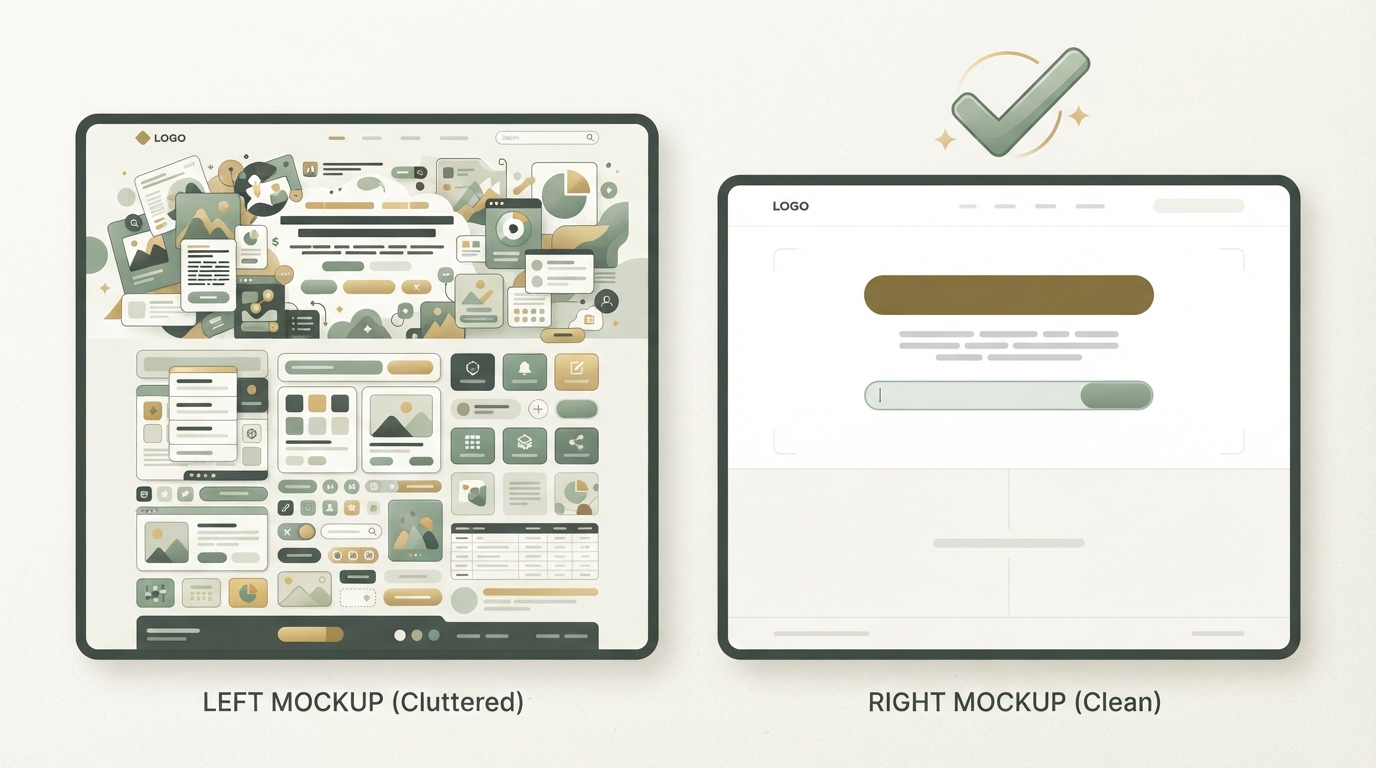
Niche Market vs. Mass Market Compared
The choice between a narrow niche and a broad market has direct consequences for marketing, pricing, and speed to your first customers. Here's a rough comparison of how this usually plays out in practice:
| Criterion | Narrow Niche Market | Broad Mass Market |
|---|---|---|
| Reaching visibility | Often through a few communities, cheaper | Usually requires an expensive ad budget |
| Competition | Often manageable to low | Usually many established providers |
| Pricing | Easier to communicate clearly, audience knows the value | Often has to fit many segments |
| Time to first customers | Can be shorter, since the audience is clearly reachable | Often longer, due to high scatter loss |
| Growth ceiling | Can be reached eventually | Theoretically higher, but harder to tap into |
A narrow niche, by the way, isn't a permanent state. Many successful SaaS products start extremely narrow and only expand later, once the first audience is paying and stable. That's also the core idea behind Paul Graham's essay "Do Things That Don't Scale": deliberately work small and unscaled at the start, just to get real users at all.
How to Validate the Niche Before You Build
A niche only counts as validated once people respond with a clear action, not just approval. A like, a "cool," a comment under your post — that's attention, not proof. Proof is an email address, a scheduled call, a pre-order, or a payment.
If you build first and ask questions later, you're making the most common sequencing mistake there is. The right order is the reverse: landing page first, then conversations, then maybe a waitlist signup, and only after that, actual development. For how to build a waitlist properly, without the usual beginner mistakes, check out the article on building a waitlist.
If you're not exactly thrilled about hours of manual forum-digging for your research, that's exactly the kind of thing I'd use a tool like Starte.ai for.
Frequently asked
Wie finde ich eine profitable Nische?
Du findest sie nicht in Trendlisten, sondern in echten Gesprächen: Reddit, Foren, Reviews und Support-Threads. Gehst du dort mit den richtigen Fragen rein, zeigt sich meist nach 20 bis 30 Reviews ein wiederkehrendes Problem, an dem du ansetzen kannst. Genau das ist deine Nische.
Was unterscheidet eine Nische von einem breiten Markt?
Bei einer echten Nische kann sich deine Zielgruppe in einem Satz selbst beschreiben, zum Beispiel Kraftdreikampf-Athleten, die auf einen Wettkampftermin peaken müssen. Bei etwas wie "alle, die produktiver sein wollen" geht das nicht. Je genauer die Beschreibung, desto leichter findest du diese Leute später auch wieder.
Warum sind langweilige Nischen wie Steuern oder Compliance oft profitabler?
Weil dort schon Zahlungsbereitschaft existiert und nicht nur Interesse, und Interesse ist billig, Geld dagegen der einzige echte Beweis. Bereiche wie Steuern, Compliance oder Versicherungen schrecken viele Gründer ab, können aber höhere Umsätze bringen als das nächste hübsche Foto-App-Projekt. Auch Stripe oder Zapier sind in solchen unspektakulären, aber zahlungskräftigen Bereichen gestartet.
Wie finde ich heraus, ob für eine Nische wirklich Bedarf da ist?
Sprich mit 10 bis 20 Leuten aus der Zielgruppe, die du noch nicht kennst, und frag sie, wie sie das Problem heute lösen und was sie zuletzt dafür bezahlt haben. Am Ende zählt nur ein echtes Commitment, etwa eine feste Terminzusage, bei der jemand dein Tool tatsächlich nutzen würde. Freunde oder Familie zu fragen bringt dagegen wenig, weil die dir fast immer zustimmen.
Written by
Bohdan BernatekFounder, Starte.ai
Founder of Starte.ai. Built a business to 125,000+ organic leads and seven-figure revenue — and now works with founders personally, deriving a strategy for their own brand from data across thousands of real projects and producing the creatives for it.