
How to Find Product Market Fit
How to find product market fit — the short answer: you have it when users would be disappointed to lose your product, and when they come back on their own, without you having to remind them. Everything else is gut feeling. Product market fit isn't a feeling, and it's not your friends' opinions — it's a pattern in real user behavior that you can measure.
I used to think PMF was something you just feel. Things are going well, people are being nice, a few downloads trickle in — must be working, right? Wrong. That mindset cost me months, because I confused politeness with real interest. What I keep seeing: founders spend months building a product before they even know whether anyone actually needs it.
What product market fit actually means
Product market fit means your product solves a problem enough people have, so well that they keep using it and keep recommending it. Marc Andreessen coined the term with a simple image: before PMF, everything feels like a slog, every sale is a fight. After PMF, the market practically pulls your product out of your hands. Customers show up on their own, usage grows without you forcing it.
The opposite is easy to spot. You constantly have to explain why your product is good. Users try it once and never come back. You wonder why nobody's paying, even though "everyone says it's a great idea." That's exactly the warning sign: opinions are cheap, behavior is expensive. If you're wondering why your SaaS isn't taking off despite positive feedback, it's worth checking out the 5 mistakes almost every founder makes when launching a SaaS — PMF illusion is one of them.
How you actually measure PMF
You measure PMF on three things: retention, unprompted referrals, and willingness to pay. Everything else is a clue, not proof.
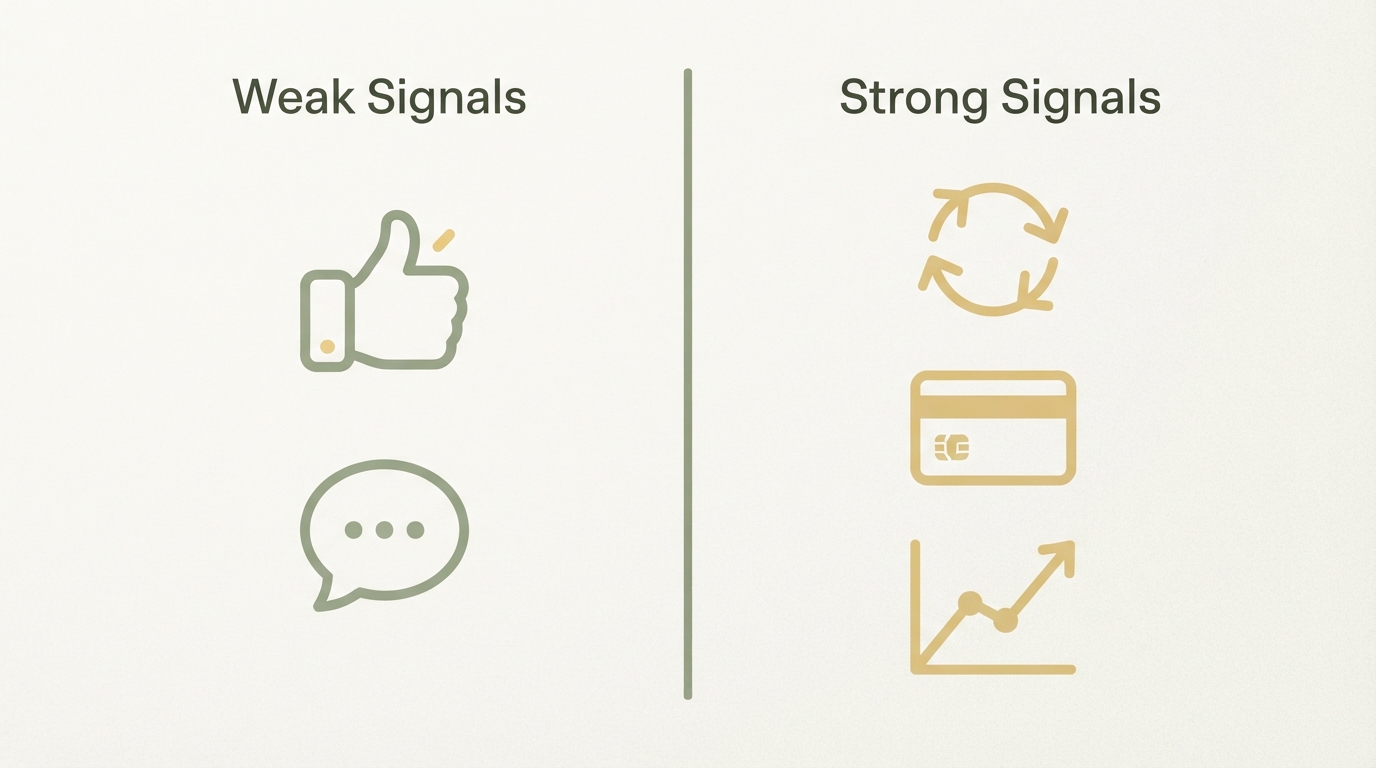
- Retention: Do users still come back at week 1, 4, and 12? A curve that eventually flattens instead of trending toward zero is one of the strongest signals there is.
- The Sean Ellis test: Ask active users "How disappointed would you be if you could no longer use this product?" If the share answering "very disappointed" is above roughly 40 percent, that's often treated in practice as a rough indicator of PMF. Important: this is a practical rule of thumb, not a law of nature — the 40 percent is a rough guideline, not a guarantee.
- Organic growth: Are new users showing up through referrals, without you running ads for it?
- Willingness to pay: Are people actually paying money before the product is even finished? As with the fake-door approach, in the end it's the credit card that counts, not the compliment.
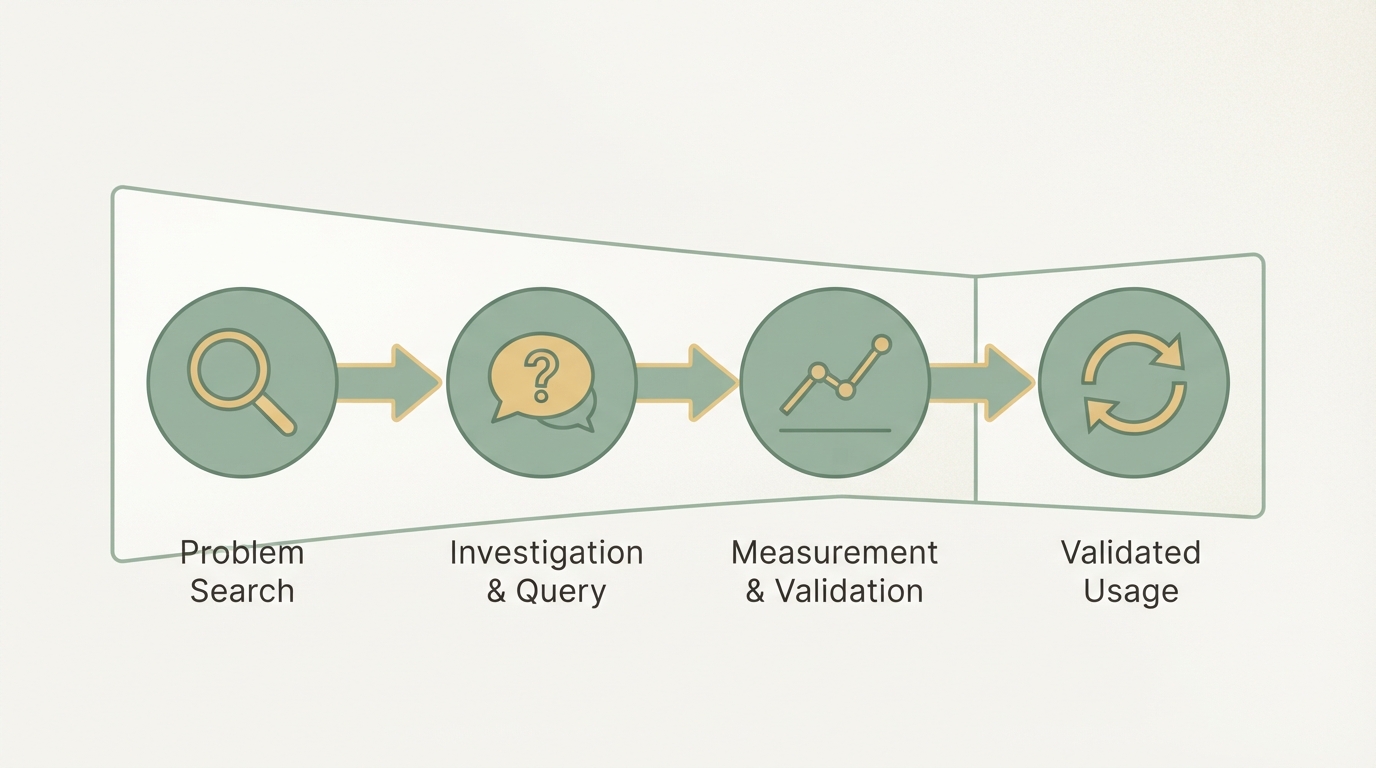
The disappointment test in practice
The Sean Ellis test only works with real active users, not friends or family. That's the core idea behind the Mom Test: people who like you will almost always tell you your idea is good. That's nice, but worthless for your decision-making. You need people who've actually used your product, ideally more than once, and who have nothing to lose by honestly saying "eh, it's okay."
Don't ask "Do you think my idea is good?" Ask "How would you feel if you couldn't use this anymore starting tomorrow?" The difference between these two questions is, at its core, the difference between opinion and a real PMF signal.
Finding PMF: 6 steps instead of gut feeling
Finding PMF isn't a single moment — it's a process with clear stages. Here's how to approach it in a structured way.
Step 1: Define a single, sharp problem
Before you can even think about product market fit, you need a problem narrow enough to actually solve. "Help small business owners with marketing" is too broad. "Help freelance photographers create client contracts in under 5 minutes" is specific enough to test. The narrower the problem, the clearer the signal later on. If you're still looking for your niche, the guide to finding a profitable niche offers a structured approach instead of gut feeling.
Step 2: Talk to real potential customers, not people you know
Have ten to twenty conversations with people who actually have this problem. Ask about their last concrete attempt to solve it, not their opinion of your idea. The best questions target the past ("What did you do the last time this happened?"), not the future ("Would you use this?"). Future-facing questions almost always get optimistic, dishonest answers. You'll find a structured guide to this in How to run customer interviews, step by step.
Step 3: Validate before you write code, not after
Build a simple landing page describing your solution and measure how many visitors leave their email. A conversion rate above roughly 10 percent is often treated in practice as a solid signal that real interest exists. Even stronger: in week three or four, offer a discounted beta and see if people actually pay. Someone who hands over money means it. Someone who just fills out a form may have only invested two seconds of curiosity. With Starte.ai's Trend Finder, you can check in advance how realistically large the demand for an idea is estimated to be, before writing a single line of code.
Step 4: Build the smallest version that actually solves the problem
Only now does the building start — and as lean as possible. Paul Graham's principle "Do Things That Don't Scale" fits well here: in the beginning, do things by hand that you'll automate later — personal support, manual onboarding, direct messages to every new user. It doesn't scale, but it shows you in real time what works and what doesn't. If you need a ready-made structure for MVP scope and tech stack, that's exactly what our Blueprint tool does: it turns an idea into a clear feature scope plus ready-to-use prompts for your coding tool.
Step 5: Measure retention, not just sign-ups
Sign-ups tell you almost nothing. Returning users tell you everything. Track your weekly and monthly retention in a simple table and watch the curve over eight to twelve weeks. If it flattens out, you likely have a core of users who genuinely need your product. If it keeps declining, something fundamental is still missing — usually not a feature, but the fit between problem and solution itself. For an overview of which numbers actually matter here, see SaaS metrics: the 5 numbers almost nobody reads correctly.
Step 6: Read the 1- and 2-star reviews of your competitors
Before polishing your own features, look at what users are complaining about with existing solutions in your space. Those bad reviews are essentially a free product roadmap. Every complaint points to a gap you can close. Combined with your own customer conversations, this often paints a very clear picture of what's still missing. Competitive analysis, step by step walks through a structured approach to this.
Product market fit: real-world examples
Product market fit often shows up first in narrow, specific niches before a product broadens out. Diode, for example, a tool for designing and manufacturing circuit boards from code, focused on a very technical, clearly defined audience — hardware developers with a very specific workflow problem.
Similarly with Snaptrade: an API that connects fintech apps to brokerage accounts. Not a huge mass market, but a very specific technical problem for a clearly defined audience of developers.
What both have in common, based on our estimates: a narrow problem, a clear target audience, high repeat usage. That's essentially the "boring is sexy" logic at work — boring, concrete problems in niches like fintech infrastructure or hardware tools often drive more reliable usage than the next generic AI photo tool.
PMF vs. early traction: the mix-up that costs the most
Early traction and real product market fit often feel similar, but they're two different things. This table shows the difference:
| Trait | Early traction (no PMF) | Real PMF |
|---|---|---|
| Growth | Comes from ads or your own push | Also comes organically, without constant pressure |
| Retention | Drops sharply after a few weeks | Flattens out and stays stable |
| User feedback | "Cool idea," little actual usage | Specific complaints about missing details |
| Disappointment test | Below roughly 40% "very disappointed" | Above roughly 40% "very disappointed" |
| Willingness to pay | Hesitant, lots of discount requests | People pay even without a big discount |
These numbers are rough, practice-based guidelines, not a fixed formula that applies to every product.
What to do when PMF is still missing
If PMF is missing, that's not a reason to scrap everything — it's a signal to look closer. The most common trap: founders build more features even though the real problem lies elsewhere — usually with the target audience or positioning, not with missing functionality. So before you keep building, it's worth taking an honest look at your onboarding: do new users actually understand, in the first few minutes, what your product does for them? That's often exactly where the gap is, not in the feature set. More on this in Improving SaaS onboarding.
Sometimes it's about how you're framing things, not the product itself. How you communicate your offer can matter just as much as the product behind it. Sales psychology for founders is a good fit here.
And sometimes, honestly, the idea just isn't the right one yet. That's a legitimate outcome of a PMF test too, not a failure.
Where to go from here
If you're still in the process of testing for PMF, the most useful next step is usually not adding more features — it's narrowing your focus. Pick the one user segment where engagement already looks strongest, talk to those people directly, and understand exactly what job the product is doing for them. That clarity often unlocks the positioning shift that makes everything else easier.
Figuring out the right channel to reach that segment — and translating your PMF signals into a growth strategy — is the step where many founders lose momentum. This is exactly where a structured outside perspective can accelerate things. Starte.ai has helped build 350+ projects and generate over 125,000 leads by combining data from real campaigns with hands-on strategy work. The first strategy call is free, and you can start exploring without any upfront commitment.
Once you have a clearer picture of who your product truly works for, revisit your onboarding with that specific person in mind. Small changes in how you communicate the core value in the first few minutes often move retention numbers more than months of additional development.
Frequently asked
How do I know if I have product market fit?
You have PMF when users would be disappointed to no longer be able to use your product, and when they come back on their own without you reminding them. Measure this through retention, unprompted referrals, and willingness to pay. Opinions from friends or acquaintances don't count here — only real user behavior does.
What is the Sean Ellis test?
In the Sean Ellis test, you ask active users how disappointed they'd be if they could no longer use your product. If the share answering 'very disappointed' is above roughly 40 percent, that's often treated in practice as a rough indicator of PMF. It's important to only do this with real active users, not family or friends.
How do I find product market fit in a few steps?
First define a single, sharp problem, then talk to real potential customers about their past experiences rather than your idea, and validate through a landing page or paid beta access before you start coding. After that, build the smallest version that actually solves the problem, consistently measure retention, and also look at your competitors' 1- and 2-star reviews.
Why isn't positive feedback enough proof of product market fit?
Because people who like you will almost always say your idea is good, no matter what they really think. That's the core idea behind the Mom Test: nice words cost nothing, but real behavior like repeat usage or payments does. So don't ask for opinions — measure whether people actually use your product again.
Written by
Bohdan BernatekFounder, Starte.ai
Founder of Starte.ai. Built a business to 125,000+ organic leads and seven-figure revenue — and now works with founders personally, deriving a strategy for their own brand from data across thousands of real projects and producing the creatives for it.