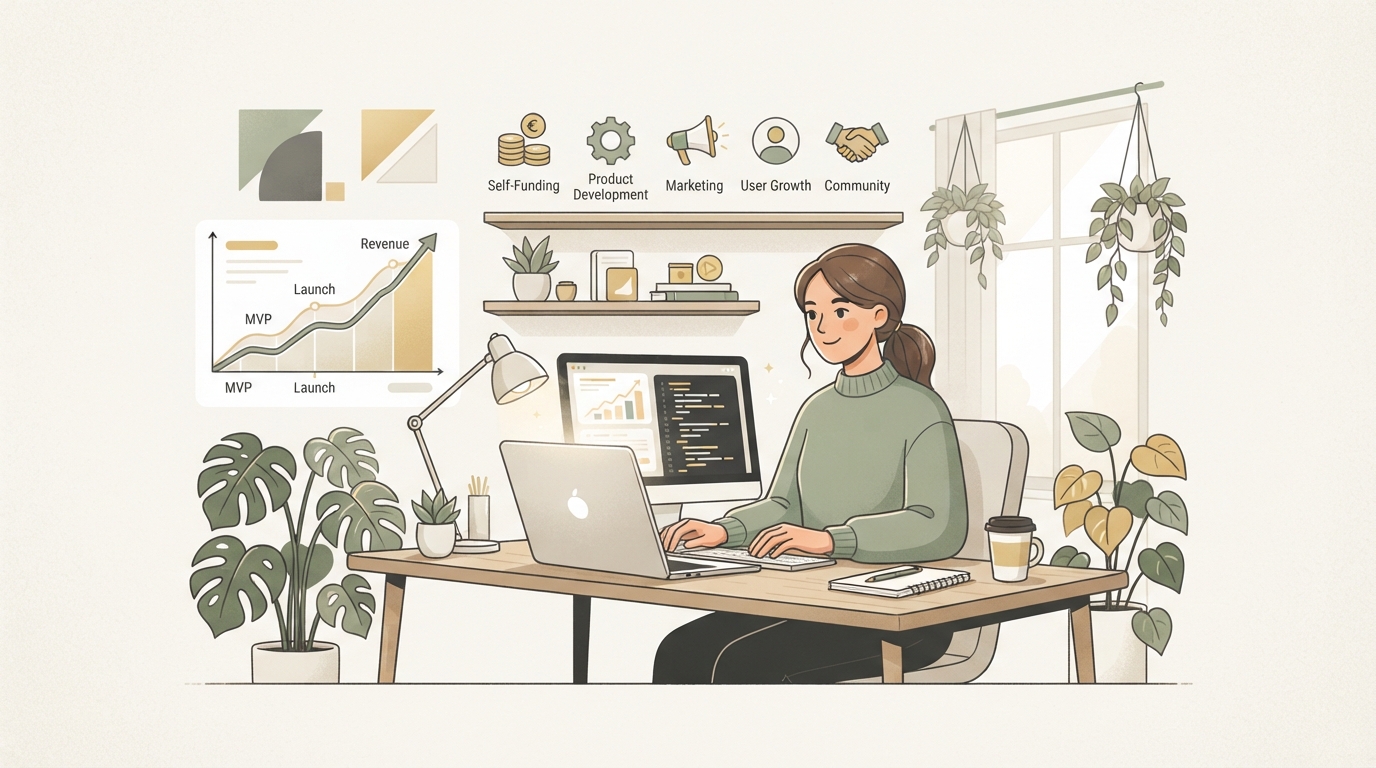
How do you get your first 100 customers without spending a single dollar on advertising?
You pick one channel, go deep on it, and speak to one very specific person instead of "everyone who might need SaaS." Sounds simple. It is — but almost nobody actually does it.
I see the same mistake over and over: founders launch on LinkedIn, Twitter, and three Facebook groups all at once, while running ads on the side. Two weeks later the energy is gone and nothing has really happened anywhere. Ten channels done shallow will never beat one channel done deep. Never.
Why the first 100 customers are different from customer #1,000
Your first 100 customers buy for a different reason than everyone after them: they believe in you as a person, not in your finished product. By customer #1,000, you're winning people over with social proof, reviews, maybe a bit of brand recognition. With customers 1 through 100, none of that exists yet. What matters is whether you genuinely understand what's bothering the person in front of you.
That's exactly why running ads tends to fall flat in this phase. You're paying for reach among people who don't know you and haven't extended your product any trust yet. What tends to work better this early on: customer acquisition for SaaS through direct, personal channels. Cold DMs, forums, comments on posts where your target customer already hangs out.
Paul Graham described this years ago in his essay "Do Things That Don't Scale": you almost always land your first users manually, by hand, one at a time. It doesn't scale. It doesn't need to. Not yet.
Step 1: Define a target person, not a target audience
You need one single, concrete person in mind — not a demographic description. "B2B SaaS founder, 25-45" isn't a target person, it's a spreadsheet row. A real target person looks like this: "Freelance tax advisor, still does her bookkeeping in Excel, has between 15 and 30 clients, loses half a day every month to manual invoicing."
The narrower you define it, the easier she is to find. That sounds counterintuitive, but it's the core of audience focus: a niche that immediately feels spoken to beats a broad mass that feels spoken to by no one. Not sure how narrow to go? It's worth checking out Narrowing Your Target Audience: The Mistake That Costs You Customers — that's exactly what it covers.
Don't ask your friends or family if the idea is good.
They'll say yes because they like you. That's the Mom Test, something many founders know about and ignore anyway. Instead, talk to real potential customers about their problems, not about your solution.
Step 2: Choose a channel where your target person actually lives
The channel isn't a matter of taste — it's a research question: where is your target person already talking about their problem? For B2B tools, that's often LinkedIn or niche forums. For creatives, more likely Instagram or specialized Discord servers. For technical audiences, sometimes Reddit or Hacker News.
We call the rule behind this the 50/50 rule: half your time goes into building, the other half into marketing — but focused on two channels, max. Not five, not three. Two. And you stick with them for 60 days straight before you even start judging whether it's working.
Anyone who gives up after a week never actually gave the channel a real chance to prove itself.
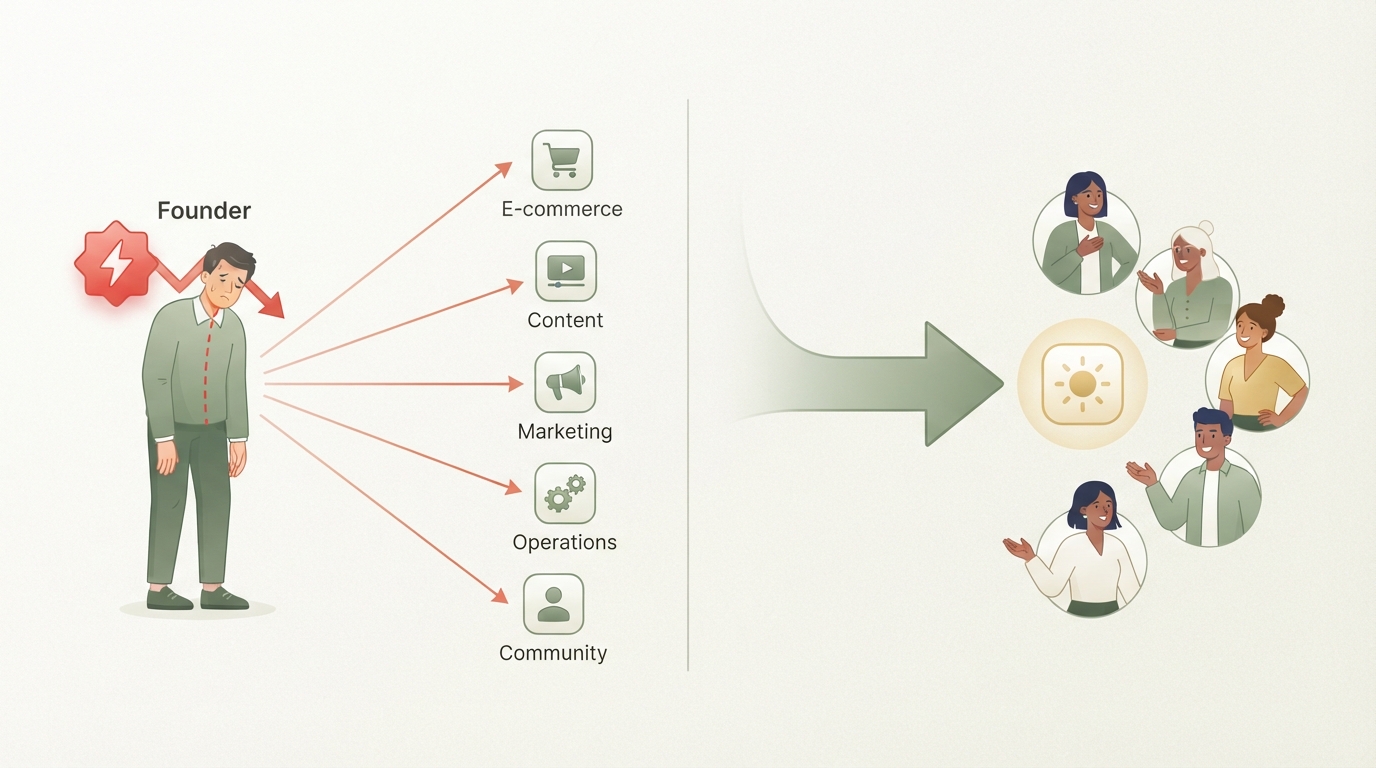
Not sure where your target person is active? That kind of research can be data-driven instead of a gut call. That's exactly why we built the Trend Finder at Starte.ai: it shows you where similar products are already building traffic and revenue, before you invest your own time.
Step 3: Tailor the offer to one person, not to the market
An offer for "everyone" is an offer for no one. Write your offer so that your one target person reads it and thinks, "wait, that's me." Concretely, that means: use her language, name her problem outright, describe her situation before you even mention your solution.
A good trick here is the so-called Problem-Process-Proof structure, which consistently works well in cold outreach: roughly 60% of your message describes the person's problem, 30% covers your path to a solution, and only 10% is proof — say, a short screenshot or link. The moment you start selling in the first line, the message is usually already dead.
People want to feel understood before they buy.
If you're working on your landing page in parallel, make sure that same single offer comes through there too, instead of listing ten features. The article Building a Landing Page: The Mistake Almost Everyone Makes goes into more detail on the most common mistake here.
Step 4: Validate before you build — commitment, not compliments
Don't build anything before someone has given a real commitment. A "cool, I'd use that" is worthless. What's valuable is an email address, a confirmed beta signup, ideally even a small payment. Words cost nothing; actions count.
A pattern that often plays out in practice: in weeks 1 and 2, you build a simple landing page describing your offer and collect at least 20 email addresses. In weeks 2 and 3, you have 10 to 20 conversations with potential customers where you only listen, never sell. In weeks 3 and 4, you offer discounted beta access to see if people are actually willing to pay. A visitor-to-email conversion rate above 10% is often considered a solid signal — though it's no guarantee of success in any individual case.
Don't have a waitlist yet? It's worth checking out Building a Waitlist: The Mistake Almost Every Founder Makes — most founders collect addresses but then never follow up with those people again.
Step 5: Acquire customers by hand before automating anything
You land your first 100 customers by hand, not with a system. Anyone asking how do I get my first 100 customers with no budget for tools or ads almost always ends up at the same answer: personal messages, real replies, time invested in individual conversations. No automation tool replaces a direct human connection at this stage.
Concretely, for winning your first customers, that means: go into the forums, groups, or comment sections where your target person is already talking about their problem. Answer real questions there with genuinely useful answers, with zero promotion. Only at the very end, if at all, do you mention your product as one possible option among several. People are more likely to buy from someone who helped them first than from someone who tried to sell right away.
If your channel is LinkedIn, a structured approach has proven more effective for many people than connecting at random. More on that in LinkedIn Outreach: The Mistake Almost Everyone Makes.
Building traction: what actually matters in the early weeks
Building traction in the early phase mostly means: repetition beats creativity. It's tempting to keep trying new channels or new formats because it feels like progress. But most of the time it's just a distraction from the real work — having conversations and gathering feedback.
A pattern that's worked well for many early-stage founders: cutting several shorter posts out of one longer video or podcast conversation. Instead of inventing new content every week, you spread one recording out over several weeks. One day of recording can turn into several weeks of distribution.
Consistency on a few channels beats presence on many.
Examples: how different products found their first customers
Sometimes it helps to look at how other products grew, even if the paths rarely transfer one-to-one. Diode, an AI platform for PCB design, currently has an estimated MRR of around $5 million with an estimated 142,000 monthly visits, and a rising trend. That's obviously a whole different league from 100 customers, but it shows: even technical niche products can grow when they serve a very clearly defined audience.
A second example is SnapTrade, an API that connects fintech apps to brokerage accounts. Estimated MRR is around $4.5 million, also with roughly 142,000 monthly visits. Both products serve a clearly defined, fairly unglamorous niche — not a consumer app chasing a broad mass market.
That fits a pattern you see across many successful SaaS products: boring but lucrative niches like fintech, compliance, or technical infrastructure often outperform the flashier ideas.
Comparing channels: where the first 100 customers usually come from
| Channel | Effort per customer | Good fit for | Common pitfalls |
|---|---|---|---|
| Cold DM / Outreach | High, but targeted | B2B, clearly defined target person | Too salesy in the first message |
| Forums & communities | Medium, needs patience | Niche products with an engaged community | Promoting instead of genuinely helping |
| Content marketing | High at first, then scales | Topics with search volume | Written too broadly, no clear target person |
| LinkedIn outreach | Medium | B2B SaaS, service providers | Mass outreach with no personalization |
| Product Hunt launch | Low, but one-off | Consumer or niche tools with good timing | No plan for afterward, traffic fizzles out |
If you choose content as your channel, it's worth checking out Content Marketing for SaaS: The Mistake Almost Everyone Makes, which explains the "written too broadly" point in more detail. If SEO is going to be your channel, SEO for SaaS: The Mistake Almost Every Founder Makes is a good next step.
What comes next: going from 100 to more without losing focus
Once you have your first 100 customers, the game shifts a bit. Now it also matters how many of them stick around. A product that keeps winning new customers but loses just as many isn't really making progress. So it's worth also looking at Reducing Churn once the first payments start coming in.
You should also revisit your pricing at this point. Many founders price too low at the start, out of fear they won't convince anyone otherwise. Patrick McKenzie has often pointed this out in his writing on pricing: price is rarely what actually scares customers off — an unclear offer usually is. More on that in SaaS Pricing: The Mistake Almost Everyone Makes.
Should your MVP's feature set match your target person from day one instead of the other way around — yes, almost always. It's much easier to expand a focused product than to trim an overbuilt one. Founders who start narrow and add features in response to real feedback nearly always move faster than those who try to design for everyone upfront.
This is also the step where a lot of founders stall — not because they lack ideas, but because translating a clear target person into the right channel, message, and creative takes a specific kind of pattern recognition that's hard to develop in isolation. Starte.ai was built around exactly that gap: combining data from 350+ real projects with hands-on support from people who've done customer acquisition themselves, so the strategy you get reflects what's actually working in markets like yours — not generic advice. Bohdan works with projects personally, the first strategy call is free, and you can start exploring without any upfront commitment.
Your next moves
- Lock in your target person before you add another feature. Write down one sentence: "This product is for [specific person] who needs to [specific outcome]." If it takes more than one sentence, it's probably still too broad.
- Pick one channel and commit for at least six weeks. The comparison table above is a starting point — choose the row that fits your situation and go deep before you try a second channel.
- Talk to five customers this week. Not a survey, an actual conversation. Ask what almost made them not sign up, and what they wish the product did that it doesn't yet.
- Check your churn number the moment you have more than ten paying customers. Acquiring new users while losing existing ones at the same rate is a treadmill, not growth.
- Revisit your pricing once you have evidence people are willing to pay at all. Most early prices are set too low out of caution, not out of data.
The first 100 customers are hard precisely because you're doing everything without proof yet. Every step after that gets a little more informed — as long as you're actually listening to what those first customers are telling you.
Frequently asked
How do I get my first 100 customers without an ad budget?
You pick a single channel where your target person genuinely spends time, and you go deep on it instead of spreading yourself thin. It's also essential to have one very concrete target person in mind, rather than a vague target audience. You typically land your first customers manually and by hand — through cold DMs, forums, or comments, for example.
Why do ads usually work poorly for landing your first customers?
Because your first 100 customers buy for a different reason than everyone after them: they believe in you as a person, not in social proof or reviews that don't exist yet. Paid reach does little to build trust with people who don't know you yet. Direct, personal channels tend to perform better at this stage.
How do I find my target person for my first customers?
Instead of a demographic description, you need a single, concrete person with a clear problem — for example, a freelance tax advisor who still works in Excel. The narrower you define this, the easier she is to find, and the more directly she'll feel spoken to. Don't ask friends or family — ask real potential customers about their problems.
How do I validate a SaaS idea before building it?
Don't build anything until someone has given a real commitment, like an email address or a beta signup — not just a nice compliment. A proven pattern: spend two weeks collecting emails on a landing page, then have conversations, then offer discounted beta access. A visitor-to-email conversion rate above 10% is often seen as a meaningful signal, though it's no guarantee of success.
Written by
Bohdan BernatekFounder, Starte.ai
Founder of Starte.ai. Built a business to 125,000+ organic leads and seven-figure revenue — and now works with founders personally, deriving a strategy for their own brand from data across thousands of real projects and producing the creatives for it.