TikTok ads play by different rules than Facebook and Instagram. The most common mistake: uploading the same creatives you're running on Meta — that's basically a guaranteed dead ad. TikTok rewards raw, authentic, fast-paced formats; Meta optimizes for polished production. In this guide, I'll show you how running TikTok ads actually works — and where most of the wasted money goes.
Running TikTok Ads: the biggest myth about TikTok advertising
Here's what I keep seeing: founders think TikTok is "YouTube for kids" and treat ads like a copy-paste of Instagram Reels. Wrong.
TikTok has a completely different culture. The algorithm doesn't reward follower counts, verification badges, or production quality — it rewards watch time and completion rates. That's the one real currency on this platform. A phone-shot video of you personally talking through your product's problem can outperform a $50,000 CGI production.
That's also why Spark Ads — native ads distributed under real creator content — often outperform classic TikTok campaigns. Spark Ads don't look like ads. The person scrolling sees content that looks exactly like everything else in their feed, and they watch it to the end.
Step 1: Understand TikTok's hook rule
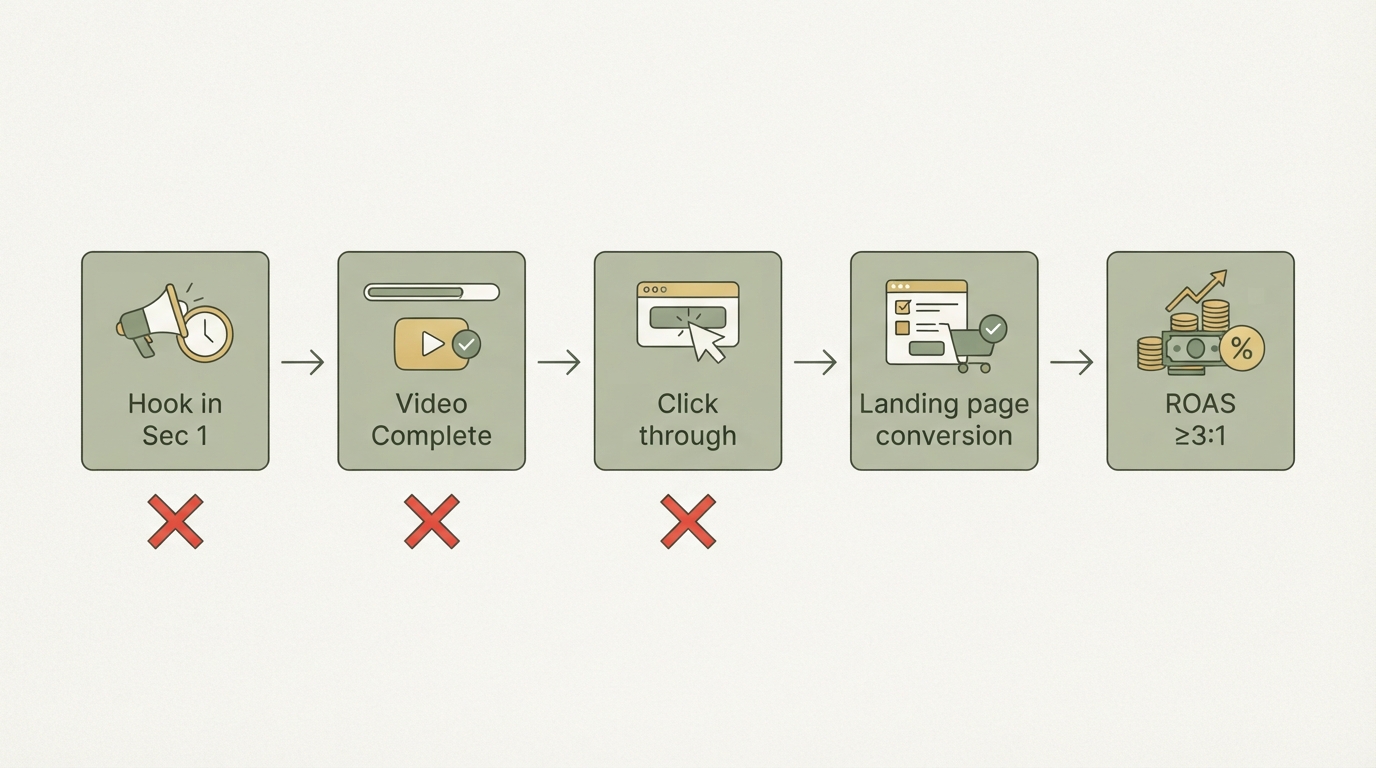
On Meta, you have 3 seconds before someone scrolls past. On TikTok, you have about 1.2 seconds — then the algorithm decides whether this person watches the whole video or skips instantly.
That changes everything.
The first frame, the first second, needs to give people a reason to stay. "Check out our new product" doesn't work. "Wait till you see the end" does. A visual or emotional jolt, a question left unanswered, a scene that feels incomplete — that's your hook.
Good TikTok hooks usually look like:
- Text overlay with a claim or question — not "click now," but "I thought the same thing — until I saw this"
- A cut or visual switch — right as it loads
- Real dialogue or a sound moment that's already established (not a silent intro)
- A paradox or contrast — before/after, expectation/reality
Test hook variations. Three videos with different opening frames, same message underneath. TikTok's Ads Manager will quickly show you which hook has the best completion rate — that's your first A/B metric.
Step 2: Use creator content instead of polish
Maybe the most important lesson: TikTok doesn't like shine. The less polished, the better.
That doesn't mean quality should be bad — it means phone footage, natural lighting, no stock background music everyone recognizes, no glossy influencer smile. Real people, real problems, real solutions.
If you're selling a product, don't talk about it — solve a problem the viewer actually has right now. And do it in a way that feels like they're watching someone live their life, not being sold to.
Example: a project management SaaS tool. Instead of "Our tool makes your team more productive," try: "Just updated my checklist in two seconds while I was still on the phone with the client. Used to be 20 minutes of admin. Now: done. That's wild."
That's native TikTok advertising. That's what works.
Some founders team up with real creators here — not influencers, but people with 5,000–50,000 followers who have genuinely engaged niche communities. You pay them for one or two custom videos made in their own style. These videos often convert better than your own, because they're already speaking the platform's language of authenticity.
Step 3: Campaign structure for TikTok
TikTok ads only work if you understand that every test is a learning loop. Meta veterans are often caught off guard by the difference.
Setting up your first campaign looks like this:
- Pick an objective: For beginners, always "Conversions" or "Traffic." "Reach" is a waste of money.
- Keep audience minimal: Not "women, 25–45, Germany, tech interest." Too narrow gets expensive. TikTok's algorithm is basically your audience manager — trust it. Use geographic targeting (Germany, Austria, Switzerland) and age brackets, and otherwise let go.
- Budget and duration: Starting at €100–200/day is realistic. Let it run at least 7–14 days before drawing conclusions. TikTok needs more time to learn than Meta does.
- Bidding: Automatic bidding is often better than manual here. TikTok's ML is good enough to find real savings for you.
Step 4: Creative formats that work on TikTok
Spark Ads — the underrated weapon.
Spark Ads run under real creator content. They don't look like ads. That's the secret. Your video gets distributed as an organic post from a real TikTok account — not with an ad label that instantly triggers skepticism. Advertising feels different on TikTok than on Meta; people know ads are coming, but they don't want to be stared down by the fact that it's an ad.
Classic TikTok ads (with the small "Ad" label in the top right) work too, but they typically run 20–30% higher CPM. Spark Ads are cheaper and convert better — because they feel like recommendations, not sales pitches.
Which formats actually work:
- Carousel ads (multiple images, individually scrollable): Good for product showcases, pre-order funnels
- Video ads (15 to 60 seconds): The standard. 15–30 seconds is the sweet spot.
- Spark ads (organic-looking ads): Best conversion rate, lowest skepticism
- Instant Pages (TikTok's own landing pages): Faster checkout, less drop-off than external links
Avoid on TikTok: text overload, music tracks everyone already knows (or licensed tracks that kill the phone-footage feel), jump cuts with no purpose, intros that drag on.
Step 5: Targeting and audience strategy
TikTok's audience model is different from Meta's. Meta gives you hundreds of interests and demographics; TikTok says: "Tell us your budget and roughly who to target — the algorithm handles the rest."
That's liberating once you understand it. It's also frustrating if you think you need micro-targeting.
Practical targeting for beginners:
- Country/region: Start with DACH (Germany, Austria, Switzerland) if that's where you sell. No global targeting — it dilutes your message.
- Age range: Product-dependent for B2C. Often 25–55 for B2B (decision-makers).
- Interests (if offered): Only if you know exactly where your people are. Better to go broader and let the algorithm drive.
- Placement: Run on TikTok Feed + Pangle (TikTok's ad network outside the app). No burst, no Spark Ads on the audience network — too unpredictable.
The trick most people miss: build multiple ad sets with different creatives, not different audiences. TikTok rewards creative variety, not audience granularity. Five different video hooks, one audience — that beats one video across five audiences.
Step 6: Proper tracking and KPIs
This is where a lot of beginners stumble, because TikTok reads differently than Meta.
Meta shows you: CPC, CTR, ROAS in real time.
TikTok shows you: cost per completed video view, conversion rate, purchase ROAS — but with a delay. TikTok's conversion tracking is less reliable than Meta's (Safari privacy, iOS updates); you'll see underreporting, especially in the first few weeks.
That means: don't blindly trust the first 3–5 days of data. Run the campaign at least 7–10 days, collect 50+ conversions, before deciding whether to scale or pause it.
KPIs that actually matter:
| Metric | Target Benchmark | Action if Off-Target |
|---|---|---|
| Video Completion Rate (VCR) | 50%+ | Weak hook; shorten the video or test a new hook |
| Cost Per View (CPV) | €0.02–0.05 | Too high = audience too broad or creative too generic |
| Cost Per Click (CPC) | €0.10–0.30 | Too high = unclear CTA; use "Shop Now" instead of "Learn More" |
| Conversion Rate | 1–3% (product-dependent) | Too low = landing page problem, not an ads problem |
| Return on Ad Spend (ROAS) | 3:1+ | €3 revenue per €1 ad spend is the breakeven line for scaling |
Step 7: Common mistakes and how to avoid them
Mistake 1: Uploading Meta creatives to TikTok and hoping for the best.
This never works. Meta ads are vertical, often text-heavy, with branded logos. TikTok ads are full-screen, dynamic, light on text. Reshoot, use phone footage, think in hook-seconds.
Mistake 2: Scaling too fast.
You see good CPR on day two, so you bump the budget from €100 to €500 — and performance instantly tanks. TikTok's algorithm needs time. Increase budget by 20–25% daily, not 300% in one jump.
Mistake 3: Ignoring creator content.
You think, "I can do this better myself." Not always true. A Spark Ad with a real TikToker who genuinely loves your product is often 5x cheaper and more effective than your own "product video." Pay €500–1,500 for 2–3 custom videos from real creators; it's your best ROI investment.
Mistake 4: Picking the wrong objective.
"Reach" sounds smart but wastes money. Always choose "Conversions" (if you have a pixel set up) or "Traffic." Everything else is vanity metrics.
Mistake 5: Squinting the audience down too small.
You think you've found a hyper-specific audience — and your CPM shoots up to €2+. That's too expensive. Give the algorithm room. Broad audience, great creative — that beats narrow audience with okay creative, every time.
Comparison: TikTok Ads vs. Meta Ads
You might be wondering: should I switch to TikTok entirely, or run both in parallel?
Parallel is realistic. Here are the key differences:
| Aspect | TikTok Ads | Meta Ads (Facebook/Instagram) |
|---|---|---|
| Hook timing | 1–1.5 seconds | 3 seconds |
| Audience targeting | Broad + algorithmic | Granular + manual |
| Creative style | Raw, authentic, fast | Polished, on-brand |
| Format strengths | Spark Ads (organic) | Carousel, Collections |
| Learning curve | 7–14 days | 3–5 days |
| Typical CPM | €0.50–2.00 | €1.00–3.00 |
| Best for | Brand awareness, viral, DTC | Conversion-optimized sales funnels |
In practice: start on TikTok if your product is self-explanatory and benefits from motion (app, SaaS, digital tool). Go with Meta if you need to communicate technical specs (B2B, detailed descriptions) or your audience skews older.
How to validate your first tests for free
Before you spend €100+, you can get feedback for free.
Post 2–3 organic videos on your own TikTok account (not through an ads platform). Use sounds and trends that are currently going viral. See which hook works with real people — without spending a cent. The video with the highest view rate and completion rate is your ad winner.
Then you replicate it as a paid campaign. That saves you €300–500 in bad tests.
Spark Ads vs. classic TikTok ads — which one, when?
You need a clear decision point.
Spark Ads (organic-looking, under creator content):
- Best completion rate
- Lower CPM (often 30–40% cheaper)
- Great for awareness and branding
- Fewer instant conversions (because the context is "content," not "ad")
Classic TikTok ads (with the ad label):
- Higher CTR (because people know it's an ad)
- Better for direct conversions
- More expensive CPM
- Good for time-limited offers
Beginners should start with Spark Ads — the learning curve is gentler, and ROI turns positive faster.
The role of Ads Manager and events
TikTok Ads Manager is... quirky. Not as polished as Meta's Ads Manager.
That means: use the SDK (pixel tracking). Install the TikTok Pixel on your website, configure conversion events (ViewContent, AddToCart, Purchase). Without the pixel, your conversion tracking won't work.
Also important: TikTok needs 50+ conversions before the algorithm really starts optimizing well. That's noticeably more than Meta. Be patient.
The one thing almost nobody does
Here's a real advantage that almost every founder ignores: competitor ad analysis on TikTok.
You know who your competitors are? Search for them on TikTok, open their account, scroll through their videos. TikTok's own algorithm automatically surfaces their best content — and that's often the exact videos they're running as ads.
You get to see their hook, their style, their message — for free. That's live market research. Use it to do things differently, not to copy.
That's exactly why analyzing competitor ads is so valuable: you learn faster what works. TikTok is just more transparent about it than Meta — the best content is visible right there, not hidden behind an algorithm.
When TikTok ads make sense for you
Not every product belongs on TikTok.
Good fit for TikTok ads:
- Consumer apps and tools (high motion, visual understanding matters)
- SaaS with a younger audience (project management, design, creator tools)
- Dropshipping and DTC products (fast-moving, viral niches)
- Gaming and entertainment
- Personal development and coaching
Probably not a fit for TikTok:
- B2B solutions for the 60+ crowd (that's LinkedIn territory)
- Financial products (regulatory complexity)
- Insurance and long-term contracts
- High-priced solutions with long sales cycles
If your product is on TikTok because the trend is there, not because your users are — walk away. That's just burning money.
Scaling strategy after week one
You've launched a campaign with a positive ROAS (3:1+). Now what?
Don't double the budget right away. Too aggressive.
Instead: push the successful campaign up to a higher campaign tier. Create new ad sets with different creatives, same audience. Test different placements (TikTok Feed vs. Pangle). After 10–14 days of stable data, you can scale 20–30% daily.
This kind of caution is what separates profitable campaigns from burned-out budgets.
2–3 weeks on average, depending on your budget and product. With €100–150/day, you can see first conversions in week 2; you'll need until week 3 for reliable data. Meta is faster; TikTok's algorithm just needs more time to learn.
No, not directly. Use the TikTok Pixel (separate). You can convert across both platforms in parallel and track the data in Google Analytics or Shopify — but not directly cross-platform.
Cheaper, typically 30–40% lower CPM than classic ads. In exchange, you need a creator or an account to run the ad under. That costs time, but not extra budget.
Start with €100–200/day. That's large enough to generate valid data in 7–10 days (50+ conversions), small enough to experiment without tearing a big hole in your cash flow.
If you're at exactly this point — good creative, right targeting, but not sure whether or how to scale — that's usually the moment I sit down with founders for a strategy call. TikTok ads aren't complicated, but they demand a different mindset than Meta. Our first session costs you nothing and shows you whether TikTok is the right channel for your product, or whether your budget is safer elsewhere.
The next step: start. Don't plan, don't perfect — one video, €100 budget, run it for 7 days, read the data. Then decide.
Frequently asked
How long does it take for TikTok ads to become profitable?
2–3 weeks on average, depending on your budget and product. With €100–150/day, you can see first conversions in week 2; you'll need until week 3 for reliable data. Meta is faster; TikTok's algorithm just needs more time to learn.
Can I use the Facebook Pixel with TikTok?
No, not directly. Use the TikTok Pixel (separate). You can convert across both platforms in parallel and track the data in Google Analytics or Shopify — but not directly cross-platform.
Are Spark Ads more expensive or cheaper?
Cheaper, typically 30–40% lower CPM than classic ads. In exchange, you need a creator or an account to run the ad under. That costs time, but not extra budget.
Should I start with €50/day or €500/day?
Start with €100–200/day. That's large enough to generate valid data in 7–10 days (50+ conversions), small enough to experiment without tearing a big hole in your cash flow.
Written by
Bohdan BernatekFounder, Starte.ai
Founder of Starte.ai. Built a business to 125,000+ organic leads and seven-figure revenue — and now works with founders personally, deriving a strategy for their own brand from data across thousands of real projects and producing the creatives for it.