Why the first three seconds of a video decide everything
If you don't stop people in the first three seconds, you lose them. Writing a good video hook isn't about being loud or sensational — it's about forcing your viewer's brain into an open question it can't ignore. And that's a skill you can learn.
Here's a pattern I see over and over: great product, solid video, zero attention — because the opening was too tame. The algorithm shows your video. Your hook decides whether someone stays or swipes.
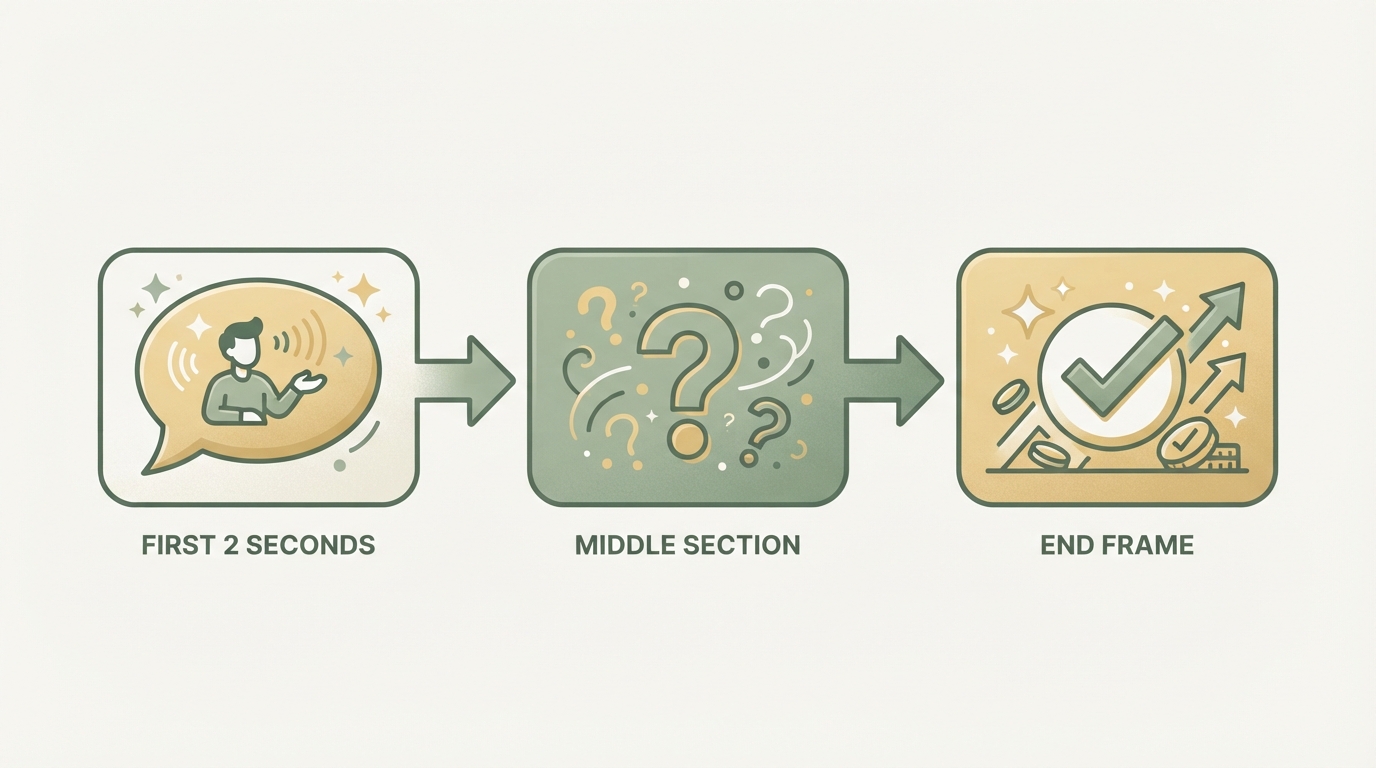
Why the first seconds decide everything
The first three seconds of a video statistically determine whether someone keeps watching or scrolls on. On TikTok, Instagram Reels, and YouTube Shorts, the average drop-off rate in the first two seconds is over 60% — that's not an edge case, that's the norm.
That's how attention works. Our brains are constantly filtering: "Relevant or not?" If the video doesn't answer that question immediately, the brain defaults to "not relevant" — reflexively, without a second thought.
The most common mistake: people open with an intro. "Hi, I'm Max, today I want to talk about…" — gone. By the time Max finishes that sentence, 70% of viewers are already on the next video.
Instead, you start right in the middle of the action. No warm-up. No greeting. You drop the viewer straight into a situation, a statement, a question — and they have to stay to get the answer.
The 3 elements every strong hook has
A video hook works when it does three things at once: creates emotion, opens a curiosity gap, and makes the stakes visible.
1. Emotion
Emotion doesn't need to be dramatic. But it does need to be there. Surprise, mild indignation, curiosity, a smirk — anything that briefly wakes the body up. "I've been making videos for 5 years, and this one mistake cost me thousands of views" creates surprise and empathy at the same time.
2. Curiosity gap
The term comes from researcher George Loewenstein: a knowledge gap that feels uncomfortable until it's filled. Good hooks actively create this gap. "Most people get this exactly wrong" — the brain immediately asks: "Wait, what? Me too?" You can't stop watching.
3. Stakes
What's on the line? Why should someone spend the next 60 seconds here instead of somewhere else? The stakes need to be tangible: "This is how I landed my first paying customer in 30 days" shows stakes. "Today I'm talking about marketing" shows none.
6 hook patterns you can use right away
These aren't fill-in-the-blank templates. They're structures — you fill them with your own specific content.
Pattern 1: The provocative counter-argument
You say the opposite of what most people think. This immediately creates cognitive dissonance.
"More followers won't get you customers. Here's what actually works."
The viewer thinks: "Wait, what do you mean?" — curiosity gap opened.
Pattern 2: Start in the middle of the action (In Medias Res)
You start in the middle of a story or process. The viewer has to rewind mentally — but they can't, so they stay.
"That was the moment I closed my laptop and wanted to quit everything." — only afterward do you explain what happened before.
Pattern 3: The specific number
Numbers create credibility and curiosity at the same time. Specific numbers hit harder than round ones — "11 customers" sounds more real than "a dozen."
"This one sentence eliminated 3 out of 5 objections I got last week."
Pattern 4: Direct address + problem
You name exactly who you're talking to — and what their problem is. People who feel called out, listen.
"If you're building a SaaS and still don't have a single paying user after three months, this is for you."
Pattern 5: The rhetorical question with urgency
Questions automatically open curiosity gaps. But careful: generic questions ("Want more success?") don't work anymore. The question needs to be specific.
"Do you actually know why your last video stopped growing after 48 hours?"
Pattern 6: The paradox or contradiction
Two things that don't fit together — the brain wants to resolve that.
"I stopped posting every day — and my reach went up because of it."
Writing a video hook: how to avoid the blank-page trap
The hardest part isn't the structure — it's finding the right content for your hook. Here's what helps me:
First, I write the ending of the video. What's the one takeaway the viewer should walk away with? Then I ask: "What would make someone curious enough about this takeaway that they absolutely have to keep watching?"
That's writing backward — and it works.
Another method: look at the 1- and 2-star reviews of videos or courses in your niche. What actually annoys people? What do they not understand? That's your hook material, right there. Someone complains, "I watched 10 videos and nobody explains what this actually looks like in practice" — then your hook is: "Finally, something concrete: I'll show you exactly what this looks like in practice, step by step."
One more thing that rarely gets talked about: test your hook ideas as text before you shoot anything. Write them as the first line of a LinkedIn or Instagram post. If the text doesn't get comments or reactions, the video probably won't either.
My own experience: good hooks aren't born on set — they're born while writing. It took me a while to really internalize that.
Understandable without sound: the silent hook
Over 80% of videos on social media are watched without sound — especially on Facebook, Instagram, and LinkedIn. That's not a minor detail, it's a requirement: your hook has to work without audio.
Concretely, that means:
- Captions from the first second, not starting at second five
- Your strongest statement shown as visual text in the frame
- Gestures and facial expressions that spark curiosity even on mute
- No pure voice-over hook without visual backup
If someone watches your hook on mute and immediately knows what it's about — it works. If not, you've probably already lost half your potential viewers.
A simple test: mute the video and show it to a friend. Can they tell you after three seconds what the video is promising? If not, back to the text editor.
Winning attention: what emotion and pattern interrupt do
Every video isn't just competing with other videos — it's competing with everything: news, cat memes, personal messages. You're interrupting a scroll flow. The technical term for this is "pattern interrupt" — you create something unexpected that breaks the rhythm.
Concretely, you can achieve this in several ways:
Visually: an unusual angle, a cut in the first second, a striking background change.
Audibly: an unexpected first statement, a loud sound, silence right after a short statement (where most people expect music).
Content-wise: a statement that contradicts what the viewer just saw in their feed.
Pieter Levels and other public builders who rely heavily on organic reach work consistently with pattern interrupts — often with zero budget, purely through the timing and phrasing of the first statement. Once you understand how good ad copy works, you'll quickly see that a video hook follows the same principles as a good headline.
Hooks for ads vs. hooks for organic videos
There's an important distinction that often gets overlooked.
| Criterion | Organic hook | Ad hook |
|---|---|---|
| Goal | Keep watching, build trust | Trigger click / action |
| Tone | More personal, narrative | More direct, action-oriented |
| Length | 3–5 second hook window | 1–2 seconds, even tighter |
| Stakes | Community, reach | Conversion, ROI |
| Risk tolerance | High (room to experiment) | More tested, proven formats |
| Storytelling | Strong | Less, more problem-solution |
If you're running ads, you need even harder-hitting hooks — and you should look at what competitors are currently running. We cover how to do that in our article on analyzing competitor ads. For organic content, on the other hand, you have more room to play — and more time to develop your own style.
If you're in the middle of scaling a video campaign, it's also worth checking out our article on scaling ad campaigns — it covers exactly what happens when the hook is great but the rest of the campaign can't keep up.
Testing hooks: how to know which one actually works
A hook is a hypothesis. No hook is perfect on the first try — not even for people who've been doing this for years.
The only real answer comes from data. And it doesn't have to be complicated:
- Make the same video with two different opening scenes (A/B test — doable manually even on TikTok or Reels)
- Compare the "average watch time" for the first three seconds — many platforms show this in analytics
- The hook with higher retention in the first three seconds wins
On the organic side, testing can take a few weeks. With paid campaigns, you get feedback within 48 hours. That's actually one of the underrated advantages of paid: you learn faster what actually works as a hook, and you can bring that knowledge back to your organic videos.
That — testing hooks, learning from data, scaling — is exactly where a lot of founders get stuck. At Starte.ai, we work with data from over 350 projects we've built, and we've seen which hook structures tend to work better than others in certain markets. There's no universal best practice, but there are clear patterns that repeat depending on the niche and channel. Anyone interested can book a free intro call — so you're not starting from zero, but building on real, hands-on experience.
A short personal take
The best hook I ever wrote was the one that felt the most uncomfortable. It was too direct, too confrontational — I was sure it wouldn't work. It worked.
The problem with hooks is: our brain often thinks something is "right" when in reality, that's not what stops people. We're too close to our own topic to feel what actually interests someone on the outside. That's exactly why testing helps so much — not as a technique, but as a dose of humility toward the market.
A video hook is the first statement, scene, or question in a video — usually the first one to three seconds. It decides whether a viewer stays or scrolls away. No matter how good the rest of the video is, without a strong hook most people will never see it.
For short-form videos (Reels, TikTok, Shorts), the hook needs to land within the first two to three seconds. For longer YouTube videos, you have up to eight seconds — but the sooner you hook the viewer, the better. Rule of thumb: one hook, one sentence.
No. Questions are just one of several patterns — a strong statement, a paradox, or an emotional opener can work just as well, or better. What matters is the curiosity gap, not the grammatical form.
The most direct next step: take your last video and write three alternative hooks for the first three seconds, using the patterns above. Then look at your watch-time data. The answer to which pattern works for your niche is already sitting in your own analytics.
Frequently asked
What is a video hook and why does it matter so much?
A video hook is the first statement, scene, or question in a video — usually the first one to three seconds. It decides whether a viewer stays or scrolls away. No matter how good the rest of the video is, without a strong hook most people will never see it.
How long should a hook be?
For short-form videos (Reels, TikTok, Shorts), the hook needs to land within the first two to three seconds. For longer YouTube videos, you have up to eight seconds — but the sooner you hook the viewer, the better. Rule of thumb: one hook, one sentence.
Does a hook always have to be a question?
No. Questions are just one of several patterns — a strong statement, a paradox, or an emotional opener can work just as well, or better. What matters is the curiosity gap, not the grammatical form.
How do I write a video hook when I'm out of inspiration?
Write the ending of your video first. What's the one takeaway? Then ask: "What would make someone curious enough that they absolutely have to keep watching?" Alternatively: read the comments and reviews in your niche. Real questions and frustrations are ready-made hook material.
Written by
Bohdan BernatekFounder, Starte.ai
Founder of Starte.ai. Built a business to 125,000+ organic leads and seven-figure revenue — and now works with founders personally, deriving a strategy for their own brand from data across thousands of real projects and producing the creatives for it.