Most people look for Instagram Reels ideas in trend lists. Wrong move. The best Reels answer questions your customers have already asked you — nobody's just filmed them yet. Once you get that, you don't have to chase every trend anymore.
I see this pattern constantly with people using Starte.ai to build their business: they start with an empty content calendar and the question "What should we post today?" That's the wrong question. The right one is: "What question did a customer ask us last week?"
Why Instagram Reels ideas from trends rarely work
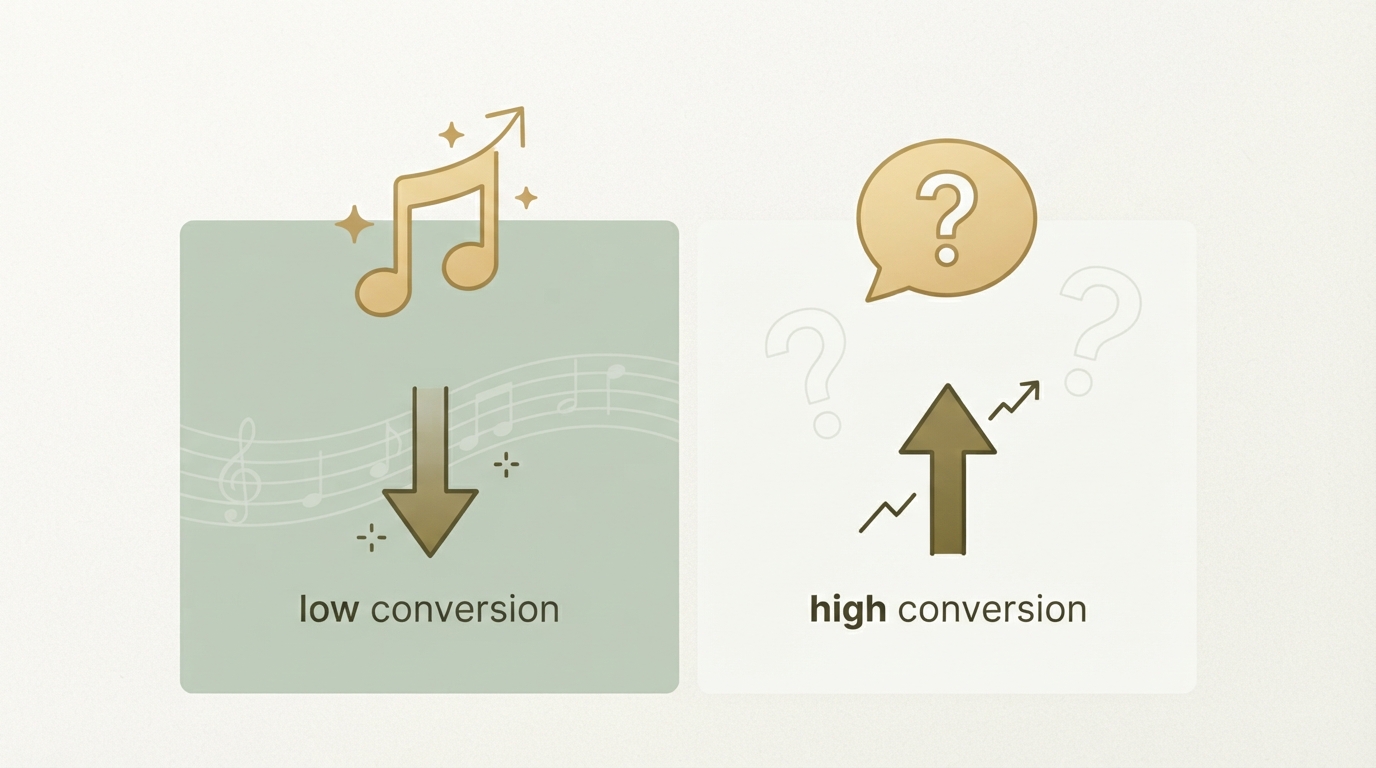
A trend Reel often brings short-term reach, but rarely customers. The reason is simple: someone who lands on your page because of a dance format or a sound doesn't have a problem you solve. They wanted entertainment, not a purchase.
Reels built from real customer questions, on the other hand, attract people who have exactly the problem you solve. That's the difference between attention and demand. Both look similar in your analytics — clicks, views, likes — but only one leads to inquiries in your inbox.
This lines up with a principle in B2B sales called "edgy sales": you mention your offer in passing, as one point within useful content, not as the main act. People buy out of curiosity, not under pressure. The same thing works on Reels — just visually instead of in a sales conversation.
The real raw material: your customers' questions as Reels content
Any question you've heard more than twice via DM, email, or in a sales call is a ready-made Reel concept. All you have to do is film it.
Go about it systematically. For two weeks, collect every recurring question from:
- DMs and comments on Instagram
- Support chats or emails
- First conversations with prospects
- Reviews of competitor products, especially the 1- and 2-star ones
That last one gets overlooked a lot. Bad reviews on market leaders show you exactly what people are frustrated about — and therefore exactly what they'd ask before buying. It's basically a ready-made content calendar someone else already wrote for you.
Once you've collected 15 to 20 questions, group them by topic. Usually you'll end up with 3 to 5 clusters. Those become your content series.
Reels formats that actually work with questions
Not every question fits every format. The format has to match the type of answer, or the Reel ends up feeling forced.
| Format | Fits | Typical length | Why it works |
|---|---|---|---|
| Talking-head Q&A | Direct questions ("How much does...cost?") | 15–30 sec. | Feels personal, high retention with a clear answer |
| Before/after | Result questions ("Does this actually work?") | 20–40 sec. | Visual proof beats any claim |
| Myth-busting | Skepticism questions ("Is it true that...?") | 15–25 sec. | Contradiction sparks curiosity, high share rate |
| Process breakdown | "How exactly does this work?" questions | 30–60 sec. | Shows expertise, works well as a series |
| Behind the scenes | Trust questions ("Who's behind this?") | 20–40 sec. | Builds closeness, lowers purchase hesitation |
A talking-head format works well when the answer is short and clear. For more complex questions, like "What does your process actually look like?", a process breakdown works better because it leaves more room for detail.
Important: don't switch formats arbitrarily. If a format works for one category of question, use it again for similar questions. Recognition builds trust — especially for Reels for businesses that aren't a big brand yet.
Series instead of one-off posts: why it makes the difference
A single Reel brings reach once. A series builds an expectation. That's exactly the lever most people leave on the table.
Imagine posting a Reel every Monday titled "Customer Question of the Week." By the third episode, followers know what's coming — some even start waiting for it. That creates something individual videos almost never achieve: a routine for the viewer.
The algorithm rewards series too. Recurring formats with a similar structure get shown by Instagram to the same viewers more easily, because the pattern (intro, question, answer, call-to-action) stays recognizable. One-off posts with no common thread don't get that recognition effect.
One format that's already working for a lot of businesses in German-speaking markets: the 5-part series. Five questions from one topic cluster, one per week, with the same intro line and the same camera setup. After five weeks, you don't just have five videos — you have five tested answers you can reuse in sales conversations.
If you're still not sure which topic will even resonate with your audience, it's worth checking out Product Market Fit first: Reels ideas that miss the mark on your offer won't get you far, even in the best series.
How to turn Reels ideas into an actual plan
A loose pile of ideas doesn't help unless it fits into a process you'll actually stick to.
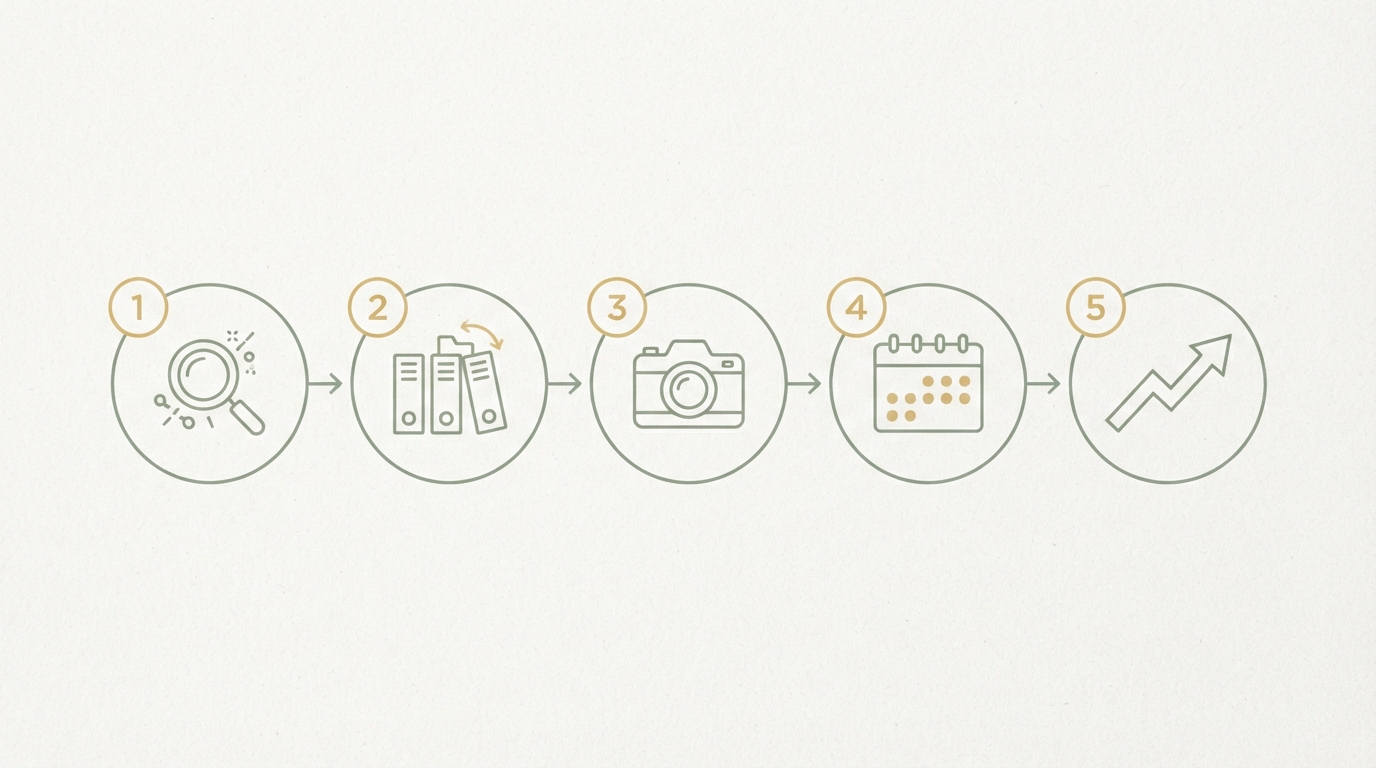
Step 1: Collect and cluster questions
Collect 15 to 20 real questions as described above. Write them down raw, without "polishing" them yet. Your audience's own wording is often better than yours, because it matches exactly the language potential customers google or type in DMs.
Step 2: Assign a format per cluster
Match each topic cluster to a format from the table above. A cluster can get two formats if it's big enough — say, a myth-busting Reel first, then later a process breakdown on the same topic.
Step 3: Write the first-two-seconds hook
The first two seconds decide whether someone keeps watching. Phrase the hook as the question itself, ideally close to word-for-word how a customer asked it. "Is this even worth it for small businesses?" works better than an abstract announcement like "Today we're covering an important topic."
Step 4: Plan a series, not a single video
Before you film anything, decide how many parts the series will have. Three to five parts is a good start. That forces you to think the topic through in advance instead of stopping spontaneously after the first answer.
Step 5: Choose a call-to-action that matches the question
Not every Reel needs to push a sale. For a trust question, "Message me if this sounds familiar" is often enough. For a pricing question, a more direct pointer to your offer can fit. The question itself dictates how hard the call-to-action should be.
What most businesses get wrong with Reels content
The most common mistake is treating Reels like ads, when viewers on Instagram would rather be informed or entertained than advertised to. A Reel that looks like an ad clip usually gets scrolled past fast, no matter how good the product actually is.
The second mistake: too much text overlay. If you cram five sentences of text onto the screen, almost nobody reads it all before the clip moves on. A clear spoken answer to a question almost always works better than a wall of text.
And the third: no clear thread running across multiple Reels. If you talk about pricing today, a company anniversary tomorrow, and a trend sound the day after, you're not building a pattern the algorithm or your viewers can recognize. This is exactly where the series logic from above helps.
If you're also working on the copy for your Reels captions right now, it's worth checking out writing good ad copy — the principles there translate directly to Reel captions.
How to see what's actually working for other people
Systematically figuring out which formats and topics actually get traction in your own market is a step almost nobody does on their own. At Starte.ai, we continuously analyze data from thousands of real projects — channels, topics, revenue estimates — with input from people who've actually pulled it off. That doesn't get you a generic list of formats; it gets you a read on what's most likely to work in your specific market. We've helped build over 125,000 leads this way, mostly through organic reach with no ad budget. An initial strategy call is free, and you can try getting started with no commitment.
Looking at products that have grown in related niches with a clear content strategy often helps more than any theory:
Vector, for example, shows how a B2B tool with an estimated ~99,156 visits a month and an estimated MRR of around $1,160,125 can grow through clear, recognizable topics — even without a huge ad budget behind it. Estimates like these show: consistency with a few formats often beats scattering across many.
Reels ideas for when nothing comes to mind
Even with a system, there's eventually a moment when nothing comes to you on the spot. That's when a fixed fallback plan helps — not waiting around for inspiration.
Go back to your question list from Step 1 and see which cluster hasn't been covered yet. If the list is empty, just ask your team directly: "What question did you hear the most this week?" That takes five minutes and almost always turns up new material.
Another source: old sales conversations or quotes that got turned down. Why didn't the customer buy? Those objections are almost always unspoken questions, and they make great Reels — something like "Why is this more expensive than the competition?"
And if you want to see how your competitors are advertising right now, check out analyzing competitor ads: other people's ads often surface questions you hadn't even thought of.
The fastest way to Reels ideas that actually land isn't more creativity — it's better listening. Collect questions, sort them into clusters, pick a matching format, and plan in series instead of one-off videos. The rest is repetition, and that's exactly what builds trust on Instagram over time.
Frequently asked
How often should I post Instagram Reels for my business?
There's no fixed number that works for every business. Consistency matters more than frequency: better to stick to two Reels a week for two months than post ten in one week and then take three weeks off.
Do I need professional equipment for good Reels content?
No, a smartphone is usually more than enough. What matters more than image quality is whether the answer to the question is clear and easy to understand quickly.
How do I figure out which Reels formats fit my offer?
Test instead of guess. Film three different formats on the same topic and, after two to three weeks, see which one brings the most inquiries or comments.
What do I do if a Reels series isn't working?
Look at whether it was the topic, the format, or the hook. Often it's the hook in the first two seconds, not the actual content, that's the problem. Before you scrap the whole topic, try swapping out just the opening first.
Written by
Bohdan BernatekFounder, Starte.ai
Founder of Starte.ai. Built a business to 125,000+ organic leads and seven-figure revenue — and now works with founders personally, deriving a strategy for their own brand from data across thousands of real projects and producing the creatives for it.