Why do you see "seen," but no reply ever comes?
Most LinkedIn messages get read, but never answered — not because of poor reach, but because they revolve around you instead of the recipient's problem. The moment someone senses they're about to be sold to, they check out in under two seconds. LinkedIn outreach usually doesn't fail because of reach — it fails because of the message's structure.
I got this wrong for a long time, until someone read my own messages back to me, out loud, with no context. That's when I heard for the first time how they actually sounded: like an ad, not a conversation. It was uncomfortable. But that's exactly where the fix begins.
Why LinkedIn messages get read but never answered
The main reason is simple: the message is about you, not about the recipient's problem. The moment someone senses they're being sold to, they tune out. That often happens right at the opening line, the second you start with "I help companies like yours..."
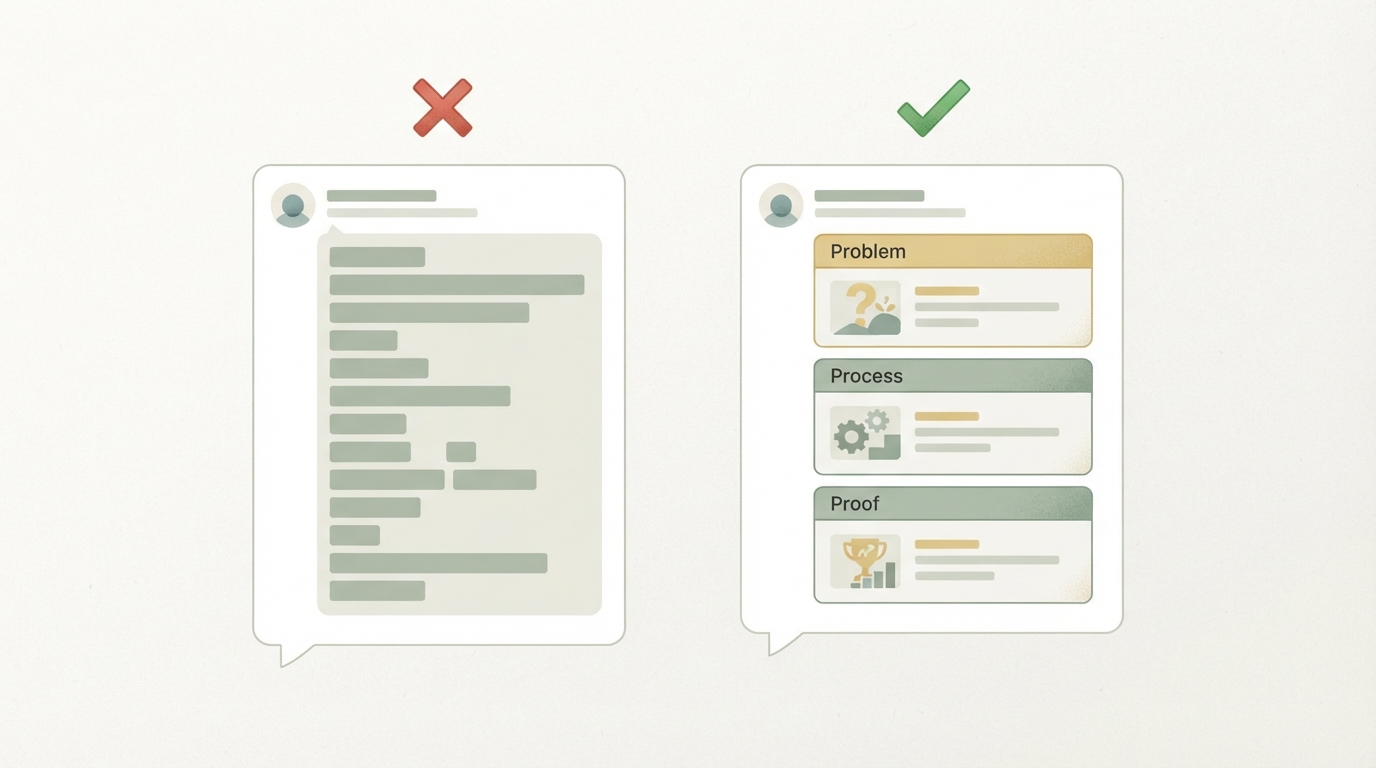
Three patterns show up again and again. But first, the ratio that changed things most for me: 60 percent of the message should describe the person's situation or problem, 30 percent your approach to solving it, and only 10 percent should be proof — like a short case-study link.
- The message is too long. Almost nobody on LinkedIn reads a five-sentence wall of text from a stranger.
- The message is too generic. If your text could just as easily go to 500 other people, they'll notice.
- The message sells too early. The pitch shows up before there's even a shred of trust.
That ratio feels like help to the recipient, not advertising. Sell in the first sentence, and you lose.
Step 1: Get clear on who you're actually talking to
Before you write a single message, you need clarity on who's on the other end. Sounds obvious, but it's exactly where most campaigns fall apart before they even start.
If your target audience is too broad, every message automatically becomes generic, because it has to address too many different problems at once. The narrower your target picture, the more concretely you can name the problem in sentence one, instead of hiding behind generalities. That's exactly where most campaigns collapse, before the first message even goes out.
A good test: can you say in one sentence why this specific person — and not just anyone else on LinkedIn — has the problem you solve? If not, your target audience is still defined too broadly.
Step 2: Build a LinkedIn message template that doesn't sound like a template
A good LinkedIn message template isn't rigid copy-paste text — it's a skeleton with gaps you fill in individually for each person. The difference between a template that works and one that gets ignored almost always comes down to those gaps.
The skeleton follows the same logic as above: start with a short opening line with a genuine connection to the person, then two to three sentences on their problem situation without talking about yourself yet, followed by a brief description of your approach with no jargon, one single proof sentence — a link or a number, not a testimonial novel — and end with a question instead of a booking link.
Important: the template is a scaffold, not a script. Send it word-for-word to 50 people and they'll notice, again. Spend a genuine two minutes per person on just the first two lines — that's the part that decides between a reply and silence.
Step 3: Use peer groups instead of cold-knocking on decision-makers' doors
A trick often overlooked in B2B practice: before messaging your actual target person, you can first interact with mutual contacts. If you give someone connected to your target person honest, genuine positive feedback on their work, a bit of social proof quietly builds in the background. Your name has already surfaced somewhere before your actual message arrives.
Not a trick in the shady sense. That's just how networks work.
People respond more openly to names that already feel somewhat familiar. But don't overdo it: three or four genuine interactions are enough — anything beyond that starts to feel staged.
Step 4: Think in terms of B2B social selling, not one-off messages
B2B social selling means building trust over weeks instead of treating a single message as a sales attempt. The difference sounds small but changes the whole approach: you post regularly about topics your audience cares about, comment genuinely on others' posts, and your direct message becomes just the last step in a chain that's already in motion.
The concept of "mind share" describes exactly this: your goal isn't the one message — it's being the name that comes up when your topic gets mentioned at the lunch table. Reach that point, and you'll have to cold-message far less, because part of your audience starts coming to you.
I only really understood this once I noticed how much longer social selling takes compared to any single message I ever sent. How fast it pays off depends heavily on your niche, content quality, and persistence — there's no guarantee. But one thing that often helps: applying the same analysis you do for your target audience to your own positioning. Because if your positioning is fuzzy, your messages come out fuzzy too, automatically.
Step 5: Verify your offer before you scale
Before sending out hundreds of messages, it's worth adding a middle step: check whether enough people actually have the problem you solve. A simple landing page describing your offer is often enough to see whether people genuinely sign up.
As a rough practical benchmark, a visit-to-email conversion rate of around 10 percent or more is often seen as a decent signal that there's real interest behind it. There's no fixed, universal number — it depends heavily on the offer and the audience.
This kind of upfront check saves you a lot of frustrating messages to the wrong audience later. Test before you build, and you'll message more precisely later on — and your reply rate tends to rise almost automatically along with it.
Step 6: Measure the right numbers, not just "seen"
Most people only look at the reply rate. Three metrics together give a far more honest picture.
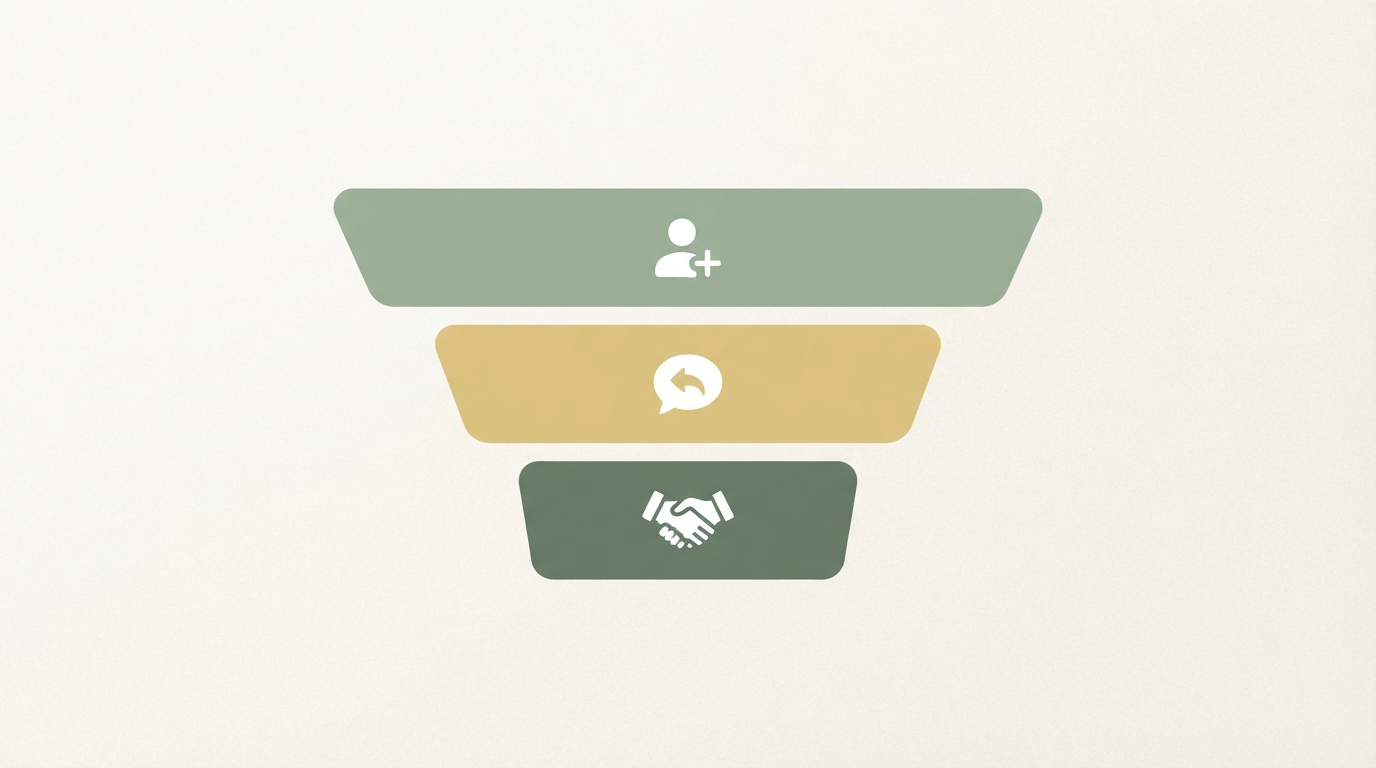
Your connection-request acceptance rate shows whether your profile and note are convincing — in practice it's often somewhere between 20 and 40 percent. The reply rate to your first message shows whether it's perceived as helpful — for a well-structured message, practical experience often puts this around 12 to 15 percent. The conversation rate from the second reply onward shows whether it turns into a real conversation — it's noticeably lower, but it's the most important number of all.
Rough practical benchmarks, not a guarantee. Depending on industry, message, and audience, they can vary widely.
Here's a concrete way to measure it: test two templates on 20 people each, note the reply rate per template after a week, and adjust the weaker version. After three or four such rounds, you'll see which phrasing actually makes a difference — not just whether some number sounds "good enough."
How is LinkedIn outreach different from cold email?
The biggest difference is context: LinkedIn immediately shows the recipient your profile, your connections, and your posts, while an email usually arrives without that social context. That makes LinkedIn outreach more personal, but also more prone to feeling intrusive, since people can literally "see" who's messaging them.
Still, the core structure — problem before pitch, brevity over completeness — works similarly across both channels. Many of the same mistakes show up in cold email too, just in a different costume: too long, too generic, sold too early.
Which tools help with this without it looking like a mass blast?
Some tools specialize exactly in this space, identifying anonymous website visitors to give you context for that first message before you ever go in cold. One example from our research database:
Vector.co shows B2B marketers which companies have recently been browsing their website without filling out a form. According to our data, estimated MRR sits at around $712,000, with an estimated 99,000 monthly visits.
The wedge here is interesting because it goes straight at the core problem of cold outreach: you're no longer reaching out completely cold, but to people who have already engaged with your offer in some way. Not a requirement for getting started with LinkedIn outreach. But it shows how the underlying principle of "context before contact" can be built into a product of its own.
If you're thinking about building a tool like this yourself, rather than just using one: for exactly this kind of idea — solving a niche problem in the sales process — I'd first check on Starte.ai how many similar tools already exist and what their numbers look like, before starting to build.
What if nobody replies even though the structure is right?
If the structure is solid and still nothing comes back, it's often the audience, not the wording. Before you tweak your message for the tenth time, it's worth stepping back: are you really talking to the person who actually has the problem you're describing?
Many people blur the lines between target market, target audience, and persona, and end up writing to the wrong level as a result. If you don't have a clear persona yet, that's exactly where to start before sending more messages.
Sometimes the answer is simpler: your LinkedIn profile itself isn't building trust. If someone clicks through to your profile and finds nothing convincing there, even the best message is wasted. The same logic that applies to building trust on landing pages carries over one-to-one to a LinkedIn profile.
Frequently asked
Why don't people reply on LinkedIn even though they've seen my message?
Usually it's because the message revolves around you instead of the recipient's problem. The moment someone senses they're about to be sold to, they check out — often right at the greeting. Too long, too generic, and selling too early are the three most common patterns.
How do I write a good LinkedIn message template?
A good template isn't rigid copy-paste text — it's a skeleton with gaps you fill in individually. Following the problem-process-proof logic, it consists of an opening line, a problem line, a process line, a proof line, and an open question instead of a call-to-action.
What is the problem-process-proof structure in cold outreach?
With this structure, 60 percent of the message describes the person's situation or problem, 30 percent your approach to solving it, and only 10 percent is proof, such as a short case-study link. This ratio feels like help to the recipient, not advertising.
How do you use peer groups for LinkedIn outreach?
Before messaging your actual target person, you genuinely interact with mutual contacts first, for example by giving positive feedback on their work. This creates a bit of social proof in the background before your actual message arrives. Three to four genuine interactions are enough — any more quickly feels staged.
Written by
Bohdan BernatekFounder, Starte.ai
Founder of Starte.ai. Built a business to 125,000+ organic leads and seven-figure revenue — and now works with founders personally, deriving a strategy for their own brand from data across thousands of real projects and producing the creatives for it.