How to scale ad campaigns without wrecking your ROAS
Scaling ad campaigns doesn't mean doubling your budget and hoping for the best. The best rule of thumb: max 20–25% budget increase every 3–4 days, paired with a steady stream of fresh creative. Ignore that, and you risk kicking the algorithm back into a new learning phase — and your ROAS tanks even though everything was working just fine before.
Why campaigns that are working often fall apart when you scale them
A campaign that's performing well isn't a machine that runs itself — it's a fragile system. Meta's algorithm learns who buys, when they buy, and which creative gets them to react. The moment you increase the budget too fast, the campaign drops out of its learning phase, and the algorithm basically has to start over.
That's the core problem: according to Meta's own ads documentation, budget increases of more than 20–25% within 24–48 hours trigger a new learning phase on both Meta and Google. It has nothing to do with bad creative or the wrong offer. It's purely a system thing.
I've seen this play out myself on different projects. Everything's clicking: CPA below target, frequency in the healthy range, solid relevance scores. Then comes the tempting idea: "Let's triple the budget." Three days later, ROAS is in the gutter. Sounds obvious in hindsight, but I ignored it plenty of times myself because the numbers just looked too good.
The good news: there's a way to scale ads without risking that crash.
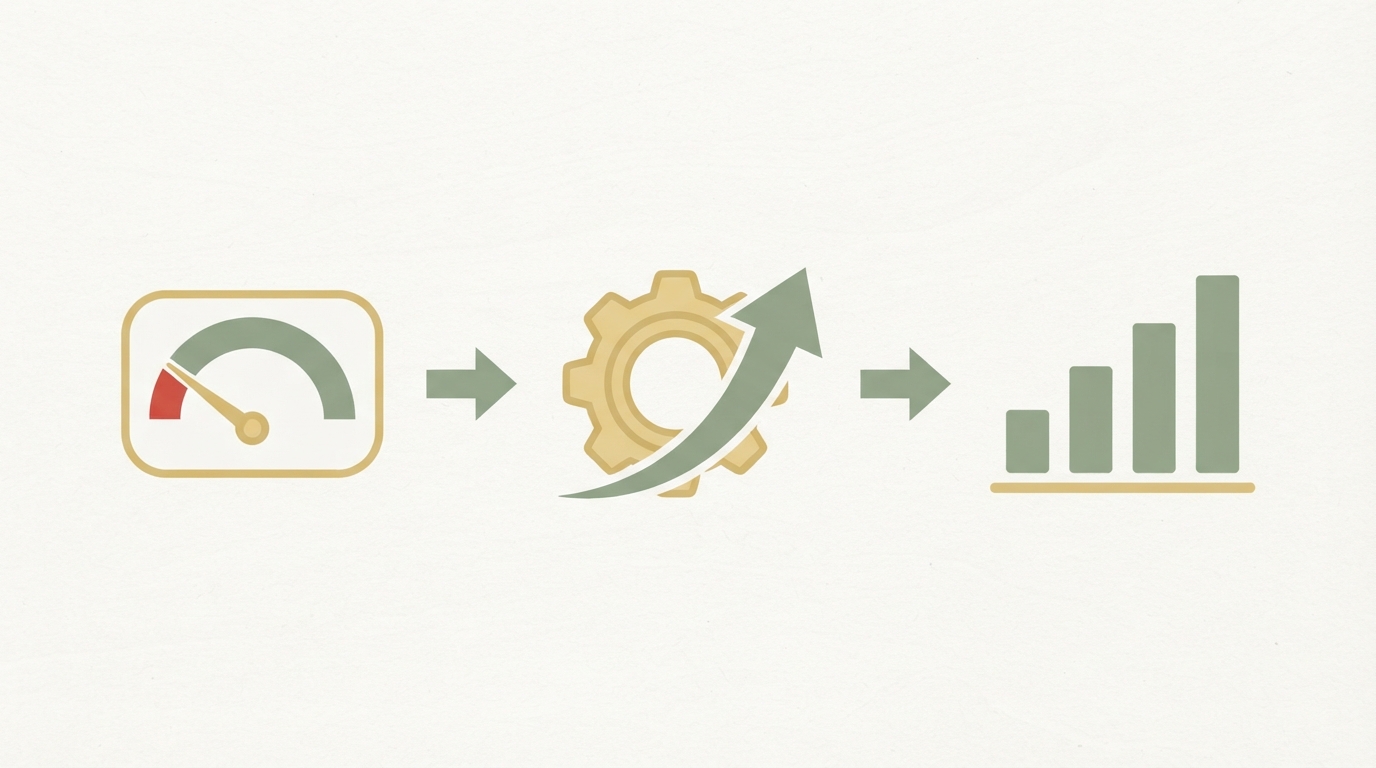
The golden rule: increase budget in small steps
Increasing your budget in small increments isn't a beginner's safety net — it's the method serious media buyers actually use. The rule of thumb: max 20% budget increase every 3–4 days, as long as the campaign keeps hitting its targets.
What this looks like in practice
Say you're spending €50 a day right now with a CPA of €15. You want to scale up to €200 a day. You don't do that in one jump.
Here's what a realistic timeline could look like:
| Day | Daily budget | Increase | What you check |
|---|---|---|---|
| 1–4 | €50 | Starting point | CPA, CTR, frequency |
| 5–8 | €60 | +20% | Is CPA holding steady? |
| 9–12 | €72 | +20% | Is frequency starting to climb? |
| 13–16 | €86 | +20% | Are creatives still fresh? |
| 17–20 | €103 | +20% | New ad variations ready? |
| 21–24 | €124 | +20% | Is audience size big enough? |
Going from €50 to €124 over three weeks — sounds slow. But the algorithm stays on its learning curve the whole time, and you don't lose a campaign that was actually working.
Of course, it doesn't always play out exactly like this. Sometimes a campaign stays stable even with a 30% increase. Sometimes it breaks at just 15%. It depends on audience size, competition in the auction, and creative quality.
Creative rotation: the real bottleneck when scaling Meta ads
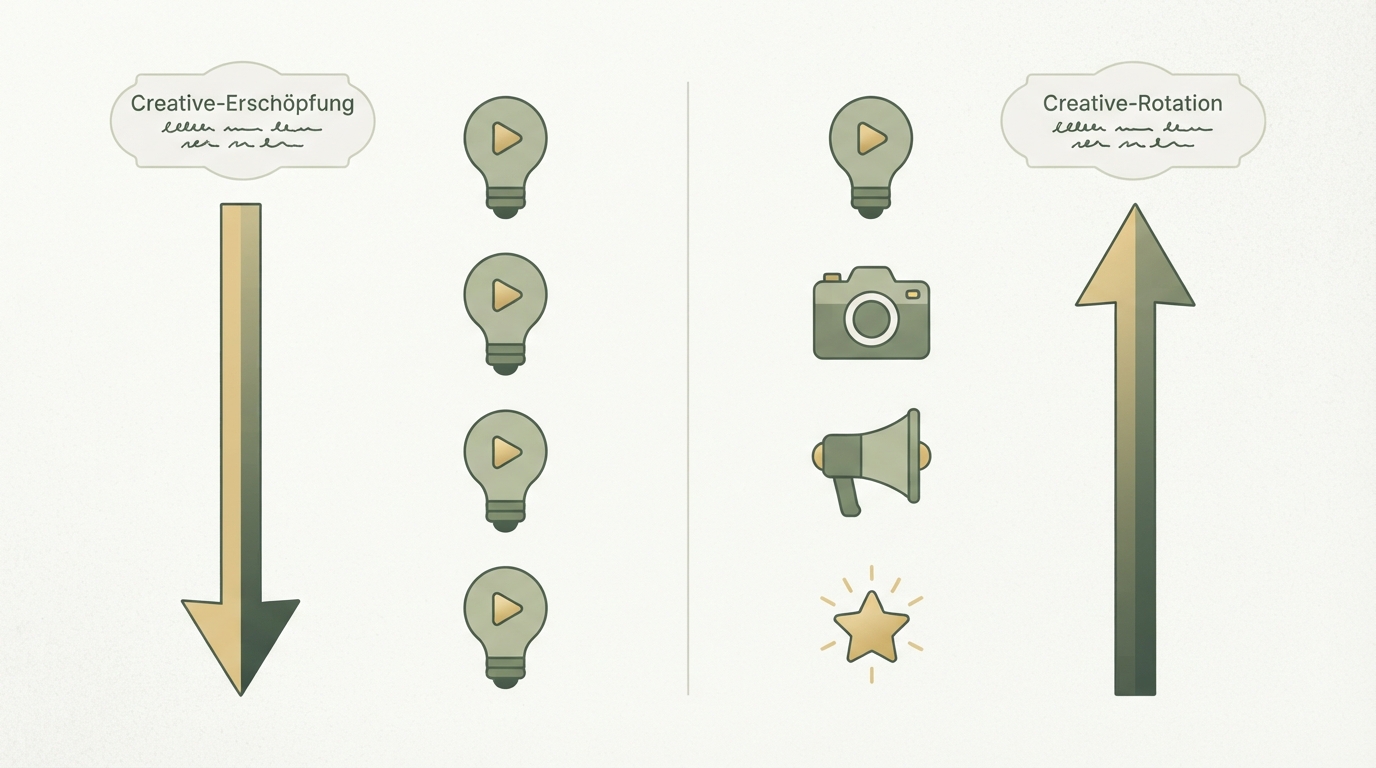
Why isn't the problem actually the budget most of the time? Because almost nobody talks about the real bottleneck. Increasing budget is easy. But the higher the budget, the faster the algorithm burns through your creative.
When scaling Meta ads, creative fatigue is the most common reason ROAS collapses — not budget, not targeting. I learned that one the hard way, too late.
Here's what happens: at €50 a day, your audience might see a given creative once every four days. At €200 a day, they might see it every other day. Frequency climbs, click-through rate drops, CPC rises. The algorithm reads that as worse performance and pushes up your effective CPM.
The result: you spend more and get less.
When creatives start to get "tired"
A few signals I watch for:
- CTR drops more than 30% compared to the first week
- Frequency crosses 3.0 on a cold audience
- Comments and reactions turn more negative or apathetic
- CPC rises even though bids stay the same
Once these signs show up, the campaign needs fresh creative — not another budget increase.
How to plan your creative pipeline systematically
Most solopreneurs and small teams treat creative reactively: they make new ads once the old ones stop working. That's too late.
Before every scaling step, you should have at least 3–5 new creatives ready to go. Not after. Before.
In practice, that means: for every budget-increase stage, plan a parallel wave of creative. That can include:
- New hook variations on the same offer (different opening line, different first image)
- A different format (static instead of video, or the other way around)
- Social proof as a new creative (screenshot, testimonial, case study)
- A different angle on the same problem (fear vs. aspiration)
By the way: if you're not sure which angles will land with your audience, it's worth taking a look at your competitors' ads. In the article on analyzing your competitors' ads, I explain why that's the most underrated research you can do.
Scaling ad campaigns: horizontal or vertical?
There are two basic strategies for scaling ads. A lot of people ask me which one is better. The honest answer: it depends.
Strategy 1: Horizontal scaling
You duplicate an ad set that's working and bump the budget up slightly on the copy. The original campaign keeps running untouched. The new campaign tests in parallel.
Pro: the original structure stays untouched. You're not risking blowing up a campaign that's already working.
Con: audience overlap can happen. Both campaigns end up competing in the same auction.
Strategy 2: Vertical scaling
You increase the budget of the existing campaign step by step, as described above.
Pro: the algorithm has more data to work with and can optimize better. No overlap issues.
Con: every increase carries the risk of a new learning phase.
| Criterion | Horizontal | Vertical |
|---|---|---|
| Protects existing campaign | ✅ | ❌ (risk) |
| Preserves algorithm learning | ❌ | ✅ |
| Audience overlap | Possible | Not relevant |
| Recommended above | > €200/day | up to ~€200/day |
| Pace | Faster | Slower, more stable |
My personal approach: below €200 a day, I prefer vertical scaling. Above that, I combine both approaches.
The 3 metrics to check before every budget increase
A lot of people bump the budget because the campaign is "doing well." But what does that actually mean?
Before you increase the budget, check these three numbers:
1. Cost per result (CPA/CPL) — Is it below your target, and has it not gotten worse over the last 3 days?
2. Frequency — Is it below 2.5 on a cold audience? If people have already seen your ad multiple times, more budget is the wrong move.
3. Creatives in reserve — Do you have at least 3 new variations ready? If not, prioritize that before the budget.
If all three check out, go ahead and increase. If even one is off, fix that first.
For a deeper look at the numbers that actually matter for a SaaS model, check out our article on SaaS metrics: the 5 numbers almost nobody reads properly.
When the problem isn't the budget — it's the offer
Is it really always about the budget? No. Sometimes a campaign won't scale because the offer itself isn't right. This happened to me early on in a project: the numbers looked like "turn up the budget," but really, nobody was going to buy no matter how much money went in.
If a campaign is barely delivering positive results at €30–50 a day, more budget won't fix the problem. It'll just speed it up.
Signs the offer is the problem:
- CTR is good, but landing page conversion rate is under 1%
- Lots of clicks, barely any purchases, no clear pattern
- A/B tests across all creatives show similarly weak performance
In that case, scaling is premature. Check product-market fit first — we've got a whole article on that: How to find product-market fit: 6 steps instead of gut feeling.
What SaaS projects that scale well do differently
I regularly look at how projects with meaningful traffic structure their growth. One thing stands out: the ones that manage to scale usually don't have some fancy tactic — they just have a better system for creative output and budget management.
Take an example from our database: Vector (vector.co) is a platform that identifies anonymous website visitors, enabling B2B targeting off the back of that. Based on our estimates, the product gets around 99,000 monthly visits and an estimated MRR of roughly $1.16 million. {{saas:vector.co}}
What's interesting: a product like this depends on ads constantly reaching fresh audiences — exactly the problem we're talking about here. Without a systematic creative pipeline, volumes like that couldn't be sustained.
The same principle applies just as much to smaller projects. If you want to scale, you don't need a massive budget — you need a system that actually works.
That's exactly where Starte.ai can help. We're not just a tool — we work alongside projects directly: we analyze competitor data, build creatives and hooks, and help put the right steps in the right order. Over 350 projects and stores have been built with this approach, generating more than 125,000 leads along the way. No guarantee for your project, but a concrete approach you can test for free.
The content plan behind scaling: organic as your safety net
Scaling paid isn't a strategy that stands on its own. The strongest setups combine paid scaling with organic growth.
Why? Because paid ads are an external dependency. If CPMs go up due to increased competition or algorithm changes, you can't control that. Organic reach — whether through content, SEO, or community — acts as a buffer.
Rob Walling, known for his book "The SaaS Playbook" and the Stacking Profits framework, keeps coming back to this point: if you only rely on one channel, you have no resilience. And that's especially true for paid ads.
That doesn't mean you need to run 10 platforms at once. Two is enough. But run those two consistently. You can find more on this in the Organic Growth section at Starte.ai.
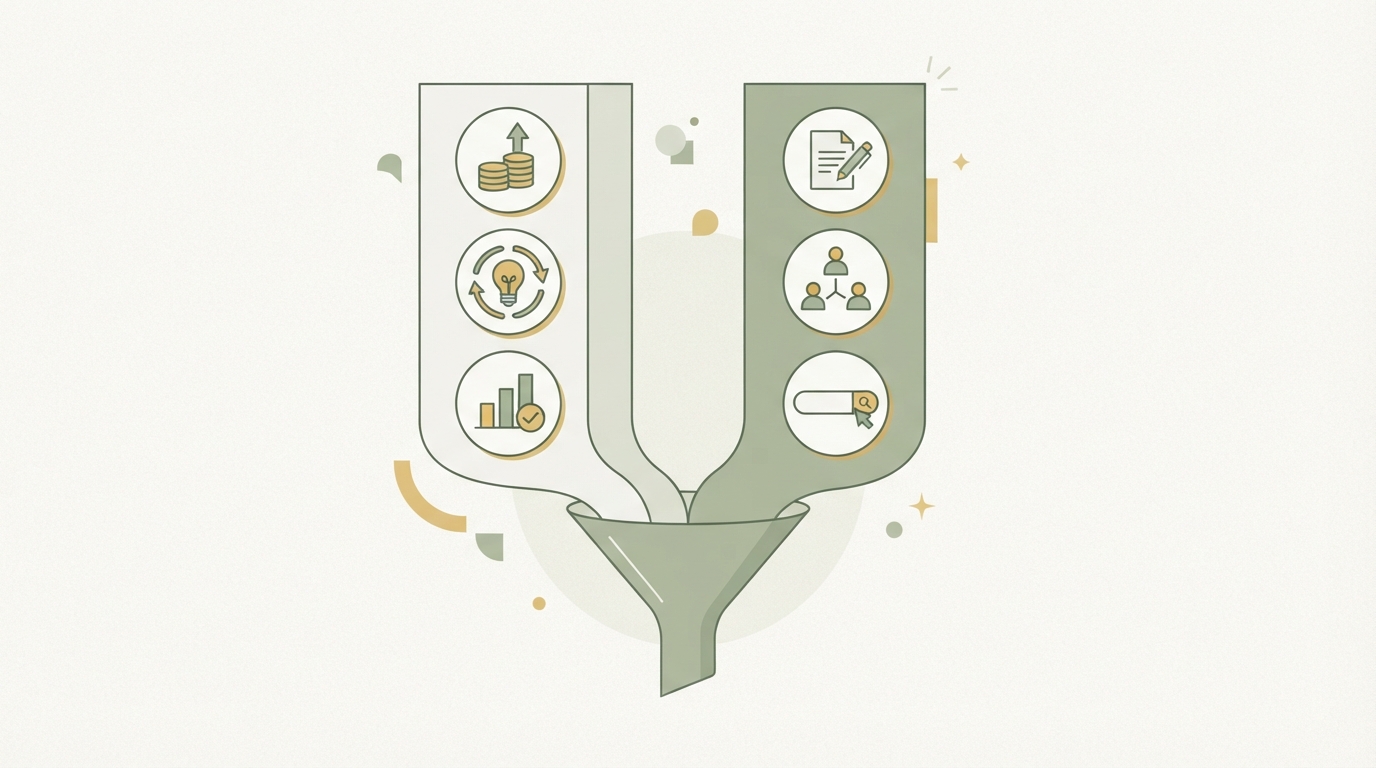
Quick checklist: before you increase the budget
Use this as a quick check before every scaling decision:
- CPA has been below target for at least 3 days
- Frequency is below 2.5 (cold audience) or below 4.0 (retargeting)
- At least 3 new creative variations are finished and ready
- Budget increase is under 25%
- Campaign's learning phase is complete (Meta: at least 50 events per ad set in 7 days)
- No significant CPM spike in the last 48 hours
- Landing page conversion rate is stable
Seven checkpoints. If more than two of them don't hold up: wait.
Scaling paid isn't autopilot. If you take it seriously, you treat creative like its own production channel and budget decisions like experiments with clear stop conditions. In the end, it comes down to patience and a system: pull the budget up slowly, always plan your creative one step ahead, and at the first warning signs, hit the brakes a day too early rather than a day too late. It's boring. And that's exactly why it usually works better than the next big trick.
Frequently asked
How much can I increase the budget on Meta ads at once?
The rule of thumb is a max of 20–25% every 3–4 days. Bigger jumps can trigger a new learning phase and seriously hurt campaign performance for a while. This is especially true for ad sets with fewer than 100 conversions a week.
When should I start refreshing creatives?
Not once performance already tanks — by then it's too late. I plan creative rotations in parallel with budget increases. A practical trigger: as soon as CTR drops more than 25–30% compared to the first week.
What's the difference between horizontal and vertical scaling?
Vertical means gradually increasing the budget of an existing campaign. Horizontal means duplicating a campaign that's working and running it in parallel. Vertical is riskier for the original structure but more efficient for the algorithm. Horizontal protects the original but can lead to audience overlap.
What should I do if the campaign tanks despite a cautious increase?
Drop the budget back to the last stable level immediately and wait 48–72 hours. Then check: is the audience too small? Are creatives worn out? Is there an external CPM spike (holidays, seasonal peaks)? Often a fresh creative does more good than any budget tweak ever could.
Written by
Bohdan BernatekFounder, Starte.ai
Founder of Starte.ai. Built a business to 125,000+ organic leads and seven-figure revenue — and now works with founders personally, deriving a strategy for their own brand from data across thousands of real projects and producing the creatives for it.