Why most people budget wrong
Calculating your ad budget correctly matters more than having the best product — yet almost no one does it right. Most founders budget arbitrarily: either with whatever's left over, or with percentages borrowed from big companies that have nothing to do with their situation. If you want to set your ad budget, don't start with a number — start with a goal. The path: target number → conversion rate → CPL → budget. This guide walks you through exactly how.
Most founders set their ad budget like this: they look at what's left over and spend that. Or they google "how much budget for ads" and land on some percentage figure that was measured for a Fortune 500 company.
Neither approach works.
The real problem: without a clear goal, any number is arbitrary. 500 euros can be too much if you haven't seen a single conversion yet. And 500 euros can be laughably little if your channel is proven to convert and you want to scale.
The core principle: goal first, budget second — never the other way around.
Arvid Kahl makes a similar point about the importance of understanding the market before you put money into it. Without that foundation, you're not just burning cash — you're not learning anything either.
Step 1: Define your goal — specific, not vague
A realistic marketing budget plan starts with a single question: what exactly should the campaign achieve?
Not "more visibility." Not "build brand awareness." But: how many paying customers do you need next month to cover your costs — or hit your next milestone?
Write it down. For example:
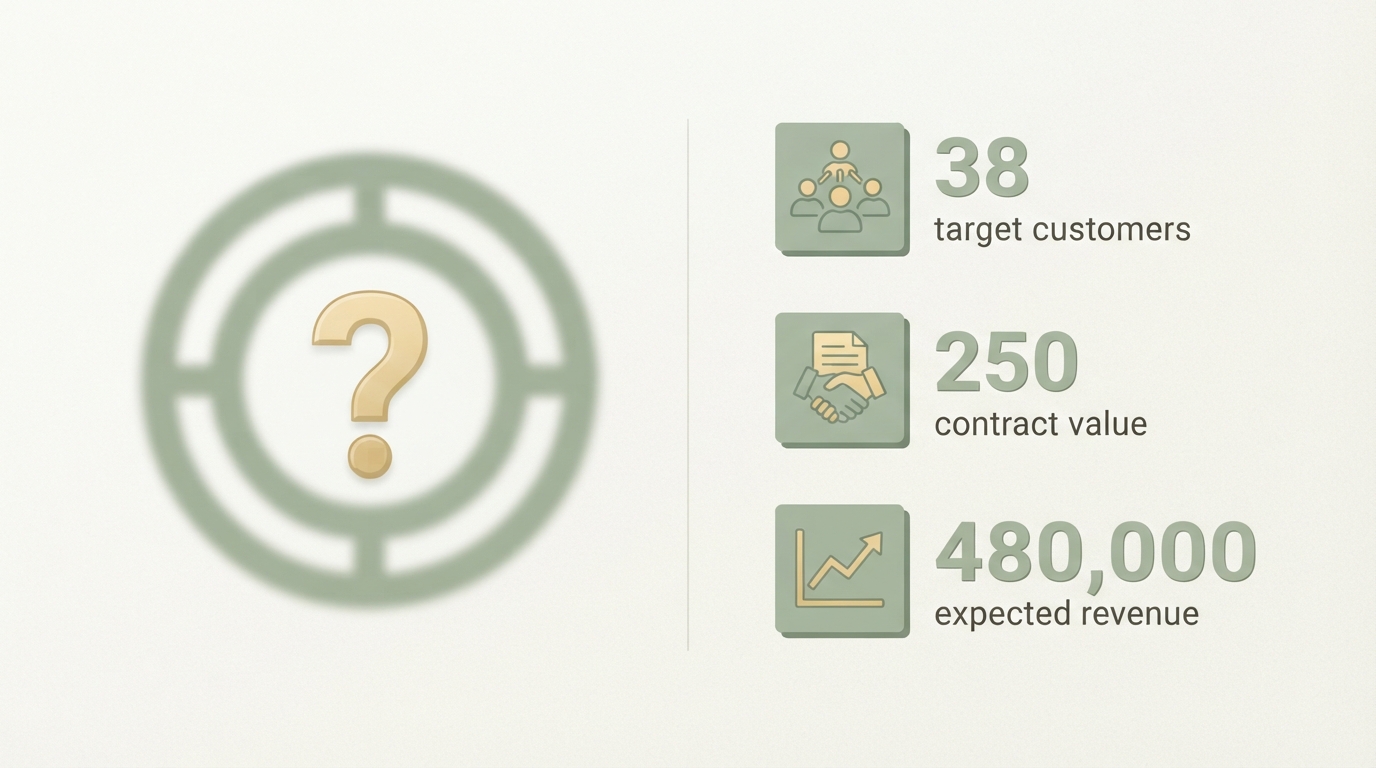
- Goal: 20 new customers next quarter
- Average contract value: 300 euros
- Planned revenue: 6,000 euros
That's your anchor. Everything else — channel, format, frequency — comes after.
Step 2: Work backward from your goal (reverse-engineering your budget)
Working backward from a target number is the only method I can genuinely recommend. It forces you to name your assumptions — and test them. That's exactly the core of setting your ad budget: don't guess, calculate.
Here's the basic formula:
Target customers ÷ conversion rate = leads needed → leads needed × cost per lead = budget
An example:
| Variable | Assumption | Value |
|---|---|---|
| Target customers | — | 20 |
| Lead-to-customer rate | approx. 10% | × 10 |
| Leads needed | — | 200 |
| Cost per lead (CPL) | estimated | €15 |
| Budget needed | €3,000 |
Where does the conversion rate come from? During the testing phase, from benchmarks of comparable projects or from early organic data. If you have no data at all yet, work with the worst realistic scenario — and plan as if it will happen.
That doesn't make the number certain, but it makes it honest.
One more thing: your CPL varies wildly by channel. Google Search, Meta Ads, LinkedIn, TikTok — they all work differently and have different learning curves. Before you allocate budget, you need to know which channel you're testing on.
Step 3: Separate your test budget from your scaling budget
This is the distinction I see missing most often — from bootstrappers and funded teams alike.
Test budget is learning budget. You spend it to gather data: which audience responds, which hook works, which channel converts. You're not expecting profitability — you're expecting insight.
Scaling budget only gets invested once you've found a profitable channel. Then you increase it methodically, not on hope.
Mixing these two phases up costs you on both sides: too little money for real learning, too much money on unproven assumptions.
Many projects start with a test budget of €300–1,000 per channel for 4–6 weeks before they even think about scaling. Below that, statistical noise is usually too large to draw real conclusions from.
Step 4: Allocate your budget across channels
Channels aren't equal. And the mistake of spreading yourself across five at once is more costly than the mistake of picking the wrong one.
My recommendation: start with a maximum of two channels. Better to put 600 euros into one channel than 200 into three.
Here's a comparison of the most common channels for small projects and early-stage SaaS:
| Channel | Typical CPL* | Learning curve | Best for |
|---|---|---|---|
| Meta Ads | €5–30 | medium | B2C, broad audiences |
| Google Search | €10–80 | low | existing purchase intent |
| LinkedIn Ads | €30–150 | high | B2B, higher deal sizes |
| TikTok Ads | €3–20 | high | young audience, impulse buys |
| Organic + SEO | €0 direct | very high | sustainable channel, slow |
*All figures are estimates and depend heavily on industry, creative quality, and the offer itself.
If you don't yet know where your audience actually buys, it's worth taking a look at what your competitors are running right now. That's faster than you'd think.
And one more thing: organic and paid aren't mutually exclusive. If you're building organic reach, you can turn the same content into an ad and gather test data cheaply. That works better than running two completely separate strategies.
Step 5: Use the competitive perspective
Before you lock in your budget, look at what others in your market are doing. Not to copy — but to get your bearings.
What budgets are they running? How many creatives are live at once? What hooks are they testing?
This saves you real money. If a competitor has been running the same ad for three months, that's not an oversight — it's probably working. You don't need to reinvent the wheel.
For a systematic way to get this data, check out the article on analyzing competitor ads — including the most common mistake people make doing it.
Step 6: Set your reinvestment rule — before you start
Almost everyone misses this. You plan the budget — but not what happens afterward.
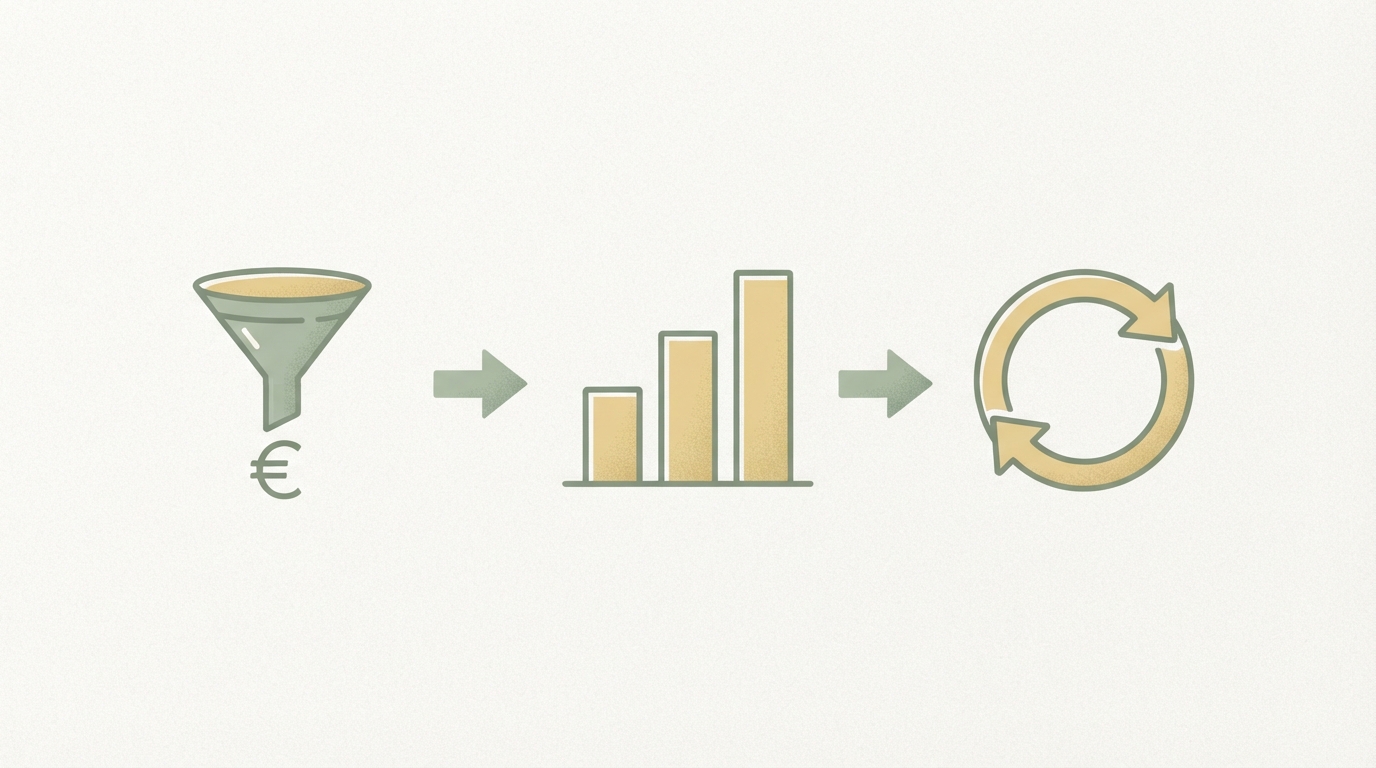
My suggestion: before you launch, decide at what ROAS (return on ad spend) you'll reinvest. For example: if 500 euros in spend generates 800 euros in revenue (ROAS 1.6), you reinvest 40% of the surplus straight back into the same channel.
Sounds simple. It isn't, if you decide on the fly while campaigns are running — because then gut feeling takes over again.
Important: ROAS alone tells you little if you don't know customer lifetime value. A customer who buys once for 100 euros is worth less than one who pays 30 euros a month for three years. If you haven't got a handle on that yet, check out the article on increasing customer lifetime value — it changes how you should evaluate your budget.
What real projects show
I regularly look at data from live projects — what's working, where budget is being wasted.
One example: Vector, a B2B platform for website visitor identification, uses a targeting approach that justifies relatively high CPLs — when the average contract value is large enough to match.
What this shows: B2B tools with sharp targeting can absorb high CPLs — if a single customer is worth 15,000 euros. A budget of 5,000 euros a month sounds like a lot, but it isn't at that ticket value.
The point: your budget has to match your ticket value. Advertise a 29-euro SaaS on LinkedIn and you'll burn money. Scale an enterprise tool on Meta and, often, you'll do the same.
How Starte.ai makes this step easier
This is exactly where most projects lose too much time — allocating budget, comparing channels, understanding competitors. Starte.ai continuously gathers data from real projects: which channels work in which niches, what competitors are running, which audiences convert. Combined with Bohdan Bernatek, who personally guides projects, this doesn't turn into a generic strategy — it turns into one that can actually fit your market. You can get started for free and see what makes sense for your situation.
The most common mistake (and how to avoid it)
In short: scaling too early, before the channel is proven.
The pattern always looks the same. Someone runs ads for two weeks, sees a few conversions, increases the budget — and performance collapses. Why? Because two weeks isn't a signal. Because the algorithm is still learning. Because seasonal swings are distorting the picture.
Rob Walling, one of the best-known bootstrapping investors, puts it roughly like this: scale what works, kill what doesn't — but give every experiment enough time and budget to actually produce data first.
The same goes for your ad budget. The most common mistake is rarely the wrong platform. It's the impatience with which people decide about it.
A blanket percentage doesn't help much — it's almost never calibrated right for your situation. Better: work backward from your goal (how many customers do you need, what CPL can you afford) and set a fixed test budget for 4–6 weeks. Once you have data, a percentage rule starts to make sense.
Test budget is learning budget — you're not expecting profitability, you're expecting insight into what converts. Scaling budget gets deployed once a channel is proven to work. Mix the two and you get neither real learning nor real scaling.
It depends on your product and ticket value. With less than 500 euros a month, Google Search (where purchase intent already exists) or Meta (with well-tested creatives) are often more efficient than LinkedIn. TikTok can be very cheap for certain B2C products — but it demands more creative work.
If after four weeks you have fewer than 50 relevant clicks or impressions on a channel, your budget is probably too small to learn anything. Below that, everything is too noisy statistically. Better to run fewer channels with more budget each than spread yourself thin.
One last point: setting a budget isn't a one-time act. Review it monthly. What you learn in month one changes what you should be spending in month two. Ignore that, and you're optimizing for yesterday — not today.
Frequently asked
What percentage of revenue should I spend on ads?
A blanket percentage doesn't help much — it's almost never calibrated right for your situation. Better: work backward from your goal (how many customers do you need, what CPL can you afford) and set a fixed test budget for 4–6 weeks. Once you have data, a percentage rule starts to make sense.
What's the difference between a test budget and a scaling budget?
Test budget is learning budget — you're not expecting profitability, you're expecting insight into what converts. Scaling budget gets deployed once a channel is proven to work. Mix the two and you get neither real learning nor real scaling.
Which channel is best for a small budget?
It depends on your product and ticket value. With less than 500 euros a month, Google Search (where purchase intent already exists) or Meta (with well-tested creatives) are often more efficient than LinkedIn. TikTok can be very cheap for certain B2C products — but it demands more creative work.
How do I know if my budget is too small?
If after four weeks you have fewer than 50 relevant clicks or impressions on a channel, your budget is probably too small to learn anything. Below that, everything is too noisy statistically. Better to run fewer channels with more budget each than spread yourself thin.
Written by
Bohdan BernatekFounder, Starte.ai
Founder of Starte.ai. Built a business to 125,000+ organic leads and seven-figure revenue — and now works with founders personally, deriving a strategy for their own brand from data across thousands of real projects and producing the creatives for it.