Starting an AI Startup: What Actually Matters in 2026
Starting an AI startup in 2026 mostly comes down to this: find a real niche, validate it before you build, and then launch with a minimal MVP. That's exactly where most people fail, because they skip the second step.
The technical barrier is basically gone. Tools like ChatGPT, Claude, or no-code builders handle most of the execution for you. That sounds great, but it's also a trap: tool costs are minimal, everyone can build an MVP in days, so validation becomes the real competition.
The bare minimum to get started:
- A niche where you either have expertise or genuine interest
- At least 3 payment commitments or firm meeting commitments from strangers before you write a single line of code
- An MVP with exactly one feature, not five
Why now is a good time
The timing is good because entry costs are historically low — but that doesn't mean every idea will work. You don't need a dev team anymore, and you don't need a big pile of startup capital for a first product.
What people often overlook: patience for validation.
That's exactly the step most people skip, because building is more fun than talking to customers.
The same pattern keeps repeating: people build first and only ask afterward if anyone wants it. That's the most expensive order of operations there is.
Step 1: Find a Niche Nobody Wants to Work In
The best AI startup ideas often live in boring, unsexy niches — not the loud trending topics. Taxes, compliance, accounting, insurance, legal processes. Sounds dry, but it often brings in more revenue than the tenth AI photo app, because there's less competition and people are more willing to pay.
A second good starting point: your own hobby or professional field. If you know a problem firsthand — like how musicians dial in their guitar tone, or how strength coaches manage their athletes — you have a knowledge edge that an outsider would have to research the hard way. Use it.
Underrated by comparison is this third strategy: take a product that already works but has a bad user experience, and make it dramatically simpler. Not new features — ten times less friction. To find these, look specifically at the 1- and 2-star reviews of market leaders. That's usually where the roadmap for your unique selling point is already written, because people spell out exactly what bugs them.
For a systematic search, Starte.ai's Trend Finder can help instead of hunting around the internet aimlessly. Tools like this can help you evaluate ideas including estimated traffic and revenue potential, which saves you some of the cold-start guesswork. For more on the overall approach, check out the article Finding a SaaS Idea in 2026: The Path from Problem to Product.
What actually makes an idea an "AI startup" idea?
Not every startup with a ChatGPT integration is automatically an "AI startup." What matters is whether AI forms the core of the value proposition or is just a bolted-on feature. A tool that automatically generates meeting notes and suggests follow-ups is an AI startup, because the product wouldn't exist without the AI component. A regular project management tool with a chatbot glued on top is not.
A good example of this category is Circleback, a meeting tool built exactly on this principle. If you want to see how a product like this is structured, check out the SaaS breakdown of Circleback.
Step 2: Validate the Idea Before You Build
Validation means strangers pay or commit their time. Everything else is just feedback. "Cool idea!" from your family is worthless, because they like you anyway.
This is also known as the Mom Test: never ask the people who love you whether your idea is good. Ask strangers who actually have the problem how they solve it today.
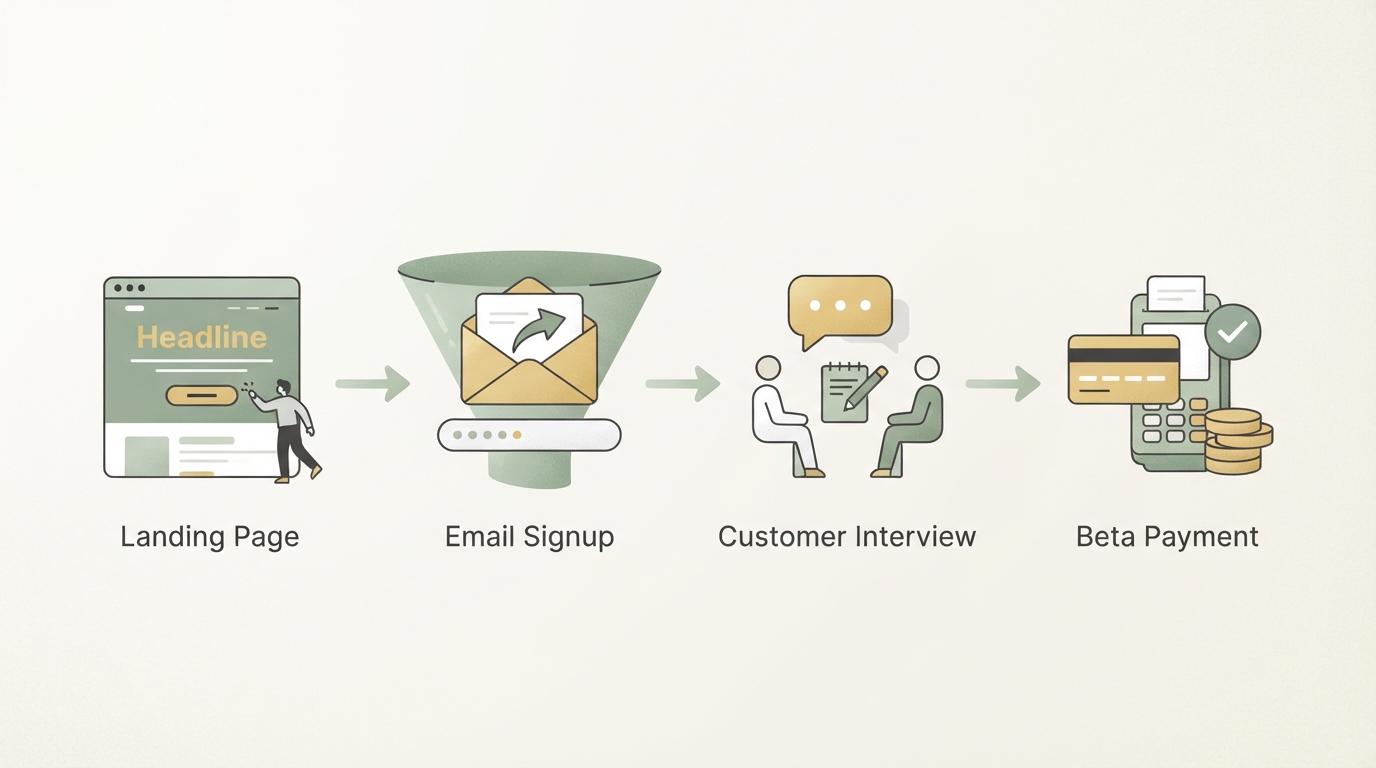
A simple, cheap way to get there: a fake-door landing page. You describe your product on a single page, collect email addresses, and look at the conversion rate. If it's above 10 percent, that's a signal worth taking seriously. If it's well below that, you've just saved a lot of time you would otherwise have spent building.
In the first few weeks with a landing page like this, a realistic timeline might look roughly like this, though every niche behaves a little differently:
| Phase | Goal | What you do |
|---|---|---|
| Week 1–2 | First signal | Launch the landing page, collect email addresses |
| Week 2–3 | Understand the problem | A few dozen conversations with potential customers, without selling |
| Week 3–4 | Real commitment | Offer discounted beta access, secure a financial commitment |
Talk is cheap — that's the whole point. Only once someone is willing to invest money or time do you actually know whether the idea holds up. This also lines up with what Rob Walling keeps emphasizing in the bootstrapping world: better an early paying signal than a big vision that arrives late.
Step 3: Build Your MVP with the Smallest Possible Feature Set
Your first product should solve exactly one problem, not five. Many people build an entire platform when a single, clearly scoped feature would have been enough. Paul Graham summed up the principle nicely in his essay on "Ramen Profitable": being small enough to survive matters more than being big enough to impress.
For the technical side, you don't necessarily need a developer on the team anymore these days.
No-code tools and AI-powered editors like Cursor or Claude can generate real, working code from a clear spec.
For this exact step, I've found Blueprint by Starte.ai useful. You enter your idea, and the tool gives you a concrete MVP feature set, a matching tech stack, and ready-made prompts you can paste straight into Cursor or Claude. That way you can rough out an idea before it goes to a developer — or before you build it yourself.
For a deeper look at how this works without any coding knowledge, see the article Starting a SaaS Without Coding: How It Really Works in 2026.
Which AI tools do you actually need?
For getting started, three or four tools are usually enough — not twenty. A code editor with AI support, a design tool, maybe an automation tool like Make or Zapier, and a tool for customer communication.
More tools doesn't automatically mean more progress.
Usually it just means more time spent setting things up instead of building. You'll find a more detailed breakdown in the article AI Tools for Founders 2026: What You Actually Need (and What You Don't).
Step 4: Land Your First Paying Customers
Your first ten customers almost never come from advertising — they come from direct conversations and referrals. Cold outreach works if you structure it right: roughly 60 percent of the message describes the recipient's specific problem, 30 percent your approach to solving it, and only 10 percent is proof, like a short case-study link. People who sell immediately get ignored. People who help first get a reply.
For a structured 30-day content plan with ready-made scripts, it's worth checking out Organic Growth by Starte.ai. The underlying idea lines up with what Pieter Levels demonstrated with #buildinpublic: showing publicly what you're building often attracts more genuine interest than traditional advertising.
Reddit and niche forums can work too, but not with clumsy self-promotion. Answer real questions from people who have the problem you solve, give useful tips, and mention your product at most once at the end, as one option among several.
It's also worth keeping an eye on competitors, for example through Ad Radar, where you can see which ads similar providers are currently running.
A word on pricing
Don't set your price by gut feeling — set it based on the value you deliver. Patrick McKenzie, known as patio11, has explained this well in several essays on software pricing: most founders set their prices too low, out of fear of losing customers.
Often it's exactly the opposite problem.
A price that's too low signals a lack of confidence in your own value and attracts the wrong customers.
What Do Real AI Startups Look Like? Three Examples
Existing products show clearly how different "AI startup" can look in practice. Some solve a very technical niche problem, others a broader marketing or finance issue.
Diode, for example, automatically converts code-based circuit schematics into finished PCB designs. A very specific engineering problem, currently estimated at around $5 million MRR with growing traffic. It's a good illustration of just how deep a niche can go and still work.
Vector, meanwhile, identifies anonymous website visitors using company and name data for B2B marketing teams, estimated at around $712,000 MRR. This is also fundamentally an AI product, since this kind of matching would barely be possible without the underlying models.
A note on both figures: these are estimates based on publicly available data, not official company numbers. But they give you a sense of the scale focused AI niche products can reach.
| Product | Core Problem | Estimated MRR | Trend |
|---|---|---|---|
| Diode | Schematic-to-PCB automation | ~$5,000,000 | rising |
| Snaptrade | Unified API for brokerage accounts (fintech) | ~$4,461,000 | rising |
| Vector | Identifying anonymous B2B website visitors | ~$712,000 | — |
If you're looking for more examples, check out 10 Micro-SaaS Examples with Estimated Revenue 2026, and for current idea patterns, Micro-SaaS Ideas 2026: 4 Patterns That Already Work.
Full-Time or Side Hustle First?
You don't have to quit your job right away to start an AI startup. Many people begin on the side, testing the idea in the evenings and on weekends, and only make the full switch once revenue looks reasonably reliable. That's not a detour — it's a sensible way to manage risk.
For a more detailed plan on this, check out the article Self-Employed on the Side with Micro-SaaS: The Realistic Plan. Important: don't set yourself unrealistic deadlines. "I'll quit in three months" is rarely a good basis for calm decision-making — it's more of a recipe for stress and rushed compromises on the product.
This ties into the idea of the "Calm Company," as championed by DHH and Jason Fried of Basecamp: a business doesn't need to grow explosively to be a good business. Sometimes a solid, steadily growing product is entirely enough.
Common Mistakes When Starting an AI Startup
The biggest mistake is building for months before a single stranger has even seen the product. Show your MVP early, even if it's unfinished and a little embarrassing. You'll get better feedback from real users with a real problem than from any number of internal debates about the perfect feature.
Second common mistake: building too many features at once, out of fear of not being taken seriously otherwise.
A look at existing products shows just how narrow most successful niche solutions actually were at the start, often with barely more than a single feature solving a single, sharply defined problem. Diode didn't try to reinvent electronics design end to end — it automated one painful step in the schematic-to-PCB process. Vector didn't build a full marketing suite — it answered one question (who just visited this site?) with unusual precision. That narrowness isn't a limitation to grow out of later; it's often the very reason the product got traction in the first place, because a stranger could understand in ten seconds what it did for them.
Your Next Step
You don't need a finished company to start — you need a problem worth solving and a way to test it quickly. Pick the narrowest version of your idea, the one that sounds almost too small to matter, and try to get it in front of five real potential users this week. Their reactions will tell you more than another month of planning ever could.
This is also the step almost nobody does well alone: turning a rough idea into a strategy that actually fits your specific market, rather than a generic playbook. At Starte.ai, we work through that process together with founders — deriving the strategy, building the creatives, and running the first campaigns, drawing on patterns from thousands of real projects we've tracked, including more than 350 stores and projects built this way. If you want a second pair of eyes on your idea, the first strategy call is free, and getting started costs nothing to try.
Frequently asked
How do I start an AI startup without coding knowledge?
You no longer need a developer on your team today, because no-code tools and AI-powered editors like Cursor or Claude can generate working code from a clear spec. Tools like Blueprint by Starte.ai give you a concrete MVP feature set, a matching tech stack, and ready-made prompts on top of that. Still, more important than the tech is checking for real demand beforehand.
How do I find a good idea for an AI startup?
The best ideas are often in boring niches like taxes, compliance, or insurance, because competition is smaller there and people are more willing to pay. Your own hobby or professional field can also be a great starting point, since you already know the problem firsthand. A third option is to take an existing product with a poor user experience and simply make it a lot easier to use.
How do I validate a startup idea before building it?
Real validation means getting a concrete commitment from strangers who could be customers, not just encouragement from friends or family. A simple method is a fake-door landing page where you collect email addresses: if the conversion rate is above 10 percent, that's a signal worth taking seriously. Only once someone is actually willing to invest money or time do you know whether the idea really holds up.
How do I get my first customers for my AI startup?
Your first ten customers usually don't come from advertising, but from direct conversations and referrals. For cold outreach, a split of roughly 60 percent problem description, 30 percent solution approach, and 10 percent proof works best. On forums like Reddit, too, it helps more to answer real questions than to promote your own product directly.
Written by
Bohdan BernatekFounder, Starte.ai
Founder of Starte.ai. Built a business to 125,000+ organic leads and seven-figure revenue — and now works with founders personally, deriving a strategy for their own brand from data across thousands of real projects and producing the creatives for it.