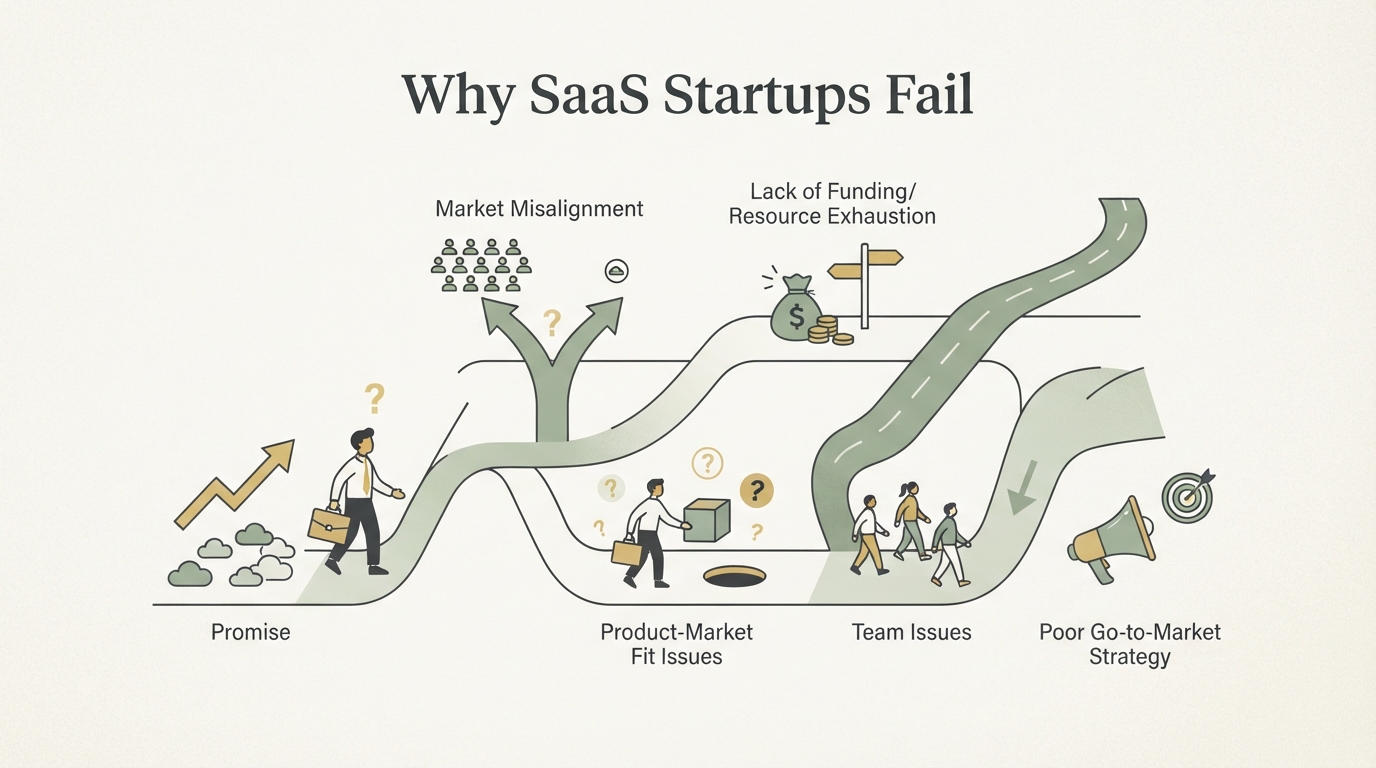
Why SaaS Startups Fail
Why SaaS startups fail almost never comes down to bad code. The most common reason is a lack of market validation, not technical shortcomings: there simply wasn't a market that actually wanted the product. I've watched enough projects fail — and built a few myself — to know that the tech is almost always the smallest problem.
Most founders build first and ask questions later. That's exactly where the failure begins, long before a single line of code gets written.
The Most Common Reasons Startups Fail
Most reasons startups fail boil down to a handful of patterns that keep repeating. It's rarely just one cause. Usually it's a combination of too little demand, bad timing, and a team that spends too long working on the wrong problem.
Here are the patterns I see most often:
- No real problem solved. The product is "nice to have," not "need to have."
- Scaled too early. Money poured into ads before anyone had even bought organically.
- Wrong audience. Built for everyone, bought by no one.
- Too long in stealth mode. Months spent building without talking to a single real customer.
- Wrong pricing. Either too cheap to be profitable, or too expensive for the value delivered.
Notice that tech doesn't appear anywhere on this list. That lines up with what Rob Walling has been preaching for years: bootstrapped SaaS almost never fails because of the technology — it fails because of a missing market.
No Market, No Demand
This is by far the biggest killer. A product with no paying demand dies, no matter how well it's built.
You can build the most beautiful app in the world. If nobody feels the problem urgently enough to pay for a solution, you won't sell anything. Full stop.
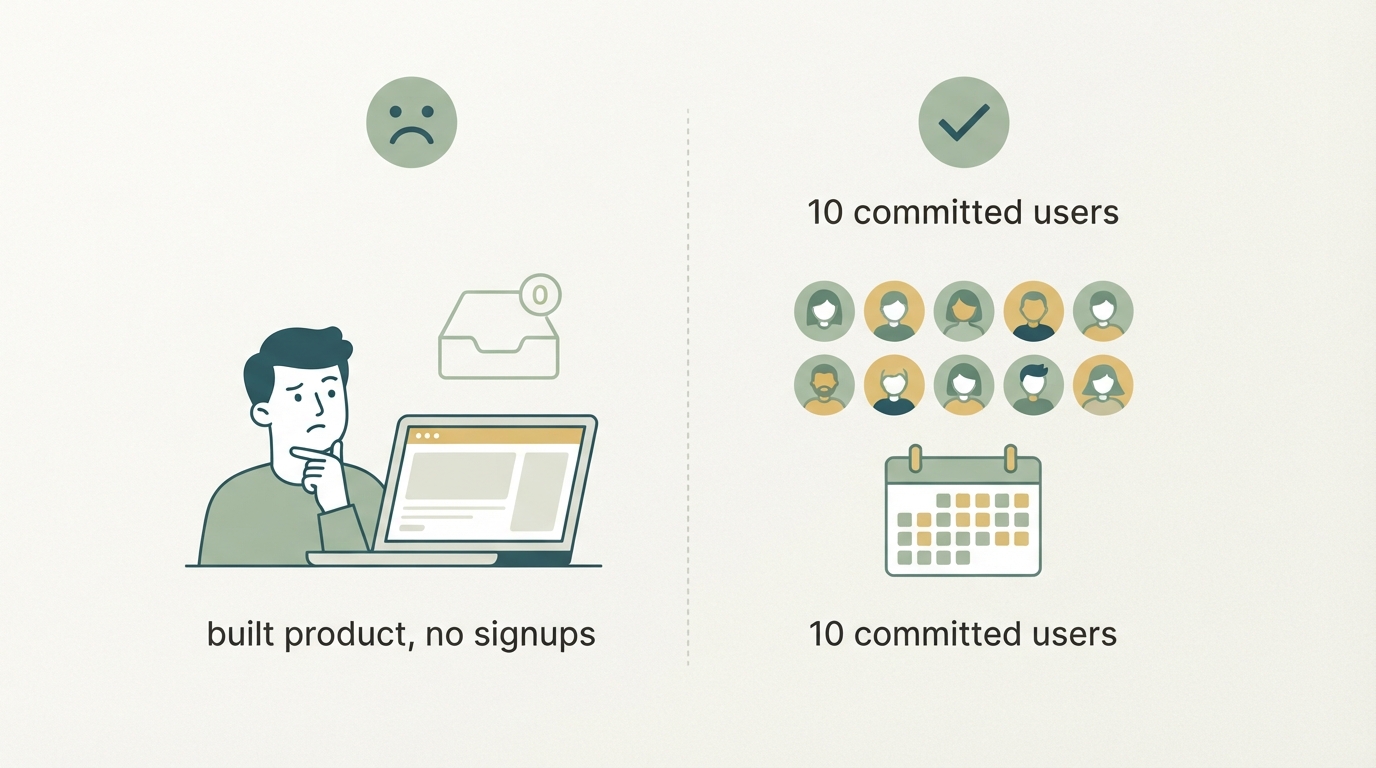
This is where Mom Test logic helps: don't ask friends and family whether your idea is good. They'll always say yes. Instead, talk to real potential customers about their problems, not your solution. If you hear "I might use that" ten times but nobody makes a concrete commitment, you don't have validation. You've collected politeness.
Scaling Too Early, Learning Too Late
Many teams pour budget into growth before the product even has a working foundation. That's like pouring gasoline on a fire before it's actually lit.
If your first ten customers already churn, bringing in a thousand more through ads won't help — you're just scaling the problem. Growth only pays off once people actually stick around and come back.
The Four-Question Diagnostic: Are You Headed for Failure?
Before you keep building, you can check your project against four simple questions that show you, in under ten minutes, where the biggest risk lies.
- Has at least one stranger (not a friend, not a family member) already paid money or made a firm commitment? If not, you're missing the most important validation there is.
- Can you describe exactly who your customer is in one sentence? If the answer is "basically anyone who...," your audience is too broad.
- Do you know what your competitors get slammed for in their 1- and 2-star reviews? That's often the fastest source of real buying arguments.
- In the last two weeks, have you talked to more customers than investors or mentors? If not, you're talking to the wrong people.
If you answer "no" to two or more of these, you should hit the brakes before sinking more time and money into it. That sounds harsh. But it's a lot cheaper than realizing six months later that you built something the market never wanted.
SaaS Failure: What the Numbers Actually Show
SaaS failure isn't a niche phenomenon — it's the rule, not the exception. I looked into various studies on startup failure, and they paint a similar picture: a large share of new software products disappear from the market again within the first two to three years. CB Insights breakdowns of startup failure reasons have consistently named "no market need" as one of the most common factors for years, though exact figures vary by study and should be read with some caution.
What stands out when you look at successful counterexamples: they often solve a problem nobody finds sexy. Taxes, compliance, accounting, immigration processes. Boring is sexy, as the saying goes in founder circles, because real willingness to pay tends to live exactly in those boring niches. A look at tools like Snaptrade shows this well:
Snaptrade makes money through API access that fintech apps pay to use, connecting brokerage accounts and pulling portfolio data in real time — a pretty dry, technical niche with clearly paying B2B customers instead of anonymous consumer users. Niches like this, with direct, predictable willingness to pay, often have better survival odds than the next trendy consumer tool, because B2B customers want to solve a real, expensive problem, not just try something out.
Similarly with Vector, which identifies anonymous website visitors and sells the data as a paid subscription to B2B marketing teams so they can target exactly the companies that already visited their site:
Both examples share one thing: a very specific, clearly defined audience. Not "somewhat useful for everyone," but "essential for exactly this role, in exactly this workflow."
Why Startups Fail Despite Having a Good Product
Why startups fail even when the product objectively works well almost always comes down to distribution, not quality. A good product that nobody finds doesn't sell itself.
This is where a lot of technical founders get stuck. They spend weeks building features almost nobody uses instead of putting time into getting seen. The 50/50 rule is a good anchor here: roughly half your time should go into building, the other half into marketing. If you spend nine months just coding and then "do marketing" for a week, you'll be disappointed.
A few things that regularly get overlooked:
| Mistake | Why it leads to failure | What helps instead |
|---|---|---|
| Relying on a single acquisition channel | If that channel breaks (algorithm change, ad prices), everything collapses | Consistently work two channels instead of half-heartedly working five |
| Launching first, planning marketing after | No momentum on launch day, visibility fizzles out | Build a waitlist and content alongside development |
| Setting price by gut feeling | Too cheap to be profitable, or too expensive for the value | Calibrate price using customer conversations and competitors |
| Ignoring feedback, building on anyway | Product drifts away from real need | Customer interviews before every major feature |
If you're at exactly this point and wondering how to land your first paying users, it's worth checking out How to Get Your First 100 Customers Without an Ad Budget. It covers exactly the part many founders skip.
The Pricing Mistake That Quietly Costs You Revenue
The wrong price doesn't kill you instantly, but it kills you reliably. Too cheap, and you can't afford a team, servers, or support. Too expensive without clear proof of value, and prospects bail at checkout.
Patrick McKenzie (patio11) has repeated this for years: most SaaS founders charge too little, not too much. If you avoid testing your pricing, you're leaving money on the table that you desperately need to survive. For a more systematic approach, see SaaS Pricing: The Mistake Almost Everyone Makes.
How to Avoid the Most Common Reasons Startups Fail
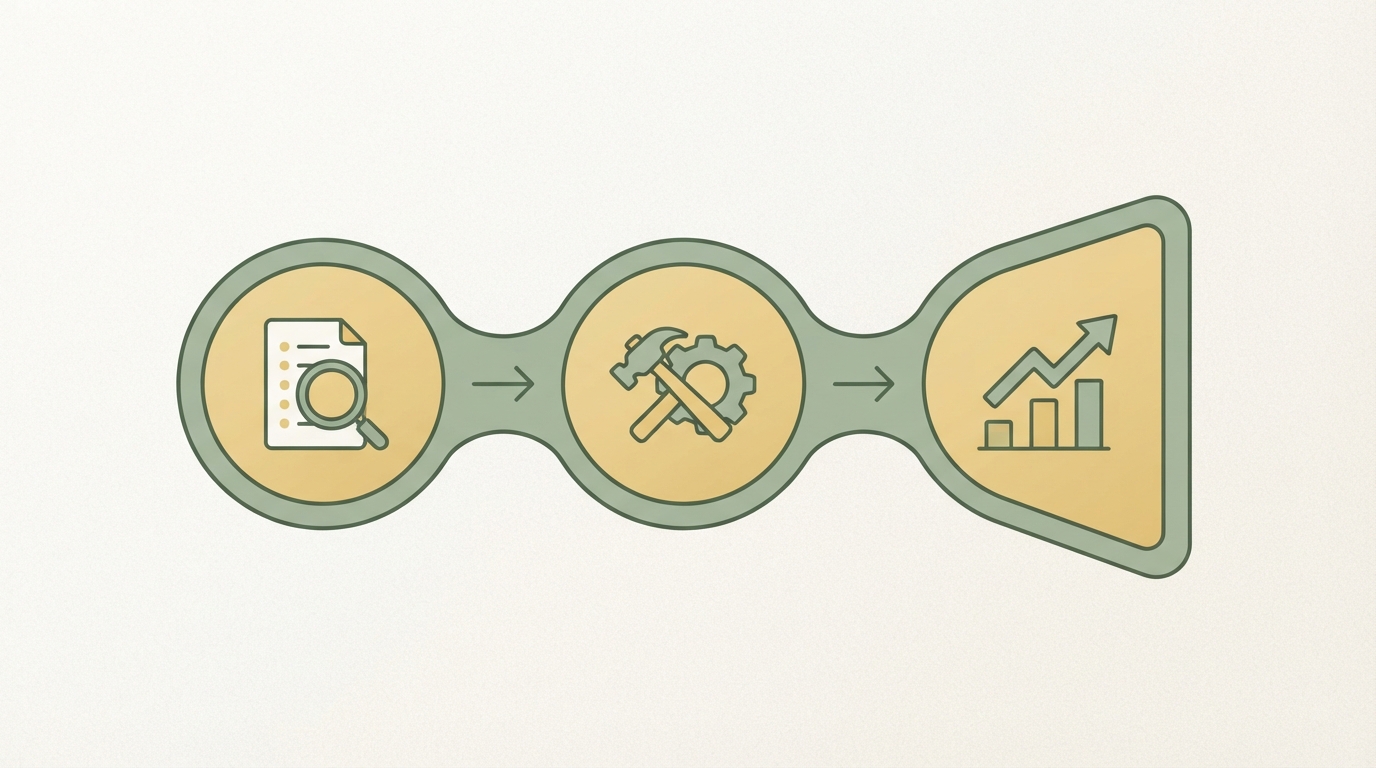
You can avoid the typical mistakes by flipping the order: confirm demand first, then build, then scale. That sounds simple, but it gets ignored constantly, because building feels more productive than talking.
Step 1: Validate Before You Code
Build a simple landing page that explains your problem and your solution in two or three sentences. A basic landing page for around 20 euros a year is plenty — you don't need a design studio for this.
Then measure how many visitors leave their email. If the rate is above roughly 10 percent, that's a signal worth taking seriously. If it's well below that, that's a signal too — just an uncomfortable one. When building a page like this, most founders make the same mistake described in Building a Landing Page: The Mistake Almost Everyone Makes.
Step 2: Conversations, Not Surveys
Have ten to twenty real conversations with people from your target audience. Don't sell — just listen. Ask about their current workaround, not their opinion of your idea.
Write down, word for word, what they say about their frustration. Those exact phrases will later become your best source of ad copy.
Step 3: Get a Hard Commitment
Words are cheap; a credit card commitment isn't. Before you keep building, try to get real commitment from at least a few people: a pre-order, a paid beta signup, a firmly scheduled date when they'll use your tool.
If you don't get that, it's not a disaster. It's information. Maybe the idea needs adjusting before you sink months into it.
Step 4: Build an MVP With Just the Essentials
Build only the core feature that solves the main problem. Everything else is a distraction at this stage. If you build too many features at once, you delay the moment real feedback comes in — and that feedback is the most valuable thing you have right now.
A common misconception here: MVP doesn't mean "a cheap version of your finished product," it means "the smallest test that gives you a real answer." Building an MVP: The Mistake Almost Every Founder Makes explains that distinction in more detail.
Step 5: Think About Distribution From Day One
Start thinking about where your first users will come from while you're still building — not on launch day. A waitlist, a few helpful posts in relevant communities, a newsletter documenting your thinking — all of that builds momentum before you even go live.
Pieter Levels, with his #buildinpublic approach, has shown how powerful it is to share the building process itself publicly, rather than showing up only at the end with a finished product. People follow the story, not just the final result.
Why Startups Fail Because of Bad Timing
Timing often matters more than founders want to admit, because even a good product fails if it arrives at the wrong time. A tool you build five years too early has no market. Five years too late, it has too much competition.
This is rarely something you can plan perfectly. What you can control, though, is how fast you react to an emerging trend.
If you notice early that a topic is gaining traction — in search trends, in community conversations, in the questions people are suddenly asking — you have a narrow window to position yourself before the space gets crowded. Move fast, but validate first: traction in a trend doesn't automatically mean there's a paying market waiting for your specific solution. The founders who time it right are usually the ones who were already listening before the wave arrived, not the ones who spotted it on a headline.
Your Next Move: From Idea to First Real Users
Here is where most people stall — not because they lack a good idea, but because the path from validated concept to actual traction has too many decision points and too little feedback. Take these steps in order:
- Narrow your problem statement to one specific person with one specific frustration. If you can't describe them in a single sentence, keep narrowing.
- Have five real conversations this week — not surveys, not polls. Phone calls or video calls with people who actually match your target user.
- Build only what forces a yes or no. A landing page with a waitlist, a prototype with one working feature, a manual process you do by hand before automating it — any of these counts as your MVP.
- Pick one distribution channel and go deep. A Reddit thread, a LinkedIn post series, a niche newsletter — one done well beats five done poorly.
- Document everything publicly if you can. Questions you're wrestling with, small wins, pivots. The audience you build while building is often your first customer base.
This is the stage where having data from hundreds of similar projects makes a measurable difference — knowing which channels actually drove early users in your category, which messaging converted, which offers got ignored. Starte.ai was built around exactly that gap: our system combines real data from 125,000+ leads generated across hundreds of projects with hands-on strategy built around your specific market, so the plan you start with reflects what has actually worked rather than what sounds reasonable in theory. Bohdan works personally with early-stage founders to map the first steps, and the first strategy call costs nothing. If you want to see what a validated, distribution-first launch plan looks like for your idea, you can start free and find out.
The hardest part of building something new is not the building — it is knowing which decisions are the right ones to make this week. Start with the problem, talk to real people, build the smallest thing that proves you are right, and keep moving before the window closes.
Frequently asked
Was ist der häufigste Grund, warum SaaS-Startups scheitern?
Fast nie schlechter Code, sondern fehlende Nachfrage. Es gibt einfach keinen Markt, der das Produkt wirklich will. Die Technik ist fast immer das kleinste Problem.
Woran erkenne ich, ob mein Startup auf dem Weg zum Scheitern ist?
Prüf dein Projekt an vier Fragen: Hat ein Fremder schon eine feste Zusage gegeben, kennst du deine Zielgruppe in einem Satz, kennst du die 1- und 2-Sterne-Kritik der Konkurrenz, und redest du mehr mit Kunden als mit Investoren? Bei zwei oder mehr Nein-Antworten solltest du bremsen.
Warum scheitern manche Startups trotz eines guten Produkts?
Meistens liegt es an Distribution, nicht an Qualität. Viele technische Gründer bauen wochenlang an Features, die kaum jemand nutzt, statt Zeit in Sichtbarkeit zu stecken. Die 50/50-Regel hilft: die Hälfte der Zeit bauen, die Hälfte vermarkten.
Welche Rolle spielt der Preis beim Scheitern von SaaS-Produkten?
Ein falscher Preis tötet zwar nicht sofort, aber zuverlässig. Zu billig, und du kannst dir kein Team oder keinen Support leisten, zu teuer ohne klaren Wertbeweis, und Interessenten springen ab. Die meisten Gründer verlangen laut Patrick McKenzie eher zu wenig als zu viel.
Written by
Bohdan BernatekFounder, Starte.ai
Founder of Starte.ai. Built a business to 125,000+ organic leads and seven-figure revenue — and now works with founders personally, deriving a strategy for their own brand from data across thousands of real projects and producing the creatives for it.