What actually makes a headline sell?
Writing headlines that sell comes down to one thing above all: promising something specific, verifiable, and interesting to exactly one person. No creativity, no wordplay. It's a craft with clear rules, and most people break the same three: vague instead of specific, curiosity without substance, headlines written for everyone instead of one person. In this article, I'll show you exactly how to spot a weak headline before it goes live, and how to fix it in just a few minutes.
A good headline doesn't promise "the best solution" — it promises "3 hours saved every week." That distinction is exactly what decides whether someone clicks or keeps scrolling, and it's exactly what this article is about.
The mistake almost everyone makes: vague instead of specific
The most common mistake in writing headlines is vagueness. "The best solution for your business" sounds like marketing but says nothing. Nobody clicks on a promise they can't picture.
Look at how many landing pages open with lines like "We're changing the way you work." That's completely interchangeable.
This is exactly the test I'll explain in more detail shortly: could any competitor write the exact same sentence about themselves? If so, the headline is worthless.
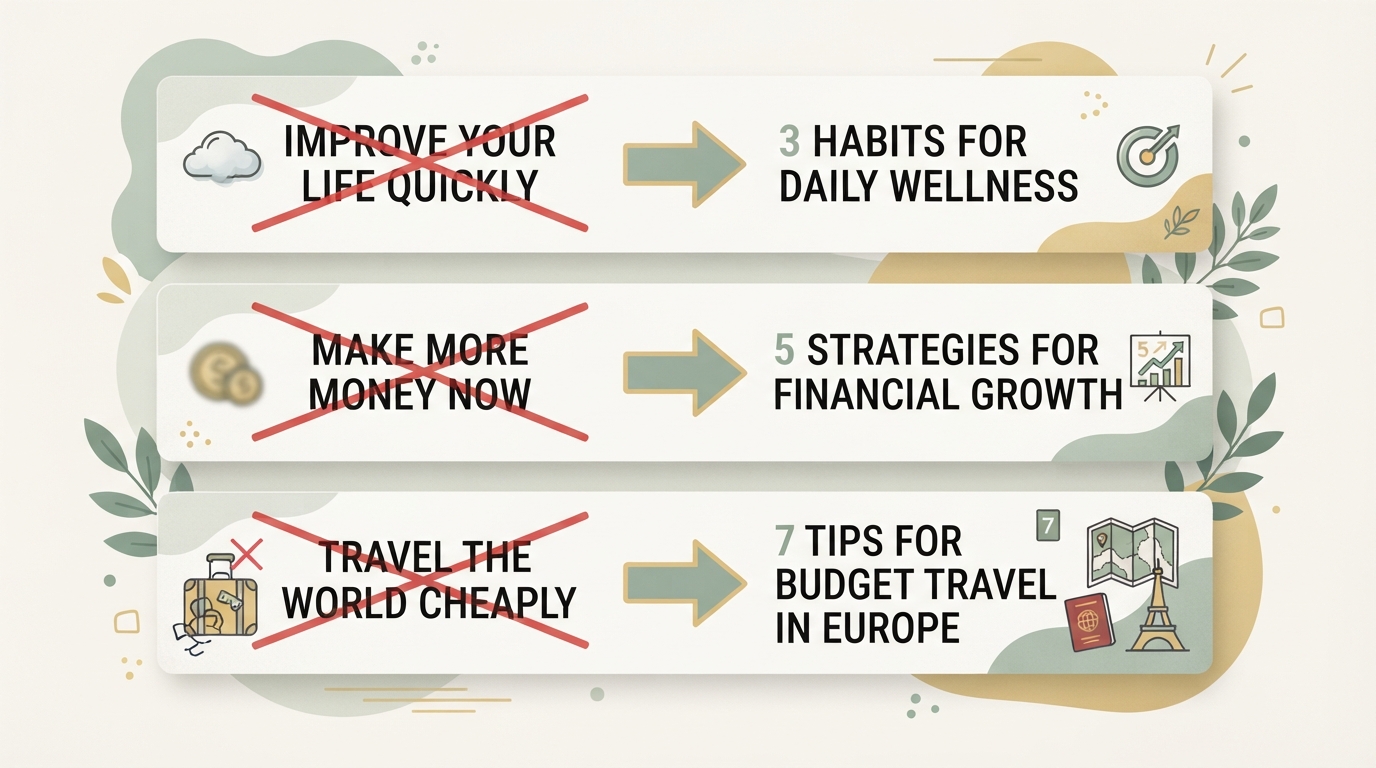
Specific means: numbers, timeframes, a clearly named problem. Not "save time," but "save 3 hours of bookkeeping every week." Not "more customers," but "your first 10 paying customers without an ad budget." If you're looking for concrete ways to do that, I've written more about it in How to get your first 100 customers without an ad budget.
Why vague language switches your brain off
Our brains respond to images, not abstractions. "Increased efficiency" creates no image. "From 2 hours down to 15 minutes" does.
That's also why numbers in headlines work so often. They give the brain something to anchor on before it scrolls past.
The curiosity gap: the second building block of good headlines
Good headlines open a gap between what the reader knows and what they want to know. This is called a curiosity gap, and it only works if it's filled honestly afterward.
Take an example: "Why most SaaS pricing pages are leaving money on the table" opens a gap. The reader thinks: am I leaving money on the table too? They want the answer. That's not clickbait, as long as the article actually delivers afterward. Clickbait is a gap that never gets closed. Readers notice immediately, and they remember it next time.
If you want to go deeper on getting attention without an ad budget, it's worth checking out Building a newsletter: the mistake almost every founder makes. The same principles for subject lines apply almost one-to-one to headlines.
Curiosity without substance is just noise
A gap with nothing behind it might get you a click, but not a conversion.
That's exactly the difference between a headline that sells and one that just annoys. If you rely on pure curiosity without delivering something concrete in the next sentence, you lose the reader immediately.
The gap has to lead to a payoff, not a disappointment.
Speak to one person, not everyone at once
A headline written for everyone convinces no one. This might be the most underrated point in writing headlines.
"Software for businesses" speaks to no one in particular. "Invoicing software for freelance graphic designers" speaks to someone who immediately recognizes themselves. That person thinks: that's me, this was made for me. That moment of recognition is often what decides whether someone keeps reading or clicks away.
I see this constantly with young SaaS founders: they're afraid of narrowing their audience too much because they think it means reaching fewer people. Usually the opposite is true. A specific headline attracts fewer clicks, but far more relevant ones — and those convert better.
How to make your target person visible in the headline
Name the role, the industry, or the specific situation directly in the sentence. "For solo founders who haven't written a line of code yet" is more precise than "For anyone who wants to start a business." The more precisely you hit the mark, the less wasted reach you get.
And yes, that sometimes means several versions of the same headline for different channels. One for LinkedIn, one for the landing page, one for Google Ads. It's more work, but it's usually worth it.
Writing headlines that sell: the competitor test
The fastest way to spot a weak headline: ask yourself whether your direct competitor could write the exact same sentence about themselves. If so, it's no good.
"The easiest way to manage projects" — any project management tool in the world could claim that. It says nothing about you. "Plan projects without spreadsheet chaos, set up in under 5 minutes" is more specific, but still generic enough to be copied.
A truly good headline contains something only you can claim: a real number from your product, a feature others don't have, a result you can actually show. Once you've written a headline, mentally run it past your three biggest competitors. Does it fit all of them? Then go back to the drawing board.
| Trait | Weak headline | Strong headline |
|---|---|---|
| Competitor test | anyone could write it | only you can claim it |
| Language | abstract, "solution," "efficiency" | specific, a number or timeframe |
| Target person | everyone | one clearly named role/situation |
| Curiosity | missing or never resolved | opens a gap and closes it in the text |
| Proof | claim without evidence | number, testimonial, or feature as proof |
Thought experiments: before and after
Let's talk concrete cases instead of theory. One thing first: the examples below aren't meant to represent headlines these companies actually used, but rather "here's how it could work" versions, to make the principle tangible. Say you're building a tool that identifies B2B website visitors, similar to what Vector (vector.co) does: a tool that recognizes anonymous website visitors by name and company, letting marketers target them directly.
A weak headline for that would be: "See who's visiting your website." Sounds nice, but any similar tool could write the exact same thing. A stronger version might look like this: "See which company visited your pricing page yesterday, without filling out a single form." Specific, an image in your head, a clear situation.
Second example, this time from fintech. Snaptrade (snaptrade.com), according to its own product description, connects fintech apps to brokerage accounts for real-time portfolio data. A generic headline would be "API for fintech integrations." Instead, Snaptrade's headline could read something like: "Real-time portfolio data, without your user ever sharing their brokerage password with you." That speaks to a concrete problem every fintech developer knows: trust and data privacy.
Third example: Diode (diode.computer), an AI platform that, according to its own description, translates code-based schematics into finished PCB designs. "AI for PCB design" is a category description, not a headline. "From code to finished board, without opening any CAD software" would be a plausible headline, because it describes one concrete step the target person knows and finds painful.
You see the pattern: take the one moment where your user normally experiences pain or friction, and describe in the headline how that moment disappears.
Headline formulas that keep showing up in practice
There's no magic formula, but a few patterns show up constantly because they work. I use them myself regularly as a starting point, never as a finished product.
Number + concrete result + timeframe. "3 invoices a week, no spreadsheets." This pattern instantly delivers an image and a proof anchor.
Problem + surprising solution. "Why the fastest reply to an email is often the worst one." This opens a gap because it contradicts intuition.
Direct audience callout + core benefit. "For solo founders: bookkeeping nobody has to explain to you." Clear who it's for, clear what's inside.
Before/after contrast. "From 40 spreadsheet tabs to one dashboard." Shows change instead of just claiming it.
A formula doesn't replace thinking about your actual target person. It's a scaffold, not a finished product. Fill it with something that's genuinely true only for your product, or you'll end up right back at the competitor-test problem from before.
Where headlines really matter in everyday SaaS life
Writing headlines that sell isn't just a blog post topic. They decide, in several places at once, whether someone keeps reading, clicks, or buys.
On your landing page, the headline is often the first thing a visitor reads before deciding whether to stay or leave. If you're still unsure what typically goes wrong there, it's worth checking out Building a landing page: the mistake almost everyone makes. The same "specific instead of vague" logic applies to the whole page there, not just the headline.
Even at a Product Hunt launch, the tagline often decides whether someone upvotes more than the actual product video does. I wrote more about that in Product Hunt launch: the mistake almost everyone makes. And even email subject lines for a waitlist follow the exact same principle on a smaller scale — more on that in Building a waitlist: the mistake almost every founder makes.
The difference between title, headline, and subheadline
These three terms often get mixed up. The title is usually what shows up in the browser tab or in Google search results. The headline is the big, visible sentence at the top of the page. The subheadline supports the headline with a second sentence, usually set in smaller type.
All three should carry the same core message, but shouldn't be identical. The subheadline can, for example, deliver the proof that the headline only hints at. "Up and running in 5 minutes" as the headline, "Over 40 templates, no setup required" as the subheadline, for example.
Test instead of guess: how to actually know what works
A headline is only good once it performs in a real test — not once you personally like it. That sounds obvious, but it gets ignored constantly.
The simplest test: write two or three variants, run them against different segments — for example via two landing page versions or different ad variations — and compare click-through rates after one or two weeks. You don't need a huge sample to spot a rough pattern, but you do need enough traffic that the difference isn't pure chance.
If you don't have meaningful traffic yet, you can still test. Send the variants to five or ten people from your target audience and ask which one would make them more likely to click, and above all why. The reasoning is often more revealing than the choice itself.
One thing you should never do: ask friends or family, because they'll almost always tell you what they think you want to hear. They know the product, they know you, and they're rooting for you — none of which describes your actual target audience. A stranger from your niche who has no reason to spare your feelings will give you a far more honest read on whether your headline actually lands.
From headline to system: what to do with this now
Start by rewriting your current headline using the "specific instead of vague" principle from this article, then test it against your original with real people from your target group. Do the same for your landing page and, if it applies, your Product Hunt tagline — small, testable changes, not a full rewrite of everything at once.
This is also the step almost nobody does alone: figuring out which headline angle actually fits your specific market, rather than guessing from general best practices. At Starte.ai, we work through this together with you — deriving the strategy from data our software pulls from thousands of real projects, then building the actual creatives and hooks around it. Bohdan, our founder, is personally involved in these calls, and the first strategy session is free, so there's no pressure to commit before you know if it fits. It's one way to skip a few rounds of trial and error on something that's easy to get wrong alone.
Whichever way you go, treat your headline as a hypothesis, not a finished product. The version that feels right to you today is just the starting point for the version your audience actually responds to.
Frequently asked
What actually makes a headline sell?
It promises one thing that's specific, verifiable, and interesting to exactly one person. Numbers, timeframes, and a clearly named problem work better than creativity or wordplay. The fastest check: could your competitor write the exact same sentence about themselves? If so, it's too vague.
What's the most common mistake in writing headlines?
Vague language like 'the best solution for your business' or 'we're revolutionizing the way you work.' Any competing company could write the exact same thing about themselves, so it says nothing at all. It only becomes concrete with real numbers, for example 'save 3 hours of bookkeeping every week' instead of 'save time.'
What is a curiosity gap, and how do you use it in headlines?
The curiosity gap opens between what the reader knows and what they want to know, for example with 'Why most SaaS pricing pages are leaving money on the table.' It only works if the article actually closes that gap afterward. If it stays open, it's clickbait, and readers remember that the next time.
Why should a headline speak to one target person instead of everyone?
A headline for everyone convinces no one, because no one feels directly spoken to. 'Invoicing software for freelance graphic designers' pulls fewer clicks than 'software for businesses,' but those clicks fit far better and so tend to convert better. The moment someone recognizes themselves usually decides whether they keep reading or click away.
Written by
Bohdan BernatekFounder, Starte.ai
Founder of Starte.ai. Built a business to 125,000+ organic leads and seven-figure revenue — and now works with founders personally, deriving a strategy for their own brand from data across thousands of real projects and producing the creatives for it.