Recognizing Creative Fatigue: The Point Where Ad Exhaustion Gets Expensive
Creative Fatigue means your audience sees an ad too often, costs explode while conversions drop. It typically hits in week 3–4 when Cost-Per-Action jumps 20–30% without any changes on your end. A burned-out creative costs you €20–30 extra per day; over 2 weeks, that's €280–420 wasted.
I see this constantly: founders think their strategy is broken when the real problem is just creative fatigue. They tweak audiences, budgets, placements—all wrong moves. The actual signal was simple: this image or video is worn out. That's why learning to recognize creative fatigue as a skill—rather than guessing—pays off.
How to Tell When a Creative Is Exhausted
| Metric | Fresh | Exhausted |
|---|---|---|
| CTR | 1.2–2.5% | 0.6–0.9% |
| Cost per Click | €0.50–0.80 | €0.90–1.40 |
| Conversion Rate | 3–8% | 3–8% (same) |
| CPA | €10–15 | €25–35 |
This table is your reference point. When your numbers shift toward the right while conversion rate stays flat, ad fatigue is clear.
Cost-Per-Result (CPR) Climbs Steadily
This is alarm signal #1. If your Cost Per Action rises 20–30% over 7–10 days without any changes, your creative is running on fumes.
Normally, CPR stays stable the first week, then ticks up slowly. If the climb comes faster than your historical average, it's not an audience problem—it's the creative getting tired.
Concrete rule of thumb: CPA going from €5 to €6.50 is still okay. From €5 to €7, start watching. At €8, you switch.
Click-Through-Rate (CTR) Falls, Conversion Rate Doesn't
This one's tricky but very telling. Fewer people click your ad (lower CTR), yet those who do still convert at the same rate—the problem is attention. Your audience is scrolling past.
Specifically: the creative is tired, not your landing page or offer.
Frequency Hits Your Threshold
Frequency is the average number of times one person sees the same ad. On Facebook and Instagram, fatigue typically sets in around frequency 2.5–3.5. On average, each person has seen your ad about 3 times.
TikTok and YouTube tolerate higher frequency (4–5) because the format is more varied. LinkedIn is lower (1.5–2.5) because usage is less repetitive.
When frequency climbs above the threshold and CTR drops at the same time, the diagnosis is clear: creative is spent.
ROAS Falls (But Not Simultaneously with CPR Rise)
Return on Ad Spend is the king metric. If ROAS drops from 3.5x to 2.5x over 7–10 days with no external changes (market shift, sudden competitor activity), that's also a clear signal.
The difference from CPR rise: ROAS falls because fewer people convert—they've already seen the ad 4 times. CPR rises because you pay more per click. Both together means: the creative is done.
Engagement and Saves Drop
On platforms like TikTok and Instagram, engagement metrics are an early indicator. If shares and saves drop 40%+ on days 3–4 while impressions stay high, the audience is saturating.
This is your heads-up signal for the next 48 hours before CPR explodes.
How to Rotate in Time
The system is simple if you structure it.
Step 1: Run Three to Four Creatives in Parallel
The strategy is called Continuous Testing and Rotation. You don't squeeze one super-creative for weeks—you always test 3–4 variations at once.
Sounds expensive. It's not. Why?
A new creative costs maybe €30–50 to produce (design, copy, or 15 minutes in an AI tool). A burned-out creative running costs you €20–30 extra per day because CPR spikes.
Let a tired creative run 2 weeks too long, and you've wasted €280–420. Testing 3–4 in parallel prevents that.
Step 2: Pause Weekly, Don't Delete
Not: Creative A → done → next week Creative B.
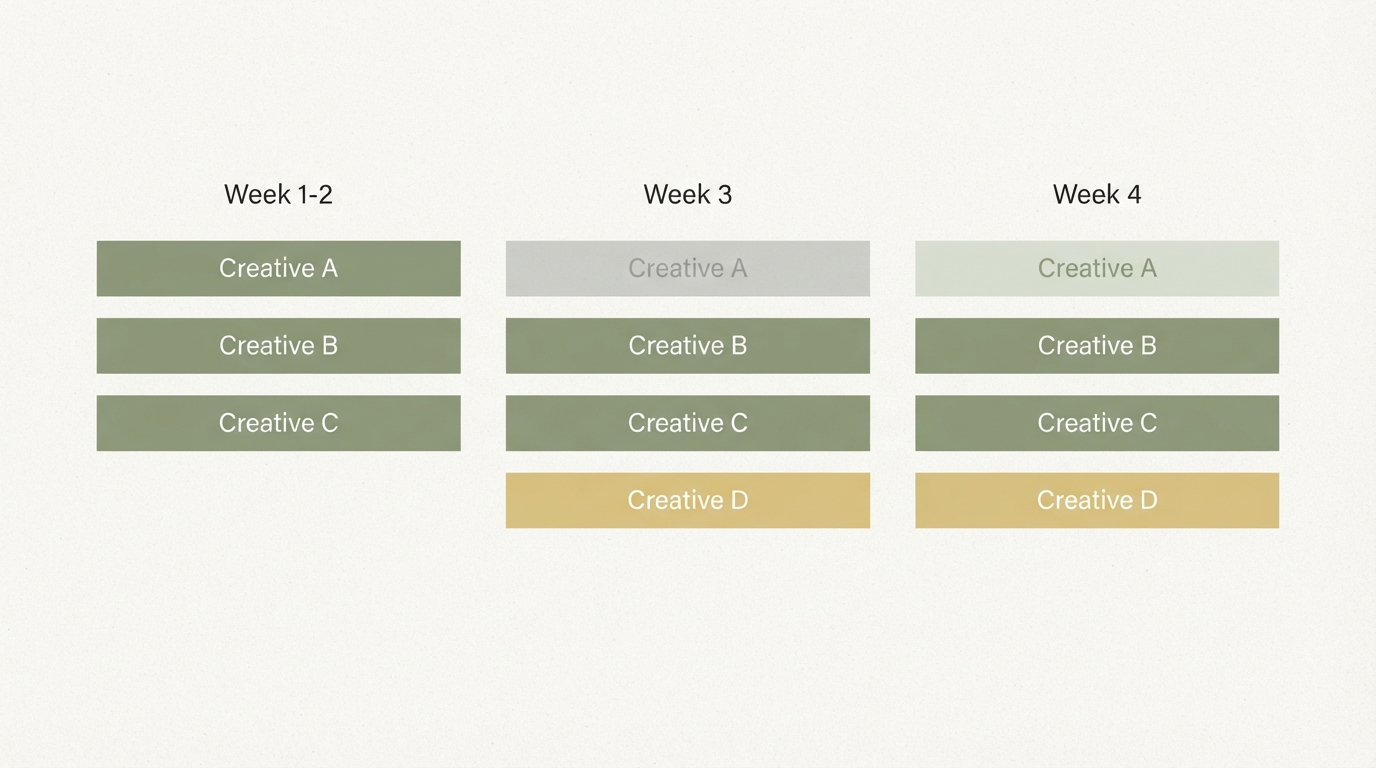
Instead: Creatives A, B, and C run together. After 10 days you pause A (don't delete!), launch C fresh, test D. The fatigue goes away, and if A recovers in two weeks, you can reactivate it.
This is called Frequency Decay. As frequency drops, the creative recovers. It happens faster with strategic pauses (1–2 weeks), not random ones.
Step 3: Define Your Refresh Rhythm
Here's the structure:
- Weekly: Validate 1 new creative idea (sketch, test video, copy variation).
- Every 10 Days: Launch a new creative into the live set.
- Monthly: Produce at least 4–5 completely new creatives.
You need rhythm, not chaos. This is called the 30-Day Creative Refresh: 4–5 new ads per month, frequency never above 3, no creative runs longer than 14 days straight.
From our database (350+ projects): founders who rotate this way save 15–25% (estimated) in ad spend versus those who squeeze one creative dry. That's not theory—it's feedback from people doing it.
Common Mistakes
Mistake 1: Looking at CTR, Not Conversion Rate
Many think: if CTR drops, the creative is dead. Not always true.
Some creatives have low CTR but higher conversion rate. They attract the right people. A viral creative has high CTR but worse conversion.
Look at both together. Only when CTR drops AND conversion rate stays the same is it fatigue.
Mistake 2: Launch New Creative, Keep Old Targeting
Wrong approach in the other direction. A fresh creative with stale targeting is like a new car with an old GPS—you drive the same route again.
When a creative tires, the audience often saturates too. New creative plus minor targeting adjustments (retrain lookalikes, rotate countries) creates real recovery.
Mistake 3: Ignore Frequency
Many beginners don't track this metric at all. They think if the numbers look okay, it's fine.
Frequency is your early warning system. It tells you 3–5 days before costs spike that something's coming.
Mistake 4: Pause Everything Too Fast
The opposite error: a creative still performs okay but frequency is high, so you kill everything.
This restarts your Learning Phase. Better: add a new creative, don't immediately shut down the tired one. The old ones might still work well for 3–4 more days in combination.
When Is a Creative Really Dead?
There's a clear point of no return.
If all three of these are true simultaneously:
- CPA is 30%+ above your historical average (e.g., was €12, now €16).
- Frequency over 3.5 on Facebook/Instagram, over 4.5 on TikTok.
- CTR under half your best creative (e.g., best creative: 1.5% CTR, tired creative: 0.7%).
Then: pause immediately. This costs money you won't recover.
Only two are true? Give the creative 2–3 more days and watch closely.
Concrete Checklist for This Week
Open your Ads Manager and do this now:
- Write down the last 7 days: average CPA, CTR, frequency for each active creative.
- Compare to values from 10 days ago.
- If CPA > +25%, CTR > -30%, frequency > 3: pause.
- Spend 2–3 hours sketching 3 new creatives (text, image, hook).
- Upload tomorrow in the same campaign setup as your best performer.
That's not a week of work—it's one afternoon. And it saves you 20–30% (estimated) in ad spend next month. If you're still unsure how to structure your ads in the first place, this guide to campaign setup might help as a starting point.
How We Standardize This
This exact point—seeing when a creative dies and getting fresh supply fast—is one of the few places real experience actually matters. We've generated over 125,000 leads this way and see daily in live campaigns how this rhythm separates who scales from who doesn't.
At Starte.ai, we do this by default: our software tracks frequency, fatigue signals, ROAS drift, and tells you daily which creatives should pause. We produce the supply in parallel—new hooks, new copy, new variations in your brand voice, ready to go live.
First strategy call is free; you can look around with no cost. But automating this rhythm is why people often pull more from their budget with us.
Typically: 4–5 new creatives if you're promoting a single product or offer. Multiple products or different audiences? You need more. Rule of thumb: for every paused creative, test at least one new one.
Sort of. Metrics vary—TikTok tolerates higher frequency, Facebook tires faster. The same video might run 10 days on TikTok but only 7 on Facebook. Better: a very similar creative (same hook, slightly different edit) optimized for each platform.
Yes, even more important. With a small budget, every wasted dollar stings. Better to test 3 creatives at €10/day each than run one into the ground. Rotation forces you to learn faster. That's exactly why recognizing creative fatigue pays double with a small budget.
Frequently asked
How do I know a creative is tired?
Watch for the combination of rising CPR and falling CTR with unchanged conversion rate. If your Cost-Per-Action climbs 20–30% in 7–10 days with no changes on your end, your creative is running on reserve. If frequency also crosses the threshold, the diagnosis is confirmed.
At what frequency is a creative exhausted?
On Facebook and Instagram, the threshold is typically 2.5–3.5. TikTok and YouTube tolerate higher (4–5) because the format is more varied. LinkedIn is lower (1.5–2.5) because scrolling is less repetitive.
How often should I produce new creatives?
The post recommends a fixed rhythm instead of chaos: validate one new idea weekly, launch a new creative every 10 days, and produce at least 4–5 completely new ads monthly. This is the 30-Day Creative Refresh—no creative runs longer than 14 days straight.
When is a creative truly dead and should be paused?
When three conditions hit simultaneously: CPA is 30%+ above your historical average, frequency is above 3.5 (Facebook/Instagram) or 4.5 (TikTok), and CTR is below half your best creative. If all three are true, pause immediately—otherwise you lose money you won't recover.
Written by
Bohdan BernatekFounder, Starte.ai
Founder of Starte.ai. Built a business to 125,000+ organic leads and seven-figure revenue — and now works with founders personally, deriving a strategy for their own brand from data across thousands of real projects and producing the creatives for it.