Building a newsletter: how to land your first subscribers for your micro-SaaS in 2026
Building a newsletter means collecting email addresses before the product is finished. Most people build first, then the list — and waste time doing it. Here are the five steps that actually work.
I see this all the time with people launching their first micro-SaaS. They have a good idea, spend weeks building, launch — and then find themselves with a product and zero people who want to see it. Subscribers from your own list tend to convert far better than social media followers, because they opted in actively and deliberately. Building an email list is basically the reverse of the usual order: you gather attention first, then you build.
Why a newsletter matters more than social media followers
A newsletter is yours. A follower count on Instagram or X isn't. That's the core difference, and it's massively underrated.
If Twitter suspends your account tomorrow, or the algorithm cuts your reach in half, you're back to zero. Your email list, on the other hand, you can export, take with you, and message whenever you want. No algorithm decides whether your message gets through.
Email tends to convert far better than social posts, because people actively opted in to hear from you. That's a warm audience, not a cold one. When you eventually launch a product, it's these subscribers who buy first — not because they happened to see your post, but because they deliberately signed up.
For product positioning, it's worth checking out SaaS positioning: the mistake almost every founder makes — a newsletter without clear positioning behind it gets you readers, not buyers.
Step 1: Find your topic before you build a signup form
Before any tool, any landing page, any freebie — you need a clear topic that people will actually hand over their email for.
This is the part most people skip. They think, "I'll just do a newsletter about my startup." But nobody cares about startup updates except your mom. What people care about is a problem they're facing right now, and a perspective they can't find anywhere else.
Ask yourself: what problem are you solving yourself, every day, with real effort? That's what you should write about. If you're currently figuring out how to land customers in a specific niche, "how I landed customers one by one" is a far stronger newsletter topic than "news from my company." Niche-before-product logic is key here, and it lines up with what's covered in Narrowing your target audience: the mistake that costs you customers: the tighter your topic, the more clearly someone knows whether they want to sign up.
A good test for whether your topic holds up: could you write ten issues without running out of things to say? If not, the topic is too narrow or too vague.
Step 2: Finding newsletter ideas that actually work
Good newsletter ideas come from the intersection of what you know and a real, recurring problem your audience has.
A few formats that consistently work well, especially early on:
- Behind-the-scenes: show how you're working on your product or niche, mistakes included. This is the #buildinpublic principle that makers like Pieter Levels have made popular: transparency pulls more attention than polished marketing.
- Curated knowledge: summarize what you read, tested, or figured out this week, tailored to your topic.
- One problem, one solution: each issue tackles one concrete question from your niche and answers it in a five-minute read.
- Numbers and data: show what's actually worked for you or others, clearly flagged as an estimate if it's someone else's data. This sticks because it's concrete instead of just claimed.
In the first few weeks, it's worth watching which topics in your niche get the most engagement online before locking into a fixed format. That's exactly what you can use Starte.ai's Trend Finder for — seeing what people in your niche are actually searching for, instead of guessing.
Step 3: Build a simple landing page for your newsletter
A newsletter landing page doesn't need to look good — it just needs to make one thing clear: what the reader gets when they sign up.
A headline, one sentence explaining the promise, and an input field. That's it. Many founders spend days on design, when really the copy is almost the only thing that decides whether someone signs up or clicks away.
What it definitely needs:
- A clear headline summing up the topic in one sentence
- Three to four bullet points on what the subscriber gets regularly
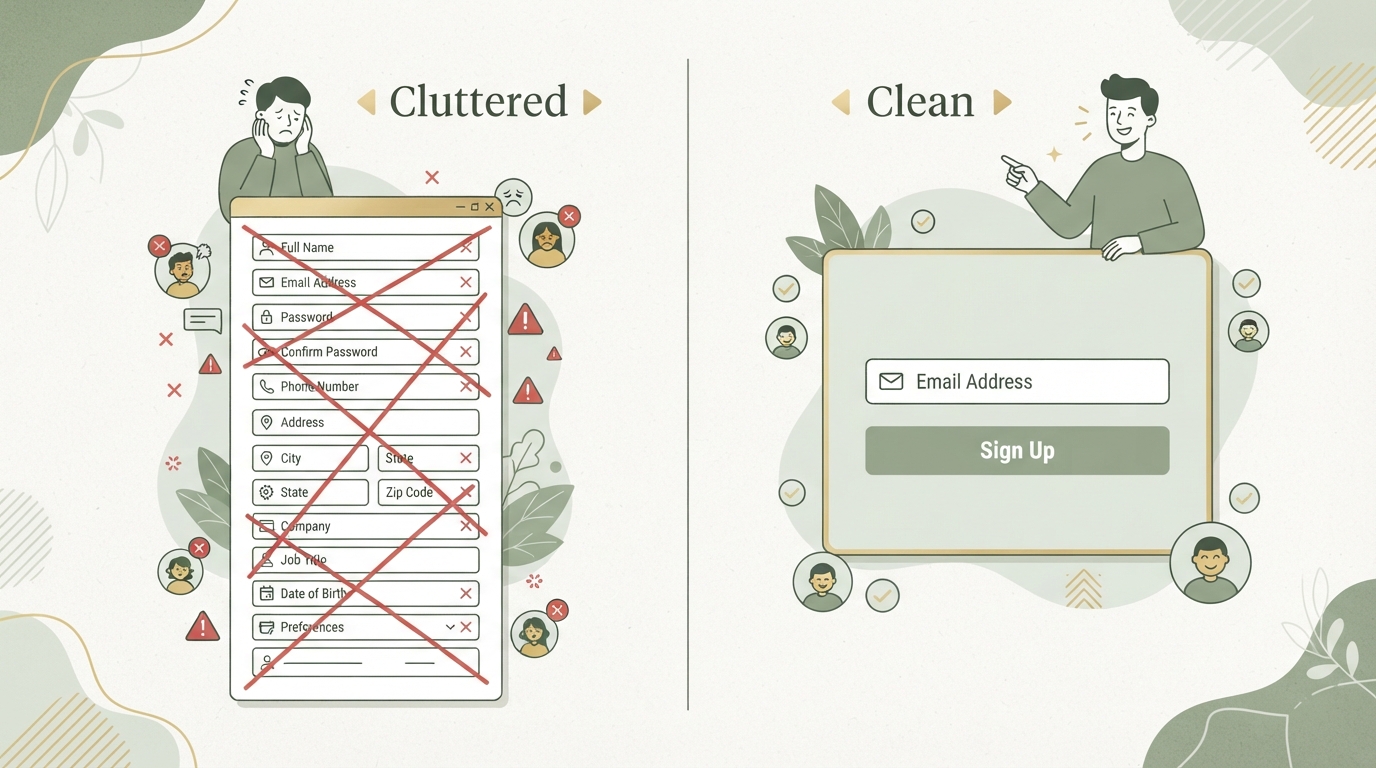
- A single email input field — no name, no extra fields
- An example of a past issue, if you have one
Too many form fields cost you signups. Every extra field lowers the odds someone actually submits the form. If you're building a product landing page alongside this, Optimizing conversion: why visitors don't buy has a few principles that carry over directly.
Step 4: Landing your first 100 subscribers
Landing your first subscribers is the hardest part, because there's no algorithm, no recommendation engine, no momentum yet to help you.
Early on, it's almost entirely direct, personal outreach. It's slow, but it works. A few approaches that have consistently helped:
Personal messages to relevant people. Not scattershot — targeted at people who genuinely fit your topic. If you're reaching out to B2B contacts, the problem-process-proof structure from Cold email: the mistake almost everyone makes helps: describe the person's problem first, then your approach, then a short piece of proof. Selling in the first sentence kills the message.
Communities where your audience already hangs out. Reddit, forums, Slack or Discord groups. The key: don't promote, help first. Answer real questions with real value, and mention your newsletter at most at the end, as one option among others. People buy — or subscribe — from those who helped them first.
A guest post or a mention from someone with existing reach. This often does more than ten of your own posts, because you're borrowing trust.
Your own network on LinkedIn. Worth checking out LinkedIn outreach: the mistake almost everyone makes, especially if you're in B2B.
Honestly: five real conversations with potential readers get you further than a hundred random posts, because in five conversations you actually hear where it hurts — in a hundred posts, almost never. A founder I know started exactly this way: not with a landing page redesign, but with a handful of real conversations about his audience's problem. It's basically the Mom Test idea, applied to newsletters: don't ask "do you like my idea," ask about people's actual problem.
Building a newsletter: comparing tools and platforms
For the technical side of building a newsletter, you basically need one tool that collects and sends emails. Nothing more.
There are plenty of providers, but the differences mostly show up in price, automation, and ease of use. Here's a rough guide to help you decide:
| Criteria | Simple provider (e.g. Substack) | Full-featured provider (e.g. Brevo, ConvertKit) |
|---|---|---|
| Setup effort | Low, ready in minutes | Higher, more settings to configure |
| Starting cost | Often free up to a certain subscriber count | Usually a small monthly fee from the start |
| Automation | Minimal | Welcome sequences, tags, segmentation |
| Best for | Your first 0–500 subscribers | Once you need recurring sequences |
Early on, it pays to start as simple as possible. The tool you choose almost never determines whether your newsletter grows. The content does.
Step 5: Consistency beats perfection
A newsletter that shows up on time every week grows more reliably than one that only appears when inspiration strikes.
This is the least glamorous part, but it matters the most. Set a fixed rhythm — weekly or every two weeks, doesn't matter — and stick to it. In our experience, the same logic applies here as with social media in general: better to stay consistent on two channels for sixty days than to spread yourself thin everywhere and quit.
What was hardest for me early on was letting go of the expectation that every issue had to be perfect. It's not glamorous, but it's true: your newsletter grows because it shows up, not because it's flawless.
A newsletter is also an SEO signal, and that gets overlooked a lot. If you later republish issues as blog posts, that brings extra organic traffic. SEO for SaaS: the mistake almost every founder makes explains how that plays together with SaaS content pretty well.
How a newsletter helps you with a real product
A newsletter with a loyal readership often ends up being the fastest sales channel a young product can have.
Take Vector, for example — a B2B tool that identifies anonymous website visitors. Estimated at around $1,160,000 MRR with about 99,000 monthly visits, according to our research data. B2B tools like this live off exactly the kind of trust a newsletter builds over weeks: people already know you before they buy your product.
The same pattern shows up with more technical niche products too. Diode, a platform for automated PCB design, is estimated at around $5,000,000 MRR with roughly 142,000 monthly visits, trending upward according to our database. Niches like this are almost always B2B, and B2B buyers rarely decide on impulse. A newsletter that demonstrates expertise over months is often more effective than any single ad.
If you're weighing which niche makes a newsletter-plus-product combo most worthwhile, check out Micro SaaS customer acquisition: what 4,000+ SaaS companies show. And if you're not yet sure who your readers should actually be, it's worth first looking at [Target market, target audience, persona: the difference almost everyone confuses](/en/blog/zielmarkt-zi...
Frequently asked
What's the best way to start a newsletter if I don't have a product yet?
That's exactly the right time to start: you collect email addresses before the product is finished, instead of figuring it out afterward. That way, by the time you launch, you already have a warm audience that actively opted in to hear from you, instead of starting from zero.
What should I write about in my first newsletter?
Not startup updates — a problem you're personally struggling with right now. A good test: if you can picture ten issues' worth of content without running out of topics, the theme is defined clearly enough.
How do I get my first 100 newsletter subscribers?
Early on, it's almost all direct, personal outreach: targeted messages to the right people, helping out in communities without promoting, and guest posts with people who already have an audience. Ten to twenty real conversations often get you further than a hundred random posts.
Why is a newsletter better than social media followers?
Because you actually own your email list, while a follower count on Instagram or X isn't really yours. No algorithm decides whether your message gets through, and email often converts better because people actively opted in to hear from you.
Written by
Bohdan BernatekFounder, Starte.ai
Founder of Starte.ai. Built a business to 125,000+ organic leads and seven-figure revenue — and now works with founders personally, deriving a strategy for their own brand from data across thousands of real projects and producing the creatives for it.